
Global Wearable Robot Market - Size and Forecast Analysis, 2021-2035
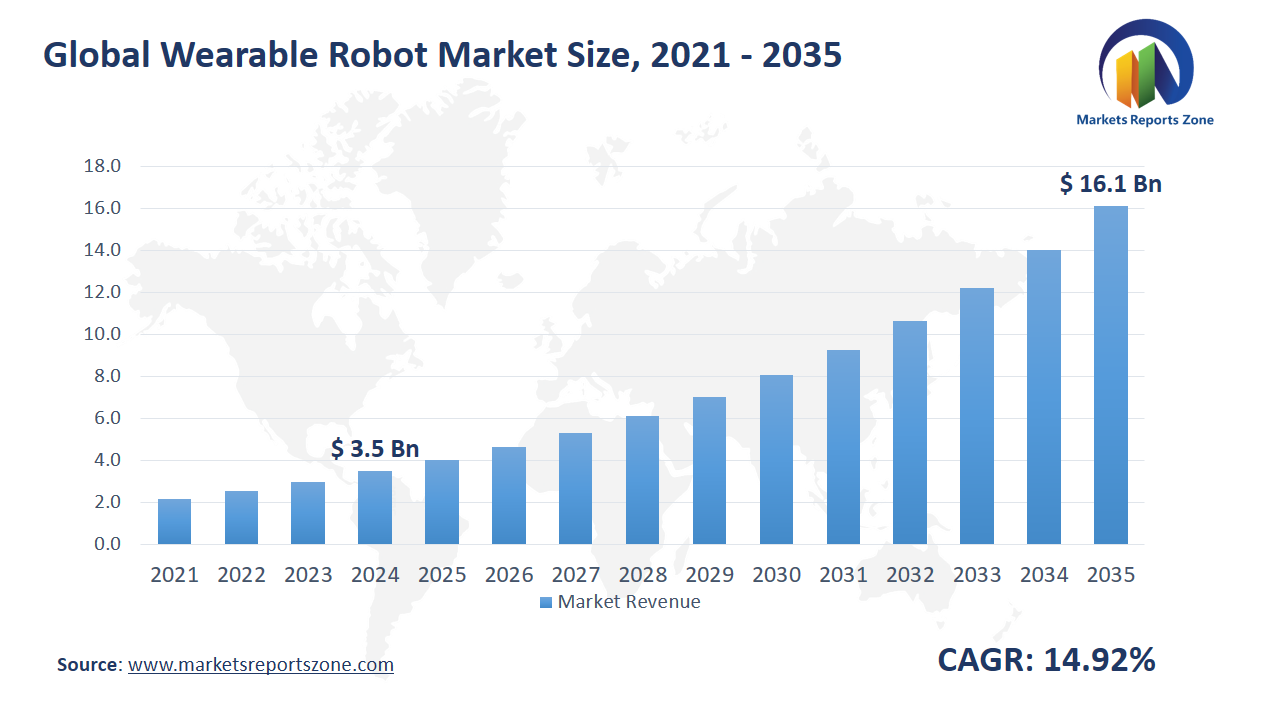
Global Wearable Robot Market Size is expected to reach USD 16.14 Billion by 2035 from USD 3.49 Billion in 2024, with a CAGR of around 14.92% between 2024 and 2035. The global wearable robot market is driven by increasing demand for rehabilitation solutions and rising adoption in industrial settings. Aging populations and growing cases of physical disabilities have increased the need for robotic exoskeletons in healthcare. Devices like ReWalk and Ekso Bionics help patients regain mobility after spinal injuries or strokes. In industries, workers use wearable robots to reduce strain and prevent injuries. Companies like Sarcos Robotics provide powered exosuits to assist in heavy lifting. However, high costs and limited accessibility restrain market growth. Many individuals and small businesses find these solutions expensive. Despite this, significant opportunities exist. Advancements in AI and sensor technology enhance robotic efficiency and affordability. Integration of smart materials and machine learning enables better adaptability. Moreover, defense and military sectors are adopting wearable robots for soldier endurance enhancement. Exoskeletons like Lockheed Martin’s ONYX improve mobility and reduce fatigue during combat. These innovations expand the market scope beyond healthcare and industry. The demand for wearable robots is expected to grow further with continuous research and development. Expanding applications in sports training and personal assistance present future growth possibilities. The market is evolving with a focus on making wearable robots more accessible, efficient, and cost-effective for widespread use.
Driver: Revolutionizing Rehabilitation with Wearable Robots
The demand for rehabilitation solutions has fueled the growth of wearable robots. Patients recovering from paralysis, spinal cord injuries, or strokes face mobility challenges. Traditional therapy is often slow and physically demanding. Wearable robots provide an advanced alternative by assisting movement and enhancing muscle strength. Devices like HAL by Cyberdyne help patients regain walking ability through neural signals. Smart exoskeletons analyze body movements and offer customized support. Hospitals and rehabilitation centers increasingly adopt these robots to improve patient outcomes. In addition, home-based wearable robots allow users to continue therapy independently. Companies are developing lightweight and user-friendly models for daily use. Wearable robots also benefit elderly individuals with mobility impairments. Aging populations require assistive solutions for maintaining independence. Exoskeletons designed for seniors help them walk without strain. Beyond medical applications, rehabilitation robots are aiding sports injury recovery. Athletes use robotic suits to regain strength after surgeries. Wearable robotic gloves assist stroke patients in restoring hand functions. Advancements in AI and biomechanics continue to enhance rehabilitation robots. Personalized therapy with robotic assistance is becoming more effective. The future of rehabilitation is shifting towards intelligent, adaptive wearable robots. These innovations are transforming lives, offering faster and more efficient recovery solutions.
Key Insights:
- The adoption rate of wearable robots in healthcare settings is estimated to be around 25% as of 2024.
- Government investments in wearable robotics technology reached approximately USD 200 million in 2023, focusing on defense and rehabilitation applications.
- In the industrial sector, around 15,000 units of wearable robots were sold in 2023, primarily for enhancing worker safety and productivity.
- The penetration rate of wearable robots in the manufacturing industry is around 10%, with increasing interest from companies aiming to reduce workplace injuries.
- Research and development funding for wearable robotics from government sources is projected to exceed USD 100 million annually by 2025.
- The healthcare sector accounts for about 60% of the total market for wearable robots, driven by the need for rehabilitation and mobility assistance.
- Approximately 30% of hospitals in urban areas have begun integrating wearable robotic devices into their rehabilitation programs as of early 2024.
Segment Analysis:
The wearable robot market serves both children and adults, addressing diverse mobility and assistance needs. Pediatric exoskeletons help children with neuromuscular disorders walk independently. Devices like Trexo Robotics enable kids with cerebral palsy to experience natural movement, improving their confidence and quality of life. For adults, wearable robots assist in rehabilitation, workplace safety, and elderly care. Exosuits designed for aging populations, such as those from Honda’s Walking Assist, support balance and reduce fall risks. By application, individual use is gaining popularity, with compact exoskeletons designed for home-based rehabilitation. Stroke survivors use robotic leg supports to continue recovery without relying on full-time caregivers. In commercial settings, wearable robots enhance worker efficiency and safety. Logistics and manufacturing industries deploy powered exosuits to reduce fatigue and prevent musculoskeletal injuries. Companies like German Bionic offer robotic wearables for lifting heavy loads with reduced physical strain. In retail warehouses, employees wear assistive suits to handle repetitive lifting tasks. Beyond industrial use, sports rehabilitation centers integrate wearable robots to help athletes recover from severe injuries. Defense sectors explore robotic exoskeletons to improve soldier endurance and load-carrying capacity. The market is rapidly evolving, with innovations making wearable robots more accessible across age groups and industries.
Regional Analysis:
The wearable robot market is growing across North America, Europe, Asia-Pacific, Latin America, and the Middle East & Africa, each with unique drivers. North America leads with strong adoption in healthcare and military sectors. U.S. companies develop exoskeletons for soldiers to enhance endurance, while hospitals use robotic suits for spinal cord injury rehabilitation. In Europe, strict workplace safety regulations drive demand for industrial exosuits. Factories integrate robotic wearables to reduce worker fatigue and prevent injuries. Companies like Comau provide robotic assistance to automotive assembly workers, increasing productivity. Asia-Pacific sees rapid growth due to aging populations and rising automation. Japan and South Korea develop exoskeletons for elderly mobility and industrial efficiency. Toyota’s robotic suits support caregivers in lifting patients, reducing strain. Latin America focuses on healthcare applications, with rehabilitation centers adopting wearable robots for stroke recovery. Patients in Brazil use robotic gait trainers to regain mobility. In the Middle East & Africa, military and construction sectors show interest. UAE construction workers use exoskeletons to handle heavy loads with less fatigue. Defense programs explore robotic gear for soldiers operating in harsh conditions. Wearable robots are advancing worldwide, catering to medical, industrial, and military applications with growing accessibility.
Competitive Scenario:
Key players in the wearable robot market are advancing technology across healthcare, industrial, and military applications. ReWalk Robotics continues to enhance exoskeletons for spinal cord injury patients, enabling greater mobility. Honda and Toyota focus on assistive wearables, with Toyota expanding robotic solutions for elderly care. Trexo Robotics develops pediatric exoskeletons, helping children with mobility disorders walk independently. Cyberdyne integrates AI-driven control systems into its HAL exosuit, improving rehabilitation outcomes. Rex Bionics advances hands-free robotic legs for individuals with severe disabilities. Lockheed Martin innovates in military applications, with its ONYX exoskeleton designed to reduce soldier fatigue and enhance endurance. DSME and Hyundai explore robotic wearables for shipbuilding and heavy industries, minimizing physical strain on workers. RB3D develops powered suits for logistics and construction, improving efficiency. Ekso Bionics expands into industrial sectors with robotic exoskeletons assisting factory workers. ATOUN refines lightweight exosuits for warehouse employees, enhancing lifting capabilities. B-Temia introduces wearable assistive devices for both medical and defense applications. Companies focus on AI integration, material advancements, and affordability to drive market growth. New partnerships and research initiatives continue to push wearable robot technology forward, making it more accessible for healthcare, industry, and defense worldwide.
Wearable Robot Market Report Scope
| Report Attribute | Details |
|---|---|
| Market Size Value in 2024 | USD 3.49 Billion |
| Revenue Forecast in 2035 | USD 16.14 Billion |
| Growth Rate | CAGR of 14.92% from 2025 to 2035 |
| Historic Period | 2021 - 2024 |
| Forecasted Period | 2025 - 2035 |
| Report Coverage | Revenue forecast, company ranking, competitive landscape, growth factors, and trends |
| Regions Covered | North America; Europe; Asia Pacific; Latin America; Middle East & Africa |
| Countries Covered | U.S.; Canada; Mexico, UK; Germany; France; Spain; Italy; Russia; China; Japan; India; South Korea; Australia; Southeast Asia; Brazil; Argentina; Saudi Arabia; UAE; South Africa |
| Key companies profiled | ReWalk Robotics; Honda; Toyota Motor Corp; Tr?x???Robotics; Cyber??dyne; Rex Bionics; Lockheed Martin; DSME; Hyundai; RB3D; Ekso Bionics; ATOUN; B-Temia |
| Customization | Free report customization (equivalent up to 8 analysts working days) with purchase. Addition or alteration to country, regional & segment scope. |
The Global Wearable Robot Market report is segmented as follows:
By Type,
- Children
- Adults
By Application,
- Individual Use
- Commercial Use
By Region,
- North America
- U.S.
- Canada
- Mexico
- Europe
- UK
- Germany
- France
- Spain
- Italy
- Russia
- Rest of Europe
- Asia Pacific
- China
- Japan
- India
- South Korea
- Australia
- Southeast Asia
- Rest of Asia Pacific
- Latin America
- Brazil
- Argentina
- Rest of Latin America
- Middle East & Africa
- Saudi Arabia
- UAE
- South Africa
- Rest of Middle East and Africa
Key Market Players,
- ReWalk Robotics
- Honda
- Toyota Motor Corp
- Cyberdyne
- Rex Bionics
- Lockheed Martin
- DSME
- Hyundai
- RB3D
- Ekso Bionics
- ATOUN
- B-Temia
Frequently Asked Questions
How big is the Wearable Robot market?
Global Wearable Robot Market Size was valued at USD 3.49 Billion in 2024 and is projected to reach at USD 16.14 Billion in 2035.
What is the Wearable Robot market growth?
Global Wearable Robot Market is expected to grow at a CAGR of around 14.92% during the forecasted year.
Which region has the largest market share in Wearable Robot market?
North America, Asia Pacific and Europe are major regions in the global Wearable Robot Market.
Who are the key players in Wearable Robot market?
Key players analyzed in the global Wearable Robot Market are ReWalk Robotics; Honda; Toyota Motor Corp; Tr?x???Robotics; Cyber??dyne; Rex Bionics; Lockheed Martin; DSME; Hyundai; RB3D; Ekso Bionics; ATOUN; B-Temia and so on.