
Global Variable Displacement Compressor Market - Size and Forecast Analysis, 2021-2035
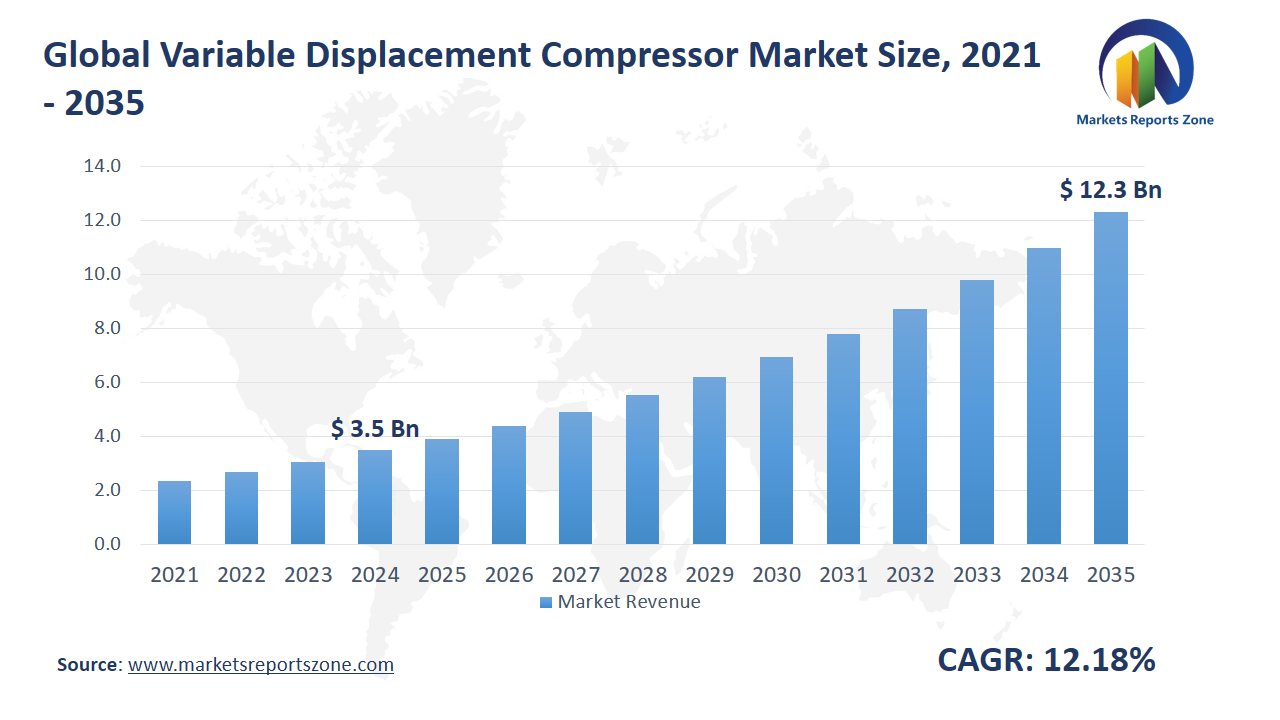
Global Variable Displacement Compressor Market Size is expected to reach USD 12.33 Billion by 2035 from USD 3.48 Billion in 2024, with a CAGR of around 12.18% between 2024 and 2035. The global variable displacement compressor market is driven by the rising demand for fuel-efficient vehicles and the increasing adoption of advanced HVAC systems. Fuel economy regulations are becoming stricter, leading to the integration of energy-efficient compressors in automobiles. Automakers are focusing on reducing emissions, boosting the adoption of these compressors. However, the high initial cost of variable displacement compressors acts as a major restraint. Many budget-conscious consumers and small manufacturers prefer fixed displacement alternatives due to cost concerns. Despite this, significant opportunities exist in the growing electric vehicle (EV) market and expanding industrial HVAC applications. The increasing production of EVs is creating a need for advanced thermal management systems, where variable displacement compressors improve energy efficiency. Additionally, the industrial sector is witnessing a surge in demand for smart HVAC solutions to optimize energy consumption. Real-life applications can be seen in modern vehicles like Toyota, BMW, and Ford, where variable displacement compressors enhance fuel efficiency. In commercial buildings, companies such as Trane and Carrier implement these compressors for energy savings in air conditioning systems. With the push for sustainability, the adoption of variable displacement compressors is expected to increase across multiple sectors, driving further innovation and efficiency in climate control solutions.
Driver: Stricter Fuel Rules Boost Adoption
Stringent fuel efficiency regulations are driving the demand for variable displacement compressors in modern vehicles. Governments worldwide are enforcing stricter emission norms, pushing automakers to enhance fuel-saving technologies. Traditional fixed displacement compressors run continuously at full capacity, consuming more power and fuel. In contrast, variable displacement compressors adjust their operation based on cooling needs, reducing engine load and improving fuel efficiency. This technology is especially beneficial in hybrid and fuel-efficient cars, where every drop of fuel counts. Leading automakers are integrating these compressors to comply with environmental regulations while enhancing vehicle performance. For example, Honda has incorporated variable displacement compressors in its latest sedans to optimize fuel consumption without compromising comfort. Similarly, Hyundai’s eco-friendly models use this technology to achieve better mileage, helping them meet global efficiency standards. Even ride-hailing companies like Uber and Lyft are promoting fuel-efficient cars equipped with such advanced compressors to reduce operational costs. As fuel prices continue to fluctuate, automakers and fleet operators are prioritizing energy-saving solutions. The increasing adoption of variable displacement compressors is not just a trend but a necessity in achieving global sustainability goals. With continued regulatory pressure, this market will witness strong growth in the coming years.
Key Insights:
- The adoption rate of variable displacement compressors in the automotive industry is approximately 65%.
- Government investments in energy-efficient compressor technologies, including variable displacement compressors, reached around $180 million in 2023.
- Approximately 700,000 units of variable displacement compressors were sold globally in 2023.
- The penetration rate of variable displacement compressors in the HVAC sector is estimated to be about 40%.
- In 2023, there was a reported increase of 25% in the use of variable displacement compressors in industrial applications compared to the previous year.
- The average lifespan of a variable displacement compressor is estimated to be around 12 years, influencing replacement and upgrade cycles.
- Training programs for technicians specializing in variable displacement compressor maintenance have increased by approximately 30% over the past two years.
- The refrigeration industry accounts for about 20% of the total market share for variable displacement compressors as of 2023.
Segment Analysis:
The variable displacement compressor market in the automotive sector is segmented into internally controlled (ICVDC) and externally controlled (ECVDC) types, each offering unique advantages. ICVDC adjusts displacement automatically based on internal pressure changes, ensuring seamless cooling efficiency without external electronic inputs. This type is widely used in passenger vehicles, where a balance between comfort and efficiency is crucial. Luxury brands like Mercedes-Benz and Audi integrate ICVDC systems to enhance climate control while optimizing fuel consumption. On the other hand, ECVDC relies on electronic control units (ECUs) to adjust compressor displacement, providing more precise regulation of cooling needs. This makes it ideal for hybrid and electric vehicles, where energy management is critical. Tesla and Nissan use ECVDC technology in their EVs to maximize battery efficiency while maintaining optimal cabin temperatures. Ride-sharing companies and fleet operators also prefer ECVDC-equipped vehicles to improve overall energy savings. As consumer demand for fuel-efficient and electric cars rises, both compressor types are witnessing increased adoption. Automakers are investing in advanced HVAC technologies to meet regulatory standards and enhance driving experiences. The growing need for sustainability and improved vehicle efficiency continues to drive innovation in variable displacement compressor technology across global automotive markets.
Regional Analysis:
The global variable displacement compressor market is expanding across five key regions: North America, Europe, Asia-Pacific, Latin America, and the Middle East & Africa. North America is leading with strong demand from automakers focused on fuel efficiency and sustainability. Companies like General Motors and Ford are incorporating advanced compressors in their latest hybrid and fuel-efficient models to comply with strict environmental regulations. In Europe, stringent emission norms and the rising popularity of electric vehicles are driving growth. Automakers such as Volkswagen and Renault are investing in variable displacement compressors to enhance energy efficiency in their EVs. Asia-Pacific dominates production, with countries like China, Japan, and South Korea leading in automotive manufacturing. Brands like Toyota and Hyundai are rapidly integrating these compressors to improve mileage and meet evolving regulatory requirements. Latin America is witnessing gradual growth, with increasing automobile sales and a shift toward modern HVAC systems in vehicles. Brazilian automakers are adopting energy-efficient compressors to enhance vehicle performance. The Middle East & Africa region is seeing demand rise due to extreme temperatures, pushing luxury car brands and commercial vehicle manufacturers to adopt variable displacement compressors for better cooling. The global push for fuel efficiency and sustainability continues to drive adoption across all regions.
Competitive Scenario:
The global variable displacement compressor market is driven by key players like TOYOTA, DENSO, SANDEN, BITZER, and others, each contributing to technological advancements and market expansion. TOYOTA and DENSO are at the forefront, integrating high-efficiency compressors into hybrid and electric vehicles to enhance performance and energy savings. SANDEN is focusing on next-generation automotive compressors with improved cooling efficiency, catering to the growing demand for electric mobility. BITZER and Carlyle Compressors are advancing industrial refrigeration solutions by developing smart, energy-efficient compressors for commercial HVAC applications. Emerson Commercial & Residential Solutions is innovating with eco-friendly refrigerants, aligning with global sustainability goals. FISCHER AG and FRASCOLD are enhancing compressor technology with digital control systems for better precision and efficiency in cooling applications. Frick by Johnson Controls is improving industrial cooling solutions, catering to large-scale applications such as food processing and cold storage. Fusheng Industrial and GEA Bock are expanding their presence in high-performance compressors, supporting the demand for energy-efficient cooling in extreme climates. Recent developments include the launch of AI-driven compressor systems and lightweight designs for reduced fuel consumption. With increasing regulations and sustainability trends, these companies continue to push innovation, shaping the future of variable displacement compressor technology.
Variable Displacement Compressor Market Report Scope
| Report Attribute | Details |
|---|---|
| Market Size Value in 2024 | USD 3.48 Billion |
| Revenue Forecast in 2035 | USD 12.33 Billion |
| Growth Rate | CAGR of 12.18% from 2025 to 2035 |
| Historic Period | 2021 - 2024 |
| Forecasted Period | 2025 - 2035 |
| Report Coverage | Revenue forecast, company ranking, competitive landscape, growth factors, and trends |
| Regions Covered | North America; Europe; Asia Pacific; Latin America; Middle East & Africa |
| Countries Covered | U.S.; Canada; Mexico, UK; Germany; France; Spain; Italy; Russia; China; Japan; India; South Korea; Australia; Southeast Asia; Brazil; Argentina; Saudi Arabia; UAE; South Africa |
| Key companies profiled | TOYOTA; DENSO; SANDEN; BITZER; Carlyle Compressors; Emerson Commercial & Residential Solutions; FISCHER AG; FRASCOLD; Frick by Johnson Controls; Fusheng Industrial; GEA Bock |
| Customization | Free report customization (equivalent up to 8 analysts working days) with purchase. Addition or alteration to country, regional & segment scope. |
The Global Variable Displacement Compressor Market report is segmented as follows:
By Type,
- The Internally Controlled Variable Displacement Compressor (ICVDC)
- The Externally Controlled VDC (ECVDC)
By Application,
- Automotive
By Region,
- North America
- U.S.
- Canada
- Mexico
- Europe
- UK
- Germany
- France
- Spain
- Italy
- Russia
- Rest of Europe
- Asia Pacific
- China
- Japan
- India
- South Korea
- Australia
- Southeast Asia
- Rest of Asia Pacific
- Latin America
- Brazil
- Argentina
- Rest of Latin America
- Middle East & Africa
- Saudi Arabia
- UAE
- South Africa
- Rest of Middle East and Africa
Key Market Players,
- TOYOTA
- DENSO
- SANDEN
- BITZER
- Carlyle Compressors
- Emerson Commercial & Residential Solutions
- FISCHER AG
- FRASCOLD
- Frick by Johnson Controls
- Fusheng Industrial
- GEA Bock
Frequently Asked Questions
How big is the Variable Displacement Compressor market?
Global Variable Displacement Compressor Market Size was valued at USD 3.48 Billion in 2024 and is projected to reach at USD 12.33 Billion in 2035.
What is the Variable Displacement Compressor market growth?
Global Variable Displacement Compressor Market is expected to grow at a CAGR of around 12.18% during the forecasted year.
Which region has the largest market share in Variable Displacement Compressor market?
North America, Asia Pacific and Europe are major regions in the global Variable Displacement Compressor Market.
Who are the key players in Variable Displacement Compressor market?
Key players analyzed in the global Variable Displacement Compressor Market are TOYOTA; DENSO; SANDEN; BITZER; Carlyle Compressors; Emerson Commercial & Residential Solutions; FISCHER AG; FRASCOLD; Frick by Johnson Controls; Fusheng Industrial; GEA Bock and so on.