
Global Vacuum Tube Lifter Market - Size and Forecast Analysis, 2021-2035
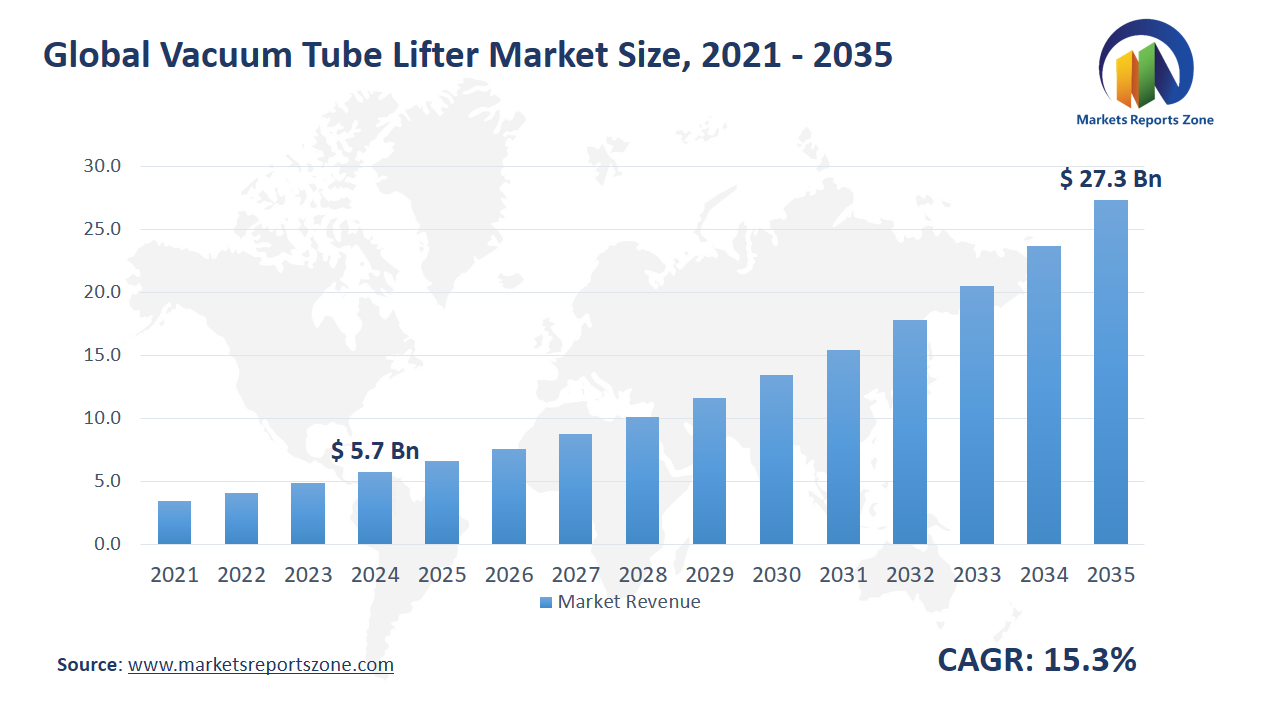
Global Vacuum Tube Lifter Market Size is expected to reach USD 27.29 Billion by 2035 from USD 5.7 Billion in 2024, with a CAGR of around 15.3% between 2024 and 2035. The global vacuum tube lifter market is driven by automation growth and ergonomic lifting solutions. Industries adopt automation to improve efficiency. Vacuum tube lifters reduce manual effort and workplace injuries. Manufacturing and logistics sectors use these lifters to handle goods safely. High initial costs restrain market expansion. Small businesses find investments challenging. However, opportunities arise with warehouse expansion and e-commerce growth. More warehouses require advanced lifting solutions. Online retailers demand efficient material handling for faster deliveries. In automotive plants, vacuum lifters streamline production by lifting heavy components with precision. In food processing, packaged goods are lifted without contamination risks. Customization options improve market potential. Different industries require tailored lifting solutions. Integration with robotic arms enhances adoption. Smart factories incorporate automated lifters for seamless workflows. Advancements in suction technology allow lifting of fragile and irregular-shaped objects. Glass manufacturers benefit from this innovation. Large sheets are moved without damage. Increasing safety regulations push industries toward vacuum lifters. Employee well-being remains a priority. The trend toward sustainable manufacturing drives demand for energy-efficient lifters. Low-energy vacuum systems gain traction. Market growth is shaped by industrial advancements and operational safety improvements. Vacuum lifters become essential across multiple sectors. Businesses continue adopting these solutions for optimized productivity.
Driver: Automation Boosts Efficiency in Industries
Automation is transforming industries, making processes faster and safer. Vacuum tube lifters play a key role in automated handling. These systems reduce human effort and improve productivity. In the electronics industry, factories use vacuum lifters to handle delicate circuit boards. The risk of damage is minimized, ensuring higher product quality. In pharmaceutical manufacturing, lifters move medicine packages efficiently. Workers no longer struggle with heavy loads, reducing fatigue and injuries. Airports also benefit from automation. Baggage handling systems use vacuum lifters to transfer luggage quickly. This speeds up operations and prevents mishandling. In construction, glass panels and tiles are lifted effortlessly. Workers complete tasks with greater accuracy and less strain. Packaging plants use vacuum technology to stack products neatly. Automated lifting helps meet high production demands. Car manufacturers rely on vacuum lifters to transport body panels. This ensures precision in assembly lines. With industries focusing on efficiency, vacuum lifters become essential. Companies invest in automation to cut costs and enhance workplace safety. The demand for smarter, automated lifting solutions continues to grow. Businesses that embrace these technologies gain a competitive edge. Automation is not just a trend—it is the future of industrial operations.
Key Insights:
- The adoption rate of vacuum tube lifters in manufacturing industries is approximately 55%.
- Government investments in automation technologies, including vacuum tube lifters, reached about $120 million in 2023.
- An estimated 500,000 units of vacuum tube lifters were sold globally in 2023.
- The penetration rate of vacuum tube lifters in the construction sector is around 25%.
- In 2023, the use of vacuum tube lifters in logistics and warehousing increased by approximately 30% compared to the previous year.
- The average operational lifespan of a vacuum tube lifter is estimated to be around 10 years, influencing replacement and upgrade cycles.
- Training programs for operators of vacuum tube lifters have seen a growth of about 40% over the past two years.
- The automotive industry accounts for approximately 35% of the total market share for vacuum tube lifters as of 2023.
Segment Analysis:
The vacuum tube lifter market is segmented by type and application, catering to diverse industries. Lifting capacities vary based on operational needs. Systems handling loads up to 100kg are widely used in packaging facilities. Cartons, paper rolls, and lightweight materials are lifted with ease. In printing and publishing, these lifters transport stacks of newspapers and magazines, improving efficiency. Medium-capacity lifters, up to 200kg, serve food and pharmaceutical industries. Bakeries use them to move flour sacks, while pharmaceutical plants handle bulk medicine containers effortlessly. In chemical and material industries, vacuum lifters manage hazardous substances safely. Drums containing liquid chemicals are transported without spills. Heavy-duty models, up to 300kg, are essential in automotive manufacturing. Large metal sheets and engine components are lifted precisely, streamlining assembly lines. Tire manufacturing plants also benefit from these powerful lifters, reducing worker strain. In food processing, bulk cheese blocks and meat slabs are transported hygienically. Across industries, vacuum lifters enhance safety and efficiency. Businesses invest in customized solutions to meet specific lifting demands. As automation rises, vacuum lifters integrate with robotic systems for seamless operations. Industries continue adopting these solutions to optimize workflows, reduce injuries, and improve productivity in material handling tasks.
Regional Analysis:
The vacuum tube lifter market is expanding across multiple regions, driven by industrial growth and automation. In North America, manufacturing and warehousing industries invest heavily in advanced lifting solutions. Large distribution centers use vacuum lifters to handle packaged goods, ensuring faster logistics. In Europe, stringent workplace safety regulations push industries to adopt ergonomic lifting systems. Furniture manufacturers use vacuum lifters to move heavy wooden panels with precision. The Asia-Pacific region sees rapid adoption due to booming e-commerce and industrialization. Electronics factories in countries like China and Japan use vacuum lifters to transport delicate components efficiently. In Latin America, the food and beverage sector increasingly relies on vacuum lifting for bulk product handling. Coffee producers in Brazil use vacuum lifters to transport large sacks of coffee beans with minimal manual effort. The Middle East & Africa region experiences growth in construction and oil industries, boosting demand for heavy-duty lifting solutions. Glass installation companies in Dubai use vacuum lifters to place large glass panels on skyscrapers safely. Across all regions, businesses seek automation to improve productivity and worker safety. As industries evolve, vacuum lifters continue to play a crucial role in material handling, ensuring efficiency, precision, and reduced labor strain.
Competitive Scenario:
Leading companies in the vacuum tube lifter market focus on innovation, automation, and industry-specific solutions. Aero Lift and Vaculex enhance warehouse logistics with lightweight and energy-efficient lifters, reducing manual handling risks. ANVER and Schmalz develop smart lifting systems with advanced suction technology, improving efficiency in packaging and automotive industries. Palamatic and PROVAK Martin Bilo introduce customizable vacuum lifters for food and pharmaceutical sectors, ensuring hygienic and contamination-free handling. Industriebedarf CASTAN GmbH and SMI Handling Systeme integrate IoT-enabled lifters for real-time monitoring, helping manufacturers optimize workflows. All-Vac Industries and Hans Hebetechnik expand their product range to cater to heavy-duty lifting needs in construction and chemical industries. UNIMOVE pioneers compact and portable vacuum lifters, increasing flexibility for small and mid-sized businesses. Recent developments include AI-powered lifting systems that adapt to different load types, enhancing precision and safety. Companies invest in sustainable vacuum technology, reducing energy consumption while maintaining high performance. Partnerships with robotic manufacturers accelerate automation adoption in logistics and manufacturing. Rising demand for e-commerce fulfillment centers drives innovation in high-speed lifting solutions. As industries seek smarter, safer, and more efficient material handling, leading players continue to push technological advancements, shaping the future of vacuum tube lifting solutions.
Vacuum Tube Lifter Market Report Scope
| Report Attribute | Details |
|---|---|
| Market Size Value in 2024 | USD 5.7 Billion |
| Revenue Forecast in 2035 | USD 27.29 Billion |
| Growth Rate | CAGR of 15.3% from 2025 to 2035 |
| Historic Period | 2021 - 2024 |
| Forecasted Period | 2025 - 2035 |
| Report Coverage | Revenue forecast, company ranking, competitive landscape, growth factors, and trends |
| Regions Covered | North America; Europe; Asia Pacific; Latin America; Middle East & Africa |
| Countries Covered | U.S.; Canada; Mexico, UK; Germany; France; Spain; Italy; Russia; China; Japan; India; South Korea; Australia; Southeast Asia; Brazil; Argentina; Saudi Arabia; UAE; South Africa |
| Key companies profiled | Aero Lift; Vaculex; ANVER; Schmalz; Palamatic; PROVAK Martin Bilo; Industriebedarf CASTAN GmbH; SMI Handling Systeme; All-Vac Industries; Hans Hebetechnik; UNIMOVE |
| Customization | Free report customization (equivalent up to 8 analysts working days) with purchase. Addition or alteration to country, regional & segment scope. |
The Global Vacuum Tube Lifter Market report is segmented as follows:
By Type,
- Loads of up to 100kg
- Loads of up to 200kg
- Loads of up to 300kg
By Application,
- Chemical & Material Industry
- Printing or Publishing Industry
- Foodstuffs and Pharmaceutical Industry
- Automotive Industry
By Region,
- North America
- U.S.
- Canada
- Mexico
- Europe
- UK
- Germany
- France
- Spain
- Italy
- Russia
- Rest of Europe
- Asia Pacific
- China
- Japan
- India
- South Korea
- Australia
- Southeast Asia
- Rest of Asia Pacific
- Latin America
- Brazil
- Argentina
- Rest of Latin America
- Middle East & Africa
- Saudi Arabia
- UAE
- South Africa
- Rest of Middle East and Africa
Key Market Players,
- Aero Lift
- Vaculex
- ANVER
- Schmalz
- Palamatic
- PROVAK Martin Bilo
- Industriebedarf CASTAN GmbH
- SMI Handling Systeme
- All-Vac Industries
- Hans Hebetechnik
- UNIMOVE
Frequently Asked Questions
How big is the Vacuum Tube Lifter market?
Global Vacuum Tube Lifter Market Size was valued at USD 5.7 Billion in 2024 and is projected to reach at USD 27.29 Billion in 2035.
What is the Vacuum Tube Lifter market growth?
Global Vacuum Tube Lifter Market is expected to grow at a CAGR of around 15.3% during the forecasted year.
Which region has the largest market share in Vacuum Tube Lifter market?
North America, Asia Pacific and Europe are major regions in the global Vacuum Tube Lifter Market.
Who are the key players in Vacuum Tube Lifter market?
Key players analyzed in the global Vacuum Tube Lifter Market are Aero Lift; Vaculex; ANVER; Schmalz; Palamatic; PROVAK Martin Bilo; Industriebedarf CASTAN GmbH; SMI Handling Systeme; All-Vac Industries; Hans Hebetechnik; UNIMOVE and so on.