
Global Unmanned Ground Vehicle Market - Size and Forecast Analysis, 2021-2035
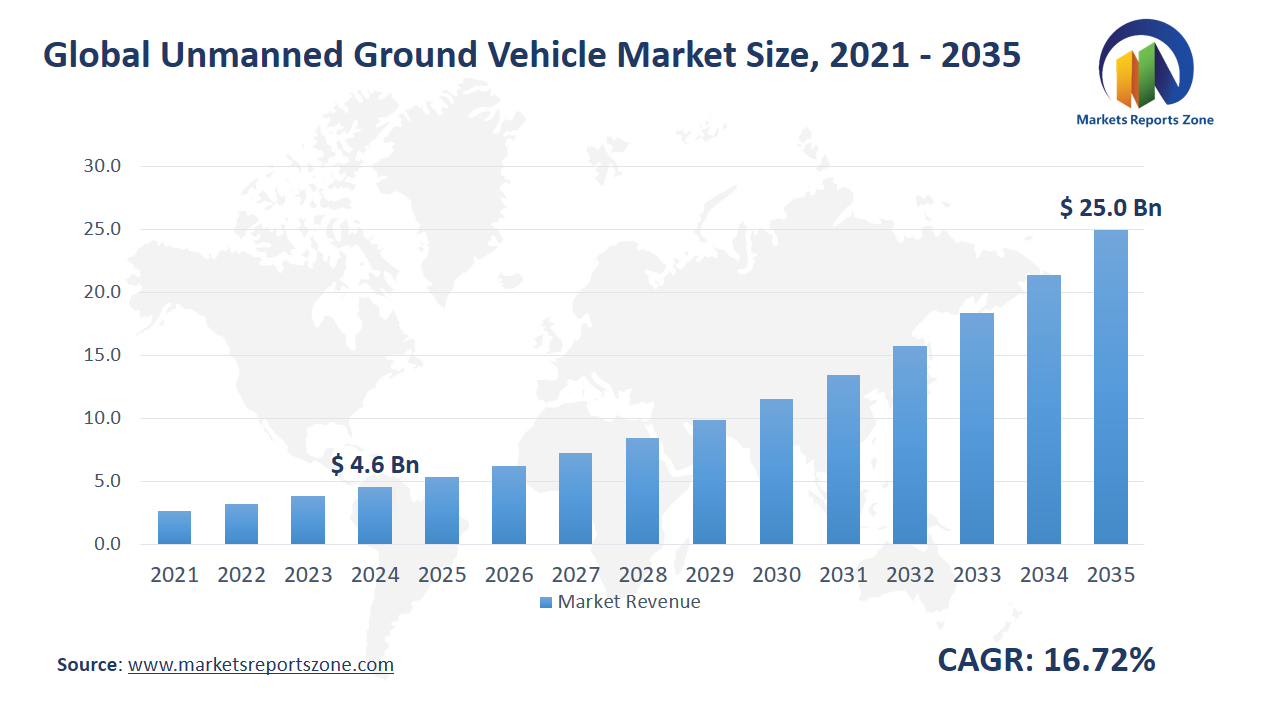
Global Unmanned Ground Vehicle Market Size is expected to reach USD 25 Billion by 2035 from USD 4.56 Billion in 2024, with a CAGR of around 16.72% between 2024 and 2035. The global unmanned ground vehicle (UGV) market is driven by increasing military demand and rising automation in commercial sectors. Defense forces use UGVs for surveillance, reconnaissance, and combat operations. Armed robotic vehicles are deployed to reduce soldier casualties. Logistics and agriculture sectors adopt UGVs for material handling and crop monitoring. However, high development costs and technical challenges restrain market growth. Advanced AI and sensor integration make UGVs expensive and complex. Despite challenges, significant opportunities exist. Disaster response applications see increased adoption. UGVs are used in search and rescue missions, such as in earthquake-hit areas for debris removal. Another opportunity lies in smart city projects. Security and traffic management utilize autonomous ground robots for patrolling and monitoring. Real-life applications include Boston Dynamics' Spot robot, which inspects hazardous sites, and Russia’s Uran-9 combat UGV, which supports military missions. Self-driving delivery bots, like Starship Technologies’ models, assist in last-mile deliveries. Agricultural UGVs, such as John Deere’s autonomous tractors, enhance farming efficiency. Industrial use of UGVs expands with automated warehouse robots from companies like Amazon. As AI and robotics evolve, UGVs will become more intelligent, autonomous, and widely adopted across industries. Global adoption is expected to rise with continuous technological advancements.
Driver: Military Adoption Boosts UGV Demand
Unmanned Ground Vehicles (UGVs) are widely used in military operations to enhance efficiency and reduce human risk. Armed forces deploy these robotic vehicles for surveillance, reconnaissance, and combat missions. UGVs help in gathering real-time intelligence in high-risk zones without endangering soldiers. They are also used for explosive ordnance disposal, ensuring safe handling of landmines and IEDs. Autonomous military convoys transport supplies across dangerous terrains, minimizing casualties. Countries invest heavily in robotic warfare to strengthen defense capabilities. AI-powered UGVs can operate in hostile environments with minimal human intervention. Real-life applications include Israel’s Jaguar UGV, which secures borders with autonomous patrolling. The U.S. Army uses robotic mules to carry heavy equipment for soldiers in rough terrains. China has developed tracked UGVs for urban combat scenarios. These vehicles support troops by providing cover fire and transporting ammunition. In naval bases, robotic ground vehicles assist in perimeter security. Some UGVs are designed for medical evacuation, helping injured soldiers from battlefields. As warfare evolves, militaries seek advanced autonomous solutions for tactical advantages. Enhanced AI, remote control systems, and weapon integration will drive further adoption. UGVs are shaping the future of defense, making military operations safer and more efficient.
Key Insights:
- The adoption rate of unmanned ground vehicles (UGVs) in military applications is approximately 60%.
- Government investments in UGV technology development reached about $200 million in 2023.
- Approximately 1.5 million units of UGVs were sold globally in 2023.
- The penetration rate of UGVs in the agricultural sector is estimated to be around 30%.
- In 2023, UGV usage in logistics and supply chain operations increased by 20% compared to the previous year.
- The average operational lifespan of a UGV is estimated to be around 8 years, influencing replacement cycles in the market.
- There has been a reported increase of 35% in training programs for operators of UGVs over the past three years.
- The military segment is projected to account for approximately 64% of the total UGV market share by 2025.
Segment Analysis:
The unmanned ground vehicle (UGV) market is segmented by type and application, each playing a crucial role in various industries. Tracked UGVs offer superior stability on rough terrains and are widely used in military operations. They assist in combat missions, border patrol, and rescue operations in hazardous zones. Wheeled UGVs provide speed and efficiency, making them ideal for logistics, warehouse automation, and urban security patrolling. Autonomous delivery robots use wheeled platforms to navigate city streets. Legged UGVs mimic human or animal movement, allowing them to traverse uneven surfaces. They are utilized in search-and-rescue missions, industrial inspections, and space exploration. By application, military UGVs dominate due to their deployment in surveillance, explosive disposal, and battlefield support. Armed robotic vehicles provide reconnaissance and firepower in conflict zones. Civilian and commercial applications are growing rapidly with the adoption of UGVs in agriculture, mining, and disaster response. Autonomous mining UGVs extract minerals efficiently in hazardous conditions. Firefighting robots navigate burning buildings to assist in emergency response. Industrial sectors use robotic ground vehicles for warehouse automation, improving operational efficiency. As technology advances, UGVs will continue transforming military and commercial sectors, offering innovative solutions for diverse applications across the globe.
Regional Analysis:
The unmanned ground vehicle (UGV) market is expanding across all major regions, driven by military, industrial, and commercial applications. In North America, defense investments and technological advancements fuel growth. The U.S. military deploys autonomous combat and surveillance UGVs for border security and battlefield support. Europe focuses on security and industrial automation, with nations integrating robotic patrol units in urban policing and airport security. Germany’s automotive sector uses UGVs in manufacturing plants for autonomous material transport. The Asia-Pacific region sees rapid adoption due to rising defense budgets and smart city initiatives. Japan deploys robotic security guards in commercial complexes, while India uses UGVs for military reconnaissance in border regions. The Middle East & Africa region leverages UGVs for oil and gas exploration, with autonomous robotic systems inspecting pipelines in remote desert locations. Military forces in the region also deploy robotic mine-clearance vehicles to enhance safety. In Latin America, UGVs assist in agriculture and disaster management. Brazil utilizes autonomous tractors for large-scale farming, while robotic ground vehicles aid in flood rescue operations. As automation demand rises, UGV applications continue expanding globally, enhancing efficiency, security, and operational capabilities in both defense and commercial sectors.
Competitive Scenario:
The unmanned ground vehicle (UGV) market is driven by key players innovating across military, industrial, and commercial sectors. Roboteam and Milrem focus on defense UGVs, developing autonomous combat and reconnaissance vehicles for military operations. Milrem has recently enhanced its robotic warfare systems with AI-driven capabilities, improving battlefield efficiency. Elbit Systems continues to expand its defense automation portfolio, integrating advanced sensors and remote-controlled weapon stations in UGVs. PrecisionHawk and SkySpecs specialize in unmanned systems for infrastructure inspection, with recent advancements in AI-powered predictive maintenance for wind turbines and power grids. Zoox and Comma are transforming urban mobility, with Zoox testing fully autonomous electric shuttles for city transportation. Comma advances self-driving technology by upgrading AI-based driver assistance systems. RE2 Robotics innovates in robotic arms for hazardous tasks, recently unveiling advanced manipulation systems for bomb disposal and industrial automation. Autonomous Solutions pioneers in agricultural and mining automation, enhancing self-driving tractors and robotic excavation systems for improved productivity. The market is evolving with AI, sensor fusion, and automation, pushing UGVs into new applications. As companies refine autonomous navigation and safety features, UGVs are set to revolutionize military, industrial, and commercial landscapes worldwide.
Unmanned Ground Vehicle Market Report Scope
| Report Attribute | Details |
|---|---|
| Market Size Value in 2024 | USD 4.56 Billion |
| Revenue Forecast in 2035 | USD 25 Billion |
| Growth Rate | CAGR of 16.72% from 2025 to 2035 |
| Historic Period | 2021 - 2024 |
| Forecasted Period | 2025 - 2035 |
| Report Coverage | Revenue forecast, company ranking, competitive landscape, growth factors, and trends |
| Regions Covered | North America; Europe; Asia Pacific; Latin America; Middle East & Africa |
| Countries Covered | U.S.; Canada; Mexico, UK; Germany; France; Spain; Italy; Russia; China; Japan; India; South Korea; Australia; Southeast Asia; Brazil; Argentina; Saudi Arabia; UAE; South Africa |
| Key companies profiled | Roboteam; Milrem; Elbit Systems; PrecisionHawk; Zoox; Comma; SkySpecs; RE2; Autonomous Solutions |
| Customization | Free report customization (equivalent up to 8 analysts working days) with purchase. Addition or alteration to country, regional & segment scope. |
The Global Unmanned Ground Vehicle Market report is segmented as follows:
By Type,
- Tracked Type
- Wheeled Type
- Legged Type
By Application,
- Civilian and Commercial Applications
- Military Applications
By Region,
- North America
- U.S.
- Canada
- Mexico
- Europe
- UK
- Germany
- France
- Spain
- Italy
- Russia
- Rest of Europe
- Asia Pacific
- China
- Japan
- India
- South Korea
- Australia
- Southeast Asia
- Rest of Asia Pacific
- Latin America
- Brazil
- Argentina
- Rest of Latin America
- Middle East & Africa
- Saudi Arabia
- UAE
- South Africa
- Rest of Middle East and Africa
Key Market Players,
- Roboteam
- Milrem
- Elbit Systems
- PrecisionHawk
- Zoox
- Comma
- SkySpecs
- RE2
- Autonomous Solutions
Frequently Asked Questions
How big is the Unmanned Ground Vehicle market?
Global Unmanned Ground Vehicle Market Size was valued at USD 4.56 Billion in 2024 and is projected to reach at USD 25 Billion in 2035.
What is the Unmanned Ground Vehicle market growth?
Global Unmanned Ground Vehicle Market is expected to grow at a CAGR of around 16.72% during the forecasted year.
Which region has the largest market share in Unmanned Ground Vehicle market?
North America, Asia Pacific and Europe are major regions in the global Unmanned Ground Vehicle Market.
Who are the key players in Unmanned Ground Vehicle market?
Key players analyzed in the global Unmanned Ground Vehicle Market are Roboteam; Milrem; Elbit Systems; PrecisionHawk; Zoox; Comma; SkySpecs; RE2; Autonomous Solutions and so on.