
Global Textile Printing Machine Market - Size and Forecast Analysis, 2021-2035
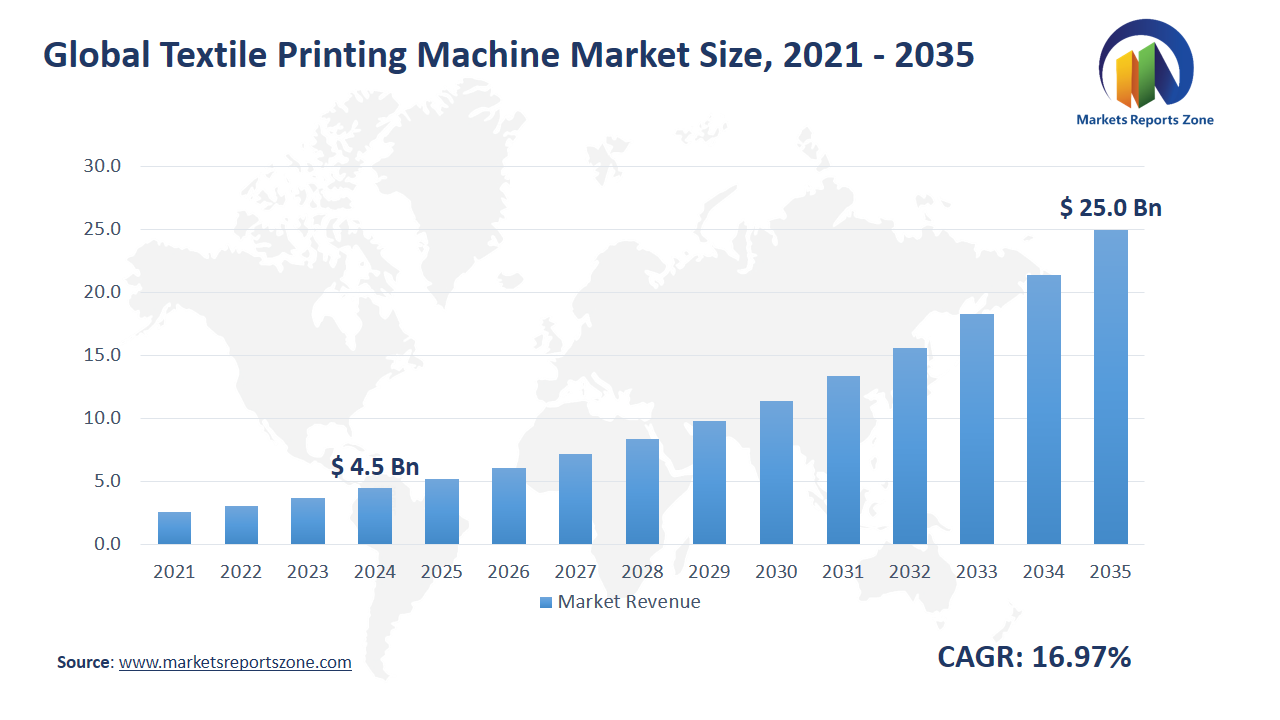
Global Textile Printing Machine Market Size is expected to reach USD 25.01 Billion by 2035 from USD 4.45 Billion in 2024, with a CAGR of around 16.97% between 2024 and 2035. The global textile printing machine market is driven by rising demand for customized apparel and advancements in digital printing technology. Consumers prefer unique and personalized designs, increasing the adoption of textile printers in fashion and home décor industries. Digital printing reduces water and chemical usage, making it an eco-friendly alternative to traditional methods. However, high initial investment costs act as a restraint, limiting adoption among small manufacturers. Opportunities exist in the growing demand for sustainable printing solutions and automation in the textile industry. Companies are shifting towards water-based inks and energy-efficient machines to meet environmental regulations. Automated printing systems improve production efficiency, reducing labor dependency and operational costs. In the fashion industry, brands are launching limited-edition collections using advanced digital printing techniques. Sportswear manufacturers use high-speed textile printers to create vibrant, durable designs for performance wear. In the home textile sector, companies adopt digital printing for intricate patterns on curtains, upholstery, and bed linens. The adoption of textile printing machines is expanding in emerging markets, where local businesses seek cost-effective and high-quality printing solutions. As industries embrace digital transformation, textile printing machines continue to evolve, offering greater flexibility, speed, and sustainability in fabric design and production.
Driver: Rising Demand for Custom Apparel
The demand for customized apparel has surged as consumers seek unique fashion statements. Brands and designers now offer personalized clothing, allowing customers to choose colors, patterns, and even personalized prints. Digital textile printing machines play a key role in fulfilling this demand by enabling small-batch production with high-quality results. Unlike traditional methods, digital printing allows intricate designs to be printed directly onto fabric without requiring costly screens or long setup times. In the fashion industry, online retailers offer "design-your-own" options, where customers create their own T-shirt prints, hoodies, and accessories. Luxury brands use digital printing to launch exclusive collections featuring limited-edition designs. In the sports sector, teams print customized jerseys with player names, numbers, and logos using high-speed textile printers. Even small businesses, such as local print shops, leverage digital textile printing to cater to niche markets with unique graphics and brand merchandise. The home décor industry also benefits, as homeowners prefer personalized curtains, bedsheets, and cushion covers with bespoke prints. The ability to produce high-resolution, durable designs quickly has made digital textile printing machines an essential tool for the growing customization trend. This shift towards personalized fashion continues to drive market expansion.
Key Insights:
- The adoption rate of textile printing machines in the fashion and apparel industry is approximately 45% as of 2024.
- Investments by companies and governments in textile printing technology have reached around $250 million in recent years.
- In 2023, an estimated 1.2 million units of textile printing machines were sold globally.
- The penetration rate of textile printing machines in the home textiles sector is about 55%, reflecting their growing importance in this market.
- Approximately 60% of textile manufacturers are utilizing digital printing technologies to enhance production efficiency and customization capabilities.
- The annual growth rate for investments in advanced textile printing solutions is projected to be around 7% over the next five years.
- Surveys indicate that nearly 50% of design studios are adopting textile printing machines to meet the demand for personalized and on-demand designs.
- The market is experiencing increased demand for eco-friendly printing solutions, with expectations of a 20% annual growth in installations through 2026.
Segment Analysis:
The textile printing industry has evolved with various techniques catering to different needs. Rotary screen printing is widely used for mass production, ensuring consistent quality in large-scale garment manufacturing. Automatic flat screen printing enhances precision and efficiency, making it ideal for intricate designs on technical textiles like automotive upholstery and industrial fabrics. Hand screen printing, though labor-intensive, remains popular for artisanal and luxury fashion, offering unique textures and high-end exclusivity. Dye sublimation transfer printing has gained traction in sportswear and activewear, as it provides vibrant, long-lasting prints with excellent color retention. Digital textile printing has transformed the industry by allowing short-run customization, reducing waste, and enabling faster turnaround times. In the clothing sector, brands utilize digital and dye sublimation printing to create fast-fashion collections with vibrant, detailed prints. Eco-conscious manufacturers use water-based inks with rotary and flat-screen techniques to produce sustainable fabrics. Technical textiles, such as fire-resistant clothing and medical textiles, rely on precise printing methods to embed logos, safety instructions, and branding onto specialized materials. As innovation continues, advanced textile printing machines support industries beyond fashion, ensuring efficiency, sustainability, and creative freedom for manufacturers looking to meet evolving consumer demands.
Regional Analysis:
Textile printing technology has seen varied adoption across different regions, driven by fashion trends, industrial needs, and technological advancements. In North America, digital textile printing is transforming the apparel industry, allowing brands to produce customized clothing with reduced waste. Many independent designers leverage direct-to-garment printing to create unique, small-batch collections. In Europe, sustainability is a key driver, with eco-friendly printing techniques gaining popularity. High-end fashion houses integrate digital printing to reduce water consumption while maintaining intricate designs. The Asia-Pacific region remains a major hub for textile production, with rotary screen and automatic flat-screen printing dominating large-scale manufacturing. Countries with strong garment exports rely on these methods to meet high-volume demand efficiently. The Middle East and Africa are witnessing growth in technical textiles, with printed fabrics used in home furnishings and industrial applications like automotive interiors. Hand screen printing is still valued for its cultural significance, especially in traditional textile markets. In South America, small and mid-sized businesses are increasingly adopting dye sublimation transfer printing for vibrant sportswear and promotional products. Across all regions, innovation in textile printing continues to support industries from fashion to industrial textiles, aligning with market needs and sustainability efforts.
Competitive Scenario:
The textile printing machine market is evolving rapidly, driven by technological advancements and the increasing demand for sustainable and high-quality printing solutions. Companies like Seiko Epson and Kornit Digital are innovating with digital textile printing, offering eco-friendly waterless printing technologies that reduce environmental impact. Agfa-Gevaert and SPGPrints are enhancing rotary screen printing capabilities to cater to large-scale textile production, ensuring faster speeds and improved precision. The rise of on-demand fashion and custom textile manufacturing has led companies such as Ricoh and Durst Group to develop advanced dye sublimation and direct-to-garment (DTG) printing solutions. These technologies enable faster turnaround times and allow small businesses to compete with larger manufacturers. Konica Minolta and Electronics for Imaging Inc. are focusing on automation and AI-driven quality control systems to optimize printing efficiency. Meanwhile, companies like ROQ International and The M&R Companies are improving automatic flat-screen printing systems to meet bulk production needs in apparel and technical textiles. The demand for durable and high-resolution prints has driven innovation in ink formulations and print head technologies. With sustainability and customization at the forefront, industry leaders continue to push the boundaries of textile printing, ensuring efficient and cost-effective production for both fashion and industrial applications.
Textile Printing Machine Market Report Scope
| Report Attribute | Details |
|---|---|
| Market Size Value in 2024 | USD 4.45 Billion |
| Revenue Forecast in 2035 | USD 25.01 Billion |
| Growth Rate | CAGR of 16.97% from 2025 to 2035 |
| Historic Period | 2021 - 2024 |
| Forecasted Period | 2025 - 2035 |
| Report Coverage | Revenue forecast, company ranking, competitive landscape, growth factors, and trends |
| Regions Covered | North America; Europe; Asia Pacific; Latin America; Middle East & Africa |
| Countries Covered | U.S.; Canada; Mexico, UK; Germany; France; Spain; Italy; Russia; China; Japan; India; South Korea; Australia; Southeast Asia; Brazil; Argentina; Saudi Arabia; UAE; South Africa |
| Key companies profiled | Agfa-Gevaert; APSOM Technologies; Durst Group; Electronics for Imaging Inc.; Konica Minolta; Kornit Digital; MHM Siebdruckmaschinen; Ricoh Company; ROQ International; Sawgrass Technologies; Seiko Epson Corporation; SPGPrints; The M&R Companies |
| Customization | Free report customization (equivalent up to 8 analysts working days) with purchase. Addition or alteration to country, regional & segment scope. |
The Global Textile Printing Machine Market report is segmented as follows:
By Type,
- Rotary Screen Textile Printing
- Automatic Flat Screen Printing
- Hand Screen Printing
- Dye Sublimation Transfer Printing
- Digital Textile Printing
By Application,
- Clothing/Garment
- Technical Textiles
By Region,
- North America
- U.S.
- Canada
- Mexico
- Europe
- UK
- Germany
- France
- Spain
- Italy
- Russia
- Rest of Europe
- Asia Pacific
- China
- Japan
- India
- South Korea
- Australia
- Southeast Asia
- Rest of Asia Pacific
- Latin America
- Brazil
- Argentina
- Rest of Latin America
- Middle East & Africa
- Saudi Arabia
- UAE
- South Africa
- Rest of Middle East and Africa
Key Market Players,
- Agfa-Gevaert
- APSOM Technologies
- Durst Group
- Electronics for Imaging Inc.
- Konica Minolta
- Kornit Digital
- MHM Siebdruckmaschinen
- Ricoh Company
- ROQ International
- Sawgrass Technologies
- Seiko Epson Corporation
- SPGPrints
- The M&R Companies
Frequently Asked Questions
How big is the Textile Printing Machine market?
Global Textile Printing Machine Market Size was valued at USD 4.45 Billion in 2024 and is projected to reach at USD 25.01 Billion in 2035.
What is the Textile Printing Machine market growth?
Global Textile Printing Machine Market is expected to grow at a CAGR of around 16.97% during the forecasted year.
Which region has the largest market share in Textile Printing Machine market?
North America, Asia Pacific and Europe are major regions in the global Textile Printing Machine Market.
Who are the key players in Textile Printing Machine market?
Key players analyzed in the global Textile Printing Machine Market are Agfa-Gevaert; APSOM Technologies; Durst Group; Electronics for Imaging Inc.; Konica Minolta; Kornit Digital; MHM Siebdruckmaschinen; Ricoh Company; ROQ International; Sawgrass Technologies; Seiko Epson Corporation; SPGPrints; The M&R Companies and so on.