
Global Rock Hammers Market - Size and Forecast Analysis, 2021-2035
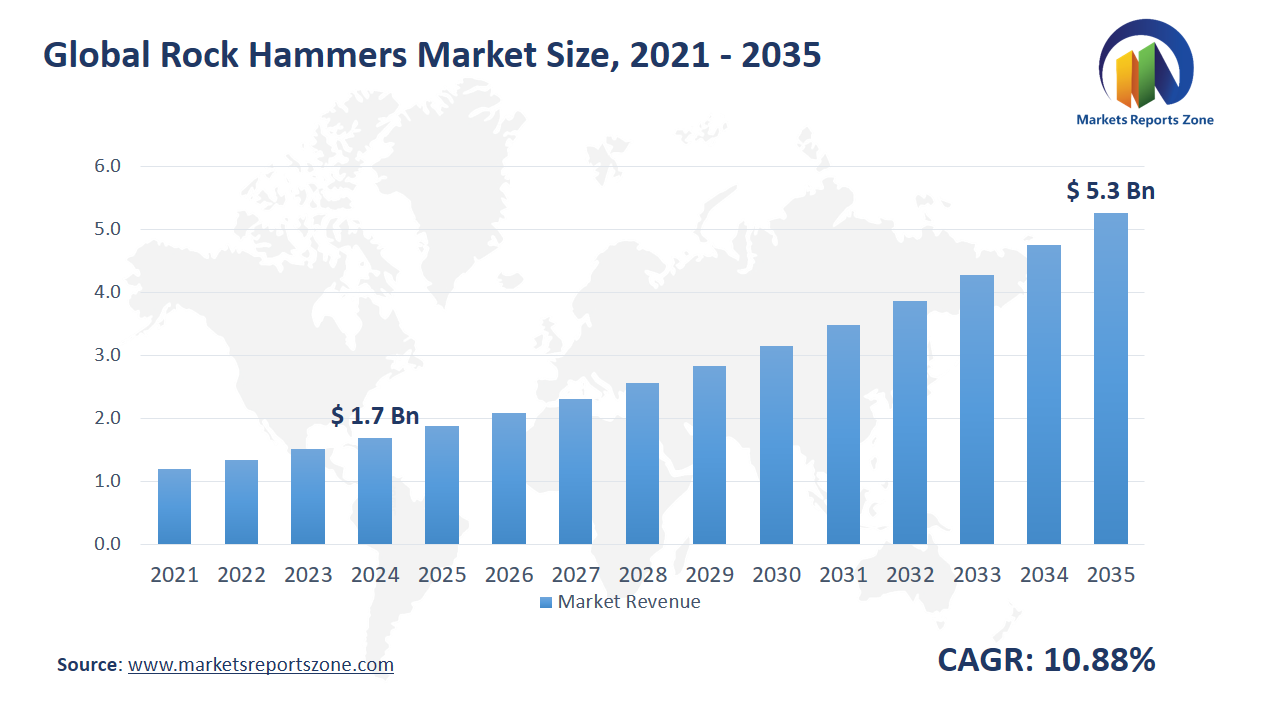
Global Rock Hammers Market Size is expected to reach USD 5.26 Billion by 2035 from USD 1.69 Billion in 2024, with a CAGR of around 10.88% between 2024 and 2035. The global rock hammers market is driven by rising construction activities and increasing mining operations. Urbanization is leading to high demand for infrastructure projects. Roads, bridges, and tunnels require rock hammers for excavation and demolition. Mining companies are expanding operations to meet the growing demand for minerals. Hard rock extraction relies on powerful hammers for efficiency. However, high equipment costs remain a major restraint. Small contractors and startups struggle to afford advanced rock hammers. Despite this, significant opportunities exist. Technological advancements are improving hammer durability and efficiency. Hydraulic and smart-controlled hammers are reducing downtime and increasing productivity. Another opportunity lies in the growing demand for sustainable solutions. Electric and low-emission rock hammers are gaining traction due to stricter environmental regulations. Real-life examples highlight these trends. In Australia, large mining firms use advanced hydraulic hammers to break tough rock formations. In the U.S., road expansion projects rely on rock hammers for asphalt removal. In India, quarry businesses use rock hammers for granite extraction. Rental services are also growing, allowing small firms to access high-quality equipment. With continuous innovation and demand from key industries, the rock hammers market is expected to see steady growth worldwide.
Driver: Booming Construction Spurs Rock Hammer Demand
Urbanization is transforming cities worldwide, driving a surge in construction activities. Expanding infrastructure requires powerful tools for excavation, demolition, and site preparation. Rock hammers play a crucial role in breaking concrete, asphalt, and tough rock formations. Large-scale projects like metro rail expansions, high-rise developments, and highway constructions depend on these tools for efficiency. In Canada, rock hammers are widely used for tunneling in urban transit projects. In Japan, earthquake-resistant buildings require deep foundation work, where rock hammers assist in excavation. In Africa, major road networks are being built to connect remote areas, increasing the demand for durable rock hammers. Demolition projects are also on the rise as old structures are replaced with modern facilities. In the UK, outdated bridges and buildings are demolished using hydraulic rock hammers before reconstruction begins. Rental services for rock hammers are expanding, making advanced equipment accessible to smaller contractors. The growing emphasis on faster and safer construction methods is pushing manufacturers to develop hammers with enhanced durability and efficiency. With cities expanding and infrastructure improving, the demand for rock hammers continues to rise, making them an indispensable tool in modern construction projects worldwide.
Key Insights:
- Adoption of rock hammers in mining and construction sectors has surged, with hydraulic models accounting for over 60% of usage due to their efficiency and versatility.
- Investments by companies like Sandvik have exceeded $100 million annually in developing advanced rock hammer technologies, focusing on durability and sustainability.
- Annual global sales of rock hammers reach millions of units, driven by infrastructure development and mining activities in regions like Southeast Asia and Africa.
- Penetration rate of rock hammers in the construction industry exceeds 70%, particularly for tasks involving excavation and demolition.
- Over 40% of rock hammers sold globally are designed for specialized applications such as geological exploration and quarrying.
- Technological advancements, including smart sensors integrated into rock hammers, are expected to reduce downtime by up to 30% in mining operations.
- Governments worldwide are allocating billions of dollars for infrastructure projects requiring rock hammers, such as road construction and mineral extraction.
- Sustainability initiatives have led to a 25% increase in demand for rock hammers made from recycled metals or eco-friendly materials.
Segment Analysis:
The rock hammers market is segmented by type and application, each catering to different industry needs. Hydraulic hammers are widely used due to their power and efficiency. These hammers are essential for breaking tough rocks and reinforced concrete. Large-scale demolition projects in urban areas rely on hydraulic hammers for controlled and effective structure removal. In mountainous regions, road construction crews use them to break through hard terrain. Pneumatic hammers are preferred in situations requiring lightweight and cost-effective solutions. These are commonly used in quarries and small excavation projects where mobility is crucial. In the mining industry, rock hammers play a key role in mineral extraction. Underground mines depend on hydraulic hammers for breaking rock formations with precision. In South America, mining companies use them for extracting gold and copper. Open-pit mining also relies on heavy-duty hammers for efficient ore collection. The construction industry is another major user of rock hammers. In China, high-rise buildings require deep foundation work, where rock hammers are used extensively. In Europe, railway expansion projects utilize hammers for tunnel excavation. Rental services for both hydraulic and pneumatic hammers are increasing, making advanced tools more accessible to small contractors. Demand continues to rise as industries seek efficiency and reliability.
Regional Analysis:
The rock hammers market is expanding across all major regions, driven by infrastructure projects, mining activities, and technological advancements. In North America, highway expansion and commercial real estate developments are increasing the demand for hydraulic hammers. Contractors in Canada use them for breaking frozen ground in extreme weather conditions. In Europe, strict regulations on construction efficiency are pushing companies to adopt advanced rock hammers. Railway tunnel projects in Switzerland and bridge renovations in Italy rely on precision equipment for controlled excavation. The Asia-Pacific region is seeing rapid urbanization, boosting the need for powerful rock hammers. In Indonesia, large-scale dam construction requires heavy-duty hammers for foundation work. In Australia, mining firms depend on rock hammers for extracting iron ore and coal. The Middle East and Africa are witnessing strong demand due to oil and gas infrastructure projects. In the UAE, hydraulic hammers are used to break hard desert rock for new pipeline routes. In South Africa, mining operations rely on pneumatic hammers for diamond and platinum extraction. Latin America is also seeing steady growth, with road development and housing projects driving sales. In Argentina, earthquake-resistant buildings require deep excavation, increasing rock hammer usage. Across all regions, demand remains strong as industries seek durable and efficient solutions.
Competitive Scenario:
The rock hammers market is highly competitive, with key players focusing on innovation, expansion, and durability. INDECO and Atlas Copco are developing advanced hydraulic hammers with improved impact force and energy efficiency. Chicago Pneumatic and Comet Breaker are enhancing pneumatic hammer designs for better mobility and ease of use. Arrowhead and Caterpillar are integrating smart monitoring systems into their hammers, helping operators track performance and maintenance needs. STELCO and ACE Pneumatics are expanding their distribution networks, making their products more accessible in emerging markets. Rockeater and Allied are introducing heavy-duty hammers designed for extreme mining conditions, improving productivity in deep excavation sites. Bobcat (Erskine Attachments) and Contech are launching compact rock hammers tailored for small-scale construction and landscaping projects. ESCO and JCB are investing in sustainable solutions, developing electric-powered hammers to reduce emissions and noise pollution. Kent and Furukawa are enhancing wear-resistant materials in hammer components, increasing longevity and reducing downtime. Stanley and Tramac are focusing on aftermarket services, providing better spare parts and repair solutions. Rammer, Toku, Soosan, and Taylor Pneumatic Tool are expanding rental services, allowing contractors to access high-quality equipment at lower costs. With ongoing innovation, the industry is advancing toward efficiency, sustainability, and reliability.
Rock Hammers Market Report Scope
| Report Attribute | Details |
|---|---|
| Market Size Value in 2024 | USD 1.69 Billion |
| Revenue Forecast in 2035 | USD 5.26 Billion |
| Growth Rate | CAGR of 10.88% from 2025 to 2035 |
| Historic Period | 2021 - 2024 |
| Forecasted Period | 2025 - 2035 |
| Report Coverage | Revenue forecast, company ranking, competitive landscape, growth factors, and trends |
| Regions Covered | North America; Europe; Asia Pacific; Latin America; Middle East & Africa |
| Countries Covered | U.S.; Canada; Mexico, UK; Germany; France; Spain; Italy; Russia; China; Japan; India; South Korea; Australia; Southeast Asia; Brazil; Argentina; Saudi Arabia; UAE; South Africa |
| Key companies profiled | INDECO; Atlas Copco; Chicago Pneumatic; Comet Breaker; Arrowhead; Caterpillar; STELCO; ACE Pneumatics; Rockeater; Allied; Bobcat(Erskine Attachments); Contech; ESCO; JCB; Kent; Furukawa; Stanley; Tramac; Rammer; Toku; Soosan; Taylor Pneumatic Tool |
| Customization | Free report customization (equivalent up to 8 analysts working days) with purchase. Addition or alteration to country, regional & segment scope. |
The Global Rock Hammers Market report is segmented as follows:
By Type,
- Hydraulic Hammer
- Pneumatic Hammer
By Application,
- Construction Industry
- Mining
By Region,
- North America
- U.S.
- Canada
- Mexico
- Europe
- UK
- Germany
- France
- Spain
- Italy
- Russia
- Rest of Europe
- Asia Pacific
- China
- Japan
- India
- South Korea
- Australia
- Southeast Asia
- Rest of Asia Pacific
- Latin America
- Brazil
- Argentina
- Rest of Latin America
- Middle East & Africa
- Saudi Arabia
- UAE
- South Africa
- Rest of Middle East and Africa
Key Market Players,
- INDECO
- Atlas Copco
- Chicago Pneumatic
- Comet Breaker
- Arrowhead
- Caterpillar
- STELCO
- ACE Pneumatics
- Rockeater
- Allied
- Bobcat(Erskine Attachments)
- Contech
- ESCO
- JCB
- Kent
- Furukawa
- Stanley
- Tramac
- Rammer
- Toku
- Soosan
- Taylor Pneumatic Tool
Frequently Asked Questions
How big is the Rock Hammers market?
Global Rock Hammers Market Size was valued at USD 1.69 Billion in 2024 and is projected to reach at USD 5.26 Billion in 2035.
What is the Rock Hammers market growth?
Global Rock Hammers Market is expected to grow at a CAGR of around 10.88% during the forecasted year.
Which region has the largest market share in Rock Hammers market?
North America, Asia Pacific and Europe are major regions in the global Rock Hammers Market.
Who are the key players in Rock Hammers market?
Key players analyzed in the global Rock Hammers Market are INDECO; Atlas Copco; Chicago Pneumatic; Comet Breaker; Arrowhead; Caterpillar; STELCO; ACE Pneumatics; Rockeater; Allied; Bobcat(Erskine Attachments); Contech; ESCO; JCB; Kent; Furukawa; Stanley; Tramac; Rammer; Toku; Soosan; Taylor Pneumatic Tool and so on.