
Global Rescue Robot Market - Size and Forecast Analysis, 2021-2035
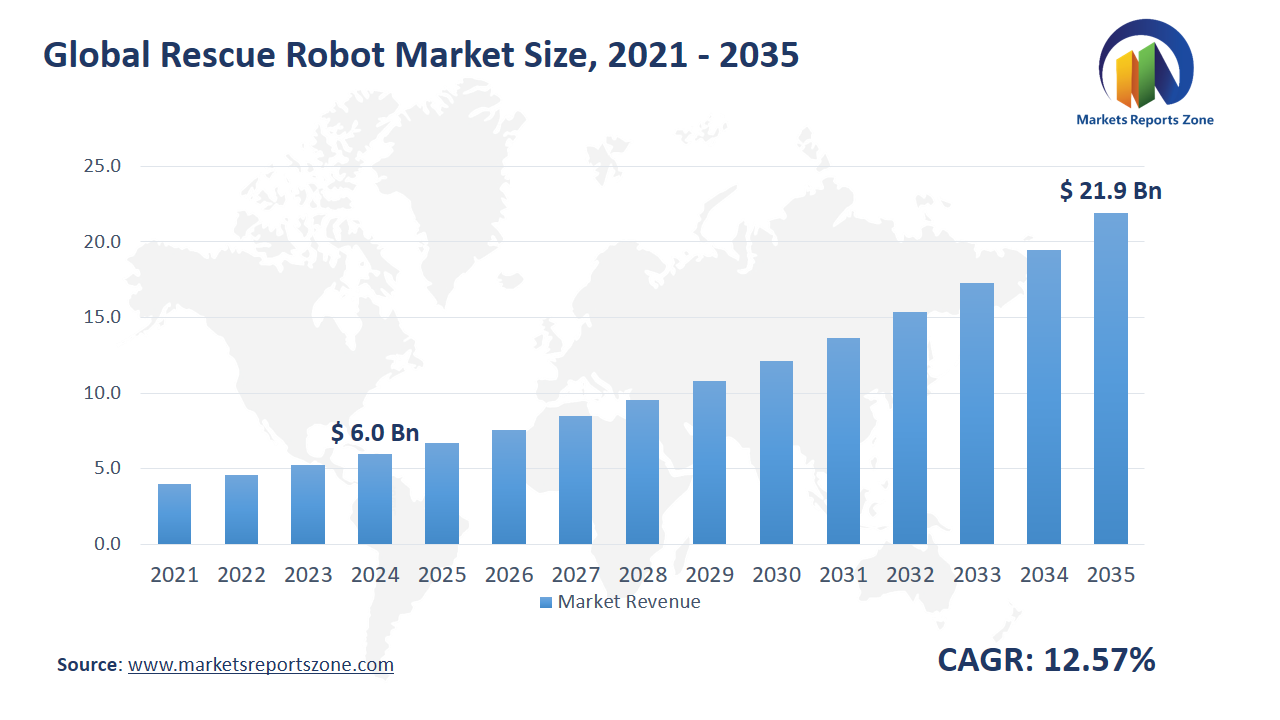
Global Rescue Robot Market Size is expected to reach USD 21.96 Billion by 2035 from USD 5.96 Billion in 2024, with a CAGR of around 12.57% between 2024 and 2035. The global rescue robot market is driven by increasing natural disasters and advancements in AI-powered robotics. The rising frequency of earthquakes, floods, and wildfires has created a strong need for automated rescue operations. AI and sensor technologies are improving robotic efficiency in detecting survivors and navigating hazardous environments. However, market growth is restrained by high development costs, making advanced rescue robots inaccessible for many regions. Despite this, opportunities exist in military rescue missions, where autonomous robots are deployed in battlefield evacuations and minefield clearance. Growing investments in underwater search and rescue operations are also creating potential for market expansion. In real-life scenarios, drones equipped with thermal cameras are used to locate missing hikers in dense forests. Snake-like robots assist in collapsed building rescues by reaching trapped victims in tight spaces. Firefighting robots are deployed in extreme heat conditions where human entry is impossible. Autonomous submarines play a vital role in locating wreckage and retrieving survivors in maritime disasters. With continuous improvements in robotic mobility and real-time data processing, rescue robots are becoming more efficient and adaptable. Future innovations in swarm robotics and self-learning AI are expected to enhance their capabilities, making them indispensable in emergency response and disaster management.
Driver: AI Advancements Enhancing Rescue Operations
Artificial intelligence is revolutionizing rescue robot capabilities, making emergency response faster and more efficient. Machine learning algorithms enable robots to analyze complex environments in real time, improving decision-making during critical situations. AI-powered drones are used to assess structural damage after earthquakes, identifying the safest paths for human rescuers. Ground robots with advanced object recognition help locate survivors trapped under rubble by distinguishing between human bodies and debris. In flood-stricken areas, AI-driven boats autonomously navigate strong currents to deliver essential supplies and evacuate stranded individuals. Firefighting robots utilize thermal imaging and AI to detect fire sources and assess the spread of flames, reducing risks for human firefighters. Robotic exoskeletons assist emergency personnel in carrying injured victims over difficult terrain, ensuring faster medical attention. AI-powered robotic dogs are deployed in nuclear disaster zones, collecting radiation data without endangering human lives. With continuous improvements in AI and sensor integration, rescue robots are becoming smarter and more adaptive. Future developments in predictive analytics and swarm robotics will further enhance their ability to operate autonomously in high-risk environments. As AI technology advances, rescue robots will play an increasingly vital role in disaster response, minimizing casualties and improving overall emergency management efficiency.
Key Insights:
- In 2023, sales of professional service robots, including rescue robots, increased by 30% worldwide, with over 205,000 units sold.
- The Asia-Pacific region accounted for nearly 80% of these sales, totaling 162,284 units, while Europe and the Americas recorded 33,918 and 8,927 units sold, respectively.
- The U.S. Department of Defense allocated $10.3 billion in its 2023 budget for autonomy and robotics technologies, which includes investments in rescue robots.
- The South Korean government allocated $172.2 million in funding for the "2022 Implementation Plan for the Intelligent Robot," promoting the development and deployment of robots, including those used in rescue operations.
- China's government provided funding of $10.2 million for the Key Special Program on Intelligent Robots in 2020, supporting advancements in rescue robotics.
Segment Analysis:
Rescue robots are playing a crucial role in fire and earthquake emergencies, with applications in both personal and commercial sectors. Firefighting robots are designed to withstand extreme temperatures, assisting in extinguishing flames and navigating smoke-filled environments. In high-rise building fires, autonomous stair-climbing robots help evacuate residents by guiding them to safe exits. In earthquake scenarios, robotic dogs equipped with sensors are used to scan unstable structures, detecting survivors trapped beneath collapsed debris. Drones with AI-powered cameras survey affected areas, providing real-time data to rescue teams. In personal applications, home safety robots equipped with fire detection systems alert homeowners and even attempt to contain small fires before they spread. Wearable exoskeletons assist injured individuals in regaining mobility after disaster-related injuries. In commercial settings, construction companies use robotic scanners to assess earthquake-damaged buildings for structural weaknesses, preventing further casualties. Smart robotic rescue pods are deployed in factories with hazardous materials, ensuring worker safety by autonomously responding to fire or seismic threats. As robotics technology evolves, fire and earthquake rescue robots are becoming more efficient and autonomous, ensuring faster response times and reducing human risk in life-threatening situations. Future advancements will further enhance their precision and adaptability in unpredictable emergencies.
Regional Analysis:
The rescue robot market is gaining traction across five key regions, each driven by unique challenges and technological advancements. In North America, disaster-prone areas are increasingly deploying autonomous search-and-rescue drones to locate survivors after hurricanes and wildfires. Earthquake-prone zones in South America are integrating robotic exoskeletons into emergency response teams, assisting injured individuals with mobility during evacuations. In Europe, flood rescue robots equipped with AI-driven navigation are being used to deliver supplies and extract stranded individuals from submerged areas. The Asia-Pacific region is witnessing rapid adoption due to frequent typhoons and tsunamis, with amphibious robots being deployed to assist in coastal rescues. In the Middle East and Africa, robotic firefighting units are being utilized in oil refineries and industrial zones to combat large-scale fires where human firefighters face extreme danger. These advancements are enhancing response efficiency while reducing risks to rescue personnel. Government initiatives and investments in robotics research are accelerating innovation, making these robots more autonomous and adaptive to unpredictable environments. As climate change intensifies the frequency of natural disasters, the demand for advanced rescue robots will continue to grow, driving technological progress and ensuring more effective disaster management across all regions.
Competitive Scenario:
The rescue robot market is witnessing rapid advancements, with key companies continuously innovating to enhance safety and efficiency in disaster response. Rovenso and ANYbotics are focusing on autonomous inspection and rescue robots capable of navigating hazardous industrial environments, ensuring safer emergency operations. ROBOTSYSTEM and SuperDroid Robots are developing rugged, all-terrain robots designed for search and rescue missions in collapsed buildings and disaster-stricken areas. Honda has been expanding its humanoid robotics research, working on advanced mobility solutions that assist emergency responders in dangerous conditions. BlackDog and Husarion are investing in AI-driven robotic dogs, capable of detecting survivors in extreme conditions such as avalanches and mine collapses. Tmsuk is developing remote-controlled rescue robots for urban disasters, enhancing response times in densely populated cities. VECNA Technologies and Sarcos Robotics are creating robotic exoskeletons, aiding rescue workers in lifting heavy debris during post-disaster recovery efforts. Boston Dynamics continues to refine its agile quadruped robots, making them more adaptable for real-world rescue applications. OC Robotics and Foster-Miller are advancing robotic arms and snake-like robots, designed to access confined spaces in collapsed buildings or dangerous environments. With continuous R&D, these companies are shaping the future of rescue robotics, making emergency response more effective and reliable.
Rescue Robot Market Report Scope
| Report Attribute | Details |
|---|---|
| Market Size Value in 2024 | USD 5.96 Billion |
| Revenue Forecast in 2035 | USD 21.96 Billion |
| Growth Rate | CAGR of 12.57% from 2025 to 2035 |
| Historic Period | 2021 - 2024 |
| Forecasted Period | 2025 - 2035 |
| Report Coverage | Revenue forecast, company ranking, competitive landscape, growth factors, and trends |
| Regions Covered | North America; Europe; Asia Pacific; Latin America; Middle East & Africa |
| Countries Covered | U.S.; Canada; Mexico, UK; Germany; France; Spain; Italy; Russia; China; Japan; India; South Korea; Australia; Southeast Asia; Brazil; Argentina; Saudi Arabia; UAE; South Africa |
| Key companies profiled | Rovenso; ANYbotics; ROBOTSYSTEM; Honda; SuperDroid Robots; BlackDog; Husarion; Tmsuk; VECNA Technologies; Sarcos Robotics; Boston Dynamics; OC Robotics; Foster-Miller |
| Customization | Free report customization (equivalent up to 8 analysts working days) with purchase. Addition or alteration to country, regional & segment scope. |
The Global Rescue Robot Market report is segmented as follows:
By Type,
- Fire
- Earthquake
By Application,
- Personal
- Commercial
By Region,
- North America
- U.S.
- Canada
- Mexico
- Europe
- UK
- Germany
- France
- Spain
- Italy
- Russia
- Rest of Europe
- Asia Pacific
- China
- Japan
- India
- South Korea
- Australia
- Southeast Asia
- Rest of Asia Pacific
- Latin America
- Brazil
- Argentina
- Rest of Latin America
- Middle East & Africa
- Saudi Arabia
- UAE
- South Africa
- Rest of Middle East and Africa
Key Market Players,
- Rovenso
- ANYbotics
- ROBOTSYSTEM
- Honda
- SuperDroid Robots
- BlackDog
- Husarion
- Tmsuk
- VECNA Technologies
- Sarcos Robotics
- Boston Dynamics
- OC Robotics
- Foster-Miller
Frequently Asked Questions
How big is the Rescue Robot market?
Global Rescue Robot Market Size was valued at USD 5.96 Billion in 2024 and is projected to reach at USD 21.96 Billion in 2035.
What is the Rescue Robot market growth?
Global Rescue Robot Market is expected to grow at a CAGR of around 12.57% during the forecasted year.
Which region has the largest market share in Rescue Robot market?
North America, Asia Pacific and Europe are major regions in the global Rescue Robot Market.
Who are the key players in Rescue Robot market?
Key players analyzed in the global Rescue Robot Market are Rovenso; ANYbotics; ROBOTSYSTEM; Honda; SuperDroid Robots; BlackDog; Husarion; Tmsuk; VECNA Technologies; Sarcos Robotics; Boston Dynamics; OC Robotics; Foster-Miller and so on.