
Global Precast/Prefabricated Construction Market - Size and Forecast Analysis, 2021-2035
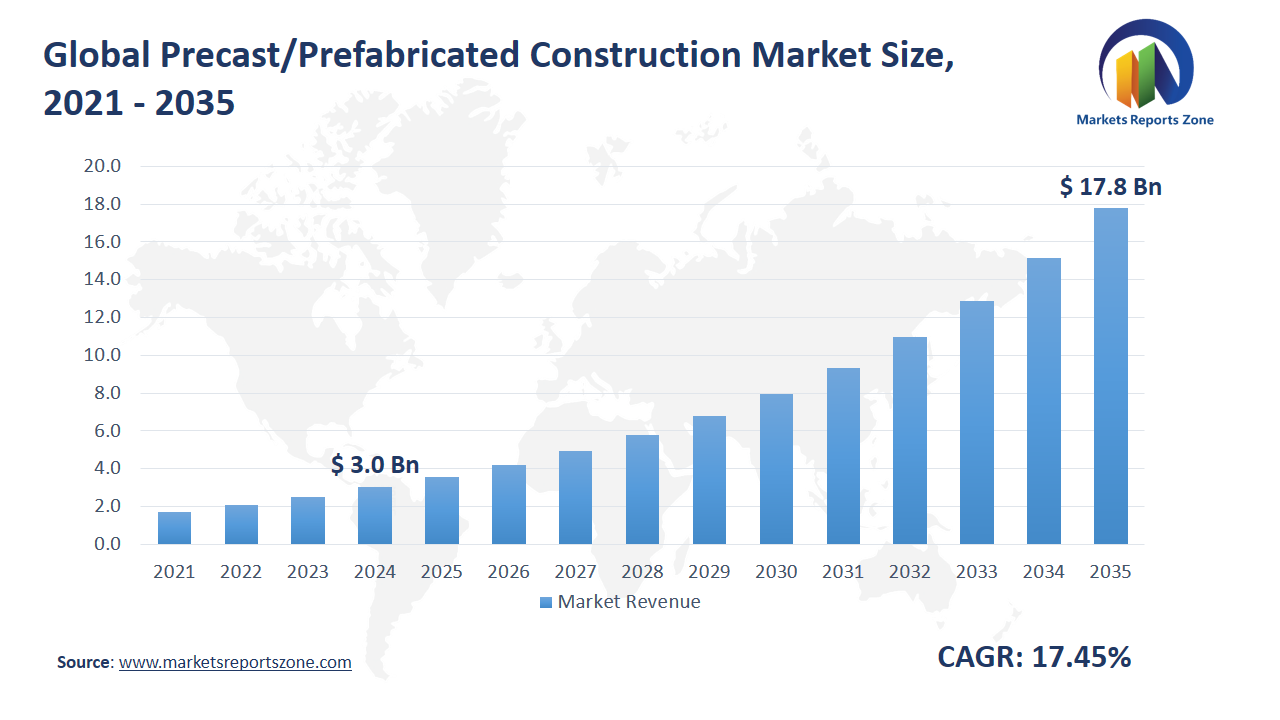
Global Precast/Prefabricated Construction Market Size is expected to reach USD 17.81 Billion by 2035 from USD 3.03 Billion in 2024, with a CAGR of around 17.45% between 2024 and 2035. The global precast/prefabricated construction market is being driven by the rising demand for faster project completion and the growing focus on cost-effective building solutions. Precast construction is being increasingly used in residential projects to reduce on-site labor and shorten construction timelines. In urban areas, prefabricated modular homes are being deployed to meet the rising housing demand quickly. However, the market is being restrained by the high transportation and handling costs of large precast components, which can limit their use in remote locations. Despite this, new opportunities are emerging. The growing adoption of green building practices is creating demand for precast solutions, as they generate less waste and reduce on-site pollution. For instance, commercial developers are using prefabricated panels with thermal insulation to enhance energy efficiency. Additionally, the rising demand for infrastructure development is fueling growth. Governments are increasingly using precast components for bridges, tunnels, and road projects to reduce construction time and improve durability. For example, precast concrete slabs are being installed on highways to accelerate repairs and minimize traffic disruptions. With the need for faster, cost-efficient, and sustainable construction methods, the demand for precast and prefabricated solutions is steadily growing.
Driver: Faster Project Completion Boosting Adoption
The demand for faster construction timelines is driving the growth of precast and prefabricated construction. With increasing urbanization, builders are under pressure to complete projects quickly without compromising on quality. Precast construction offers a solution by enabling off-site manufacturing of components, which significantly reduces on-site labor and assembly time. In the residential sector, developers are using precast panels for apartment complexes, allowing entire floors to be installed in days rather than weeks. In commercial construction, hotels are increasingly adopting modular prefabricated rooms, which arrive fully assembled with plumbing and electrical systems, slashing project timelines by months. For instance, in the healthcare sector, prefabricated hospital rooms are being deployed during emergency expansions, such as during pandemic-related surges, allowing rapid scaling of medical facilities. Infrastructure projects are also benefiting from faster completion using precast bridge segments, which are manufactured in controlled environments and quickly assembled on-site, reducing road closures and traffic disruptions. With labor shortages and tight project schedules becoming common challenges, the efficiency and speed of precast construction are making it an attractive solution across various industries, helping companies meet deadlines while controlling costs.
Key Insights:
The adoption rate of precast/prefabricated construction methods in the residential sector is approximately 40%, reflecting a growing trend towards efficient building practices.
In 2023, investments in precast construction technologies by governments and private companies reached around $2 billion, aimed at enhancing infrastructure and housing projects.
The total number of precast concrete units produced globally in 2024 is estimated to be around 30 million tons, driven by increasing demand in various construction sectors.
The penetration rate of precast construction in the commercial building industry is reported to be about 35%, as businesses seek faster and more sustainable construction solutions.
Government initiatives promoting sustainable urban development have led to funding of approximately $750 million for research into advanced precast technologies and materials.
The average lifespan of precast components is typically around 50 years, contributing to their appeal in long-term infrastructure projects.
Approximately 25% of large-scale infrastructure projects utilize precast methods, highlighting their importance in modern construction practices.
Segment Analysis:
The global precast/prefabricated construction market is expanding across various segments, driven by the need for efficient and durable building solutions. Columns and beams are being widely used in non-residential projects such as office buildings and warehouses, providing structural stability while speeding up construction timelines. In residential construction, floors and roofs made of precast concrete panels are being deployed to create uniform and durable structures, reducing on-site labor requirements. Precast walls are gaining popularity in large-scale housing projects, offering faster installation and better insulation, which improves energy efficiency. In commercial spaces, precast staircases are being installed as pre-assembled units, cutting down on labor-intensive on-site work. Girders, essential for infrastructure projects, are being widely used in bridges and flyovers, ensuring rapid construction and consistent quality. For example, transportation departments are increasingly using precast girders for overpasses, minimizing road closures and traffic delays. In the non-residential sector, factories and shopping malls are leveraging precast components to meet tight deadlines and reduce construction waste. With the growing demand for faster, safer, and cost-effective building solutions, precast and prefabricated construction is becoming a preferred choice across both residential and non-residential applications.
Regional Analysis:
The global precast/prefabricated construction market is experiencing steady growth across North America, Europe, Asia-Pacific, Latin America, and the Middle East & Africa, driven by rising demand for faster and cost-efficient building solutions. In North America, precast concrete panels are being widely used in industrial warehouses and distribution centers, enabling quick construction and reducing labor costs. In Europe, prefabricated housing units are being deployed in urban areas to address the housing shortage, offering faster project delivery and improved energy efficiency. The Asia-Pacific region is witnessing strong growth, with China and India using precast segments for large-scale infrastructure projects, such as metro stations and highways, ensuring durability and reducing construction time. In Latin America, governments are increasingly adopting precast concrete walls for affordable housing programs, accelerating construction timelines in low-income areas. The Middle East & Africa is seeing rising adoption in commercial and hospitality sectors, with prefabricated hotel modules being assembled off-site and installed quickly, reducing project delays. Additionally, precast beams and girders are being used for airport expansions in the region, enhancing project efficiency. With the growing demand for durable, fast, and sustainable building solutions, precast and prefabricated construction is expanding across all regions.
Competitive Scenario:
Leading companies in the precast/prefabricated construction market are driving innovation and expanding their capabilities to meet the rising demand for faster and more efficient building solutions. ACS Group and Balfour Beatty plc are increasingly focusing on infrastructure projects, using precast girders and beams for bridge and highway construction to reduce project timelines. Bouygues Construction is advancing its modular construction solutions, recently developing prefabricated residential units to address the housing shortage in urban areas. Julius Berger Nigeria plc is investing in precast concrete plants, enhancing its capacity to supply large-scale infrastructure projects across Africa, including roads and commercial buildings. Kiewit Corporation is incorporating precast tunnel segments into transportation projects, ensuring faster assembly and improved structural strength. Komatsu Ltd is introducing automated precast production systems, boosting efficiency and reducing labor costs. Laing O’Rourke is expanding its prefabrication facilities, enabling large-scale production of modular building components for healthcare and educational facilities. Larsen & Toubro Limited is deploying precast walls and panels for commercial buildings in Asia-Pacific, accelerating project delivery. Meanwhile, Red Sea Housing Services and Taisei Corporation are developing modular prefabricated housing units for remote and temporary accommodations, catering to growing demand in the hospitality and mining sectors.
Precast/Prefabricated Construction Market Report Scope
| Report Attribute | Details |
|---|---|
| Market Size Value in 2024 | USD 3.03 Billion |
| Revenue Forecast in 2035 | USD 17.81 Billion |
| Growth Rate | CAGR of 17.45% from 2025 to 2035 |
| Historic Period | 2021 - 2024 |
| Forecasted Period | 2025 - 2035 |
| Report Coverage | Revenue forecast, company ranking, competitive landscape, growth factors, and trends |
| Regions Covered | North America; Europe; Asia Pacific; Latin America; Middle East & Africa |
| Countries Covered | U.S.; Canada; Mexico, UK; Germany; France; Spain; Italy; Russia; China; Japan; India; South Korea; Australia; Southeast Asia; Brazil; Argentina; Saudi Arabia; UAE; South Africa |
| Key companies profiled | ACS Group; Balfour Beatty plc; Bouygues Construction; Julius Berger Nigeria plc; Kiewit Corporation; Komatsu Ltd; Laing O?Rourke; Larsen & Toubro Limited; Red Sea Housing Services; Taisei Corporation |
| Customization | Free report customization (equivalent up to 8 analysts working days) with purchase. Addition or alteration to country, regional & segment scope. |
The Global Precast/Prefabricated Construction Market report is segmented as follows:
By Type,
- Columns & Beams
- Floors & Roofs
- Walls
- Staircases
- Girders
By Application,
- Residential
- Non-residential
By Region,
- North America
- U.S.
- Canada
- Mexico
- Europe
- UK
- Germany
- France
- Spain
- Italy
- Russia
- Rest of Europe
- Asia Pacific
- China
- Japan
- India
- South Korea
- Australia
- Southeast Asia
- Rest of Asia Pacific
- Latin America
- Brazil
- Argentina
- Rest of Latin America
- Middle East & Africa
- Saudi Arabia
- UAE
- South Africa
- Rest of Middle East and Africa
Key Market Players,
- ACS Group
- Balfour Beatty plc
- Bouygues Construction
- Julius Berger Nigeria plc
- Kiewit Corporation
- Komatsu Ltd
- Laing O?Rourke
- Larsen & Toubro Limited
- Red Sea Housing Services
- Taisei Corporation
Frequently Asked Questions
How big is the Precast/Prefabricated Construction market?
Global Precast/Prefabricated Construction Market Size was valued at USD 3.03 Billion in 2024 and is projected to reach at USD 17.81 Billion in 2035.
What is the Precast/Prefabricated Construction market growth?
Global Precast/Prefabricated Construction Market is expected to grow at a CAGR of around 17.45% during the forecasted year.
Which region has the largest market share in Precast/Prefabricated Construction market?
North America, Asia Pacific and Europe are major regions in the global Precast/Prefabricated Construction Market.
Who are the key players in Precast/Prefabricated Construction market?
Key players analyzed in the global Precast/Prefabricated Construction Market are ACS Group; Balfour Beatty plc; Bouygues Construction; Julius Berger Nigeria plc; Kiewit Corporation; Komatsu Ltd; Laing O?Rourke; Larsen & Toubro Limited; Red Sea Housing Services; Taisei Corporation and so on.