
Global Podcasting Market - Size and Forecast Analysis, 2021-2035
The Global Podcasting Market was valued at USD 28.14 Billion in 2024 and is projected to reach USD 109.62 Billion by 2033 at a CAGR of around 16.31% between 2024 and 2033. The global podcasting market is driven by rising smartphone penetration and increasing demand for on-the-go content. Easy access to audio streaming platforms has fueled the popularity of podcasts among diverse audiences. Major brands and influencers are using podcasts for marketing and audience engagement. However, monetization challenges remain a key restraint, as many independent creators struggle to generate consistent revenue. Despite this, opportunities exist with the growing adoption of AI-powered content creation tools. Automated transcription and personalized recommendations are enhancing user experiences. Another key opportunity lies in multilingual podcasting. Content in regional languages is gaining traction, expanding reach in non-English-speaking markets.
Real-life examples include global media companies launching exclusive podcast series to attract subscribers. Fitness brands are integrating motivational podcasts into workout apps to engage users. In the education sector, universities are offering academic podcasts to enhance remote learning. Small businesses are leveraging podcasts to share industry insights and build brand authority. Emerging markets are witnessing a surge in local storytelling podcasts, catering to cultural preferences. As technology evolves, innovations like interactive podcasts and spatial audio are being introduced. The market continues to expand with evolving consumer preferences and advanced content delivery methods.

Driver: Smartphones Driving Podcast Popularity
The rapid growth of smartphone usage has fueled the podcasting boom worldwide. With high-speed internet and affordable data plans, users can stream or download podcasts anytime, anywhere. Mobile apps have made it easier to access diverse content across multiple genres, from business insights to true crime stories. The convenience of listening on the go has attracted busy professionals, students, and fitness enthusiasts. Voice-controlled assistants like Siri and Google Assistant are further simplifying podcast discovery. Real-life examples include daily news podcasts gaining traction among commuters who prefer quick updates over reading articles. Audiobook platforms are integrating podcast sections, allowing seamless switching between content types.
In rural areas, smartphones are enabling access to educational podcasts, bridging learning gaps. Music streaming services are investing in exclusive podcast content, driving higher user engagement. Fitness enthusiasts are using workout-focused podcasts to stay motivated during exercise sessions. Even mental health professionals are leveraging podcasts to provide guided meditation and self-care advice. With smartphones becoming more advanced, AI-driven recommendations are personalizing podcast experiences, making them more relevant for users. As mobile technology continues to evolve, the podcasting industry is expected to grow further, offering limitless opportunities for creators and listeners alike.
Key Insights:
- In 2016, programs produced by the top five New York City-based podcast networks resulted in over 1.3 billion downloads.
- In 2016, podcast advertising grew 48%, with ad revenue reaching about $167 million.
- By 2017, employment at New York City's top podcast networks increased by 33%, from approximately 450 people in 2015 to about 600 people.
- In 2017, New York City-based podcast networks expanded their office space from about 100,000 square feet in 2014-2015 to almost 140,000 square feet.
- In 2023, India's media and entertainment sector, which includes digital media and podcasting, grew at a CAGR of 10% between 2023 and 2026.
- In 2024, advertisements accounted for an average of 10.9% of podcast run times, up from 7.9% in 2021.
- Podcasters earned 6 cents in ad revenue per hour of programming heard in 2024, an increase from 5 cents in 2021 and 2 cents in 2015.
Segment Analysis:
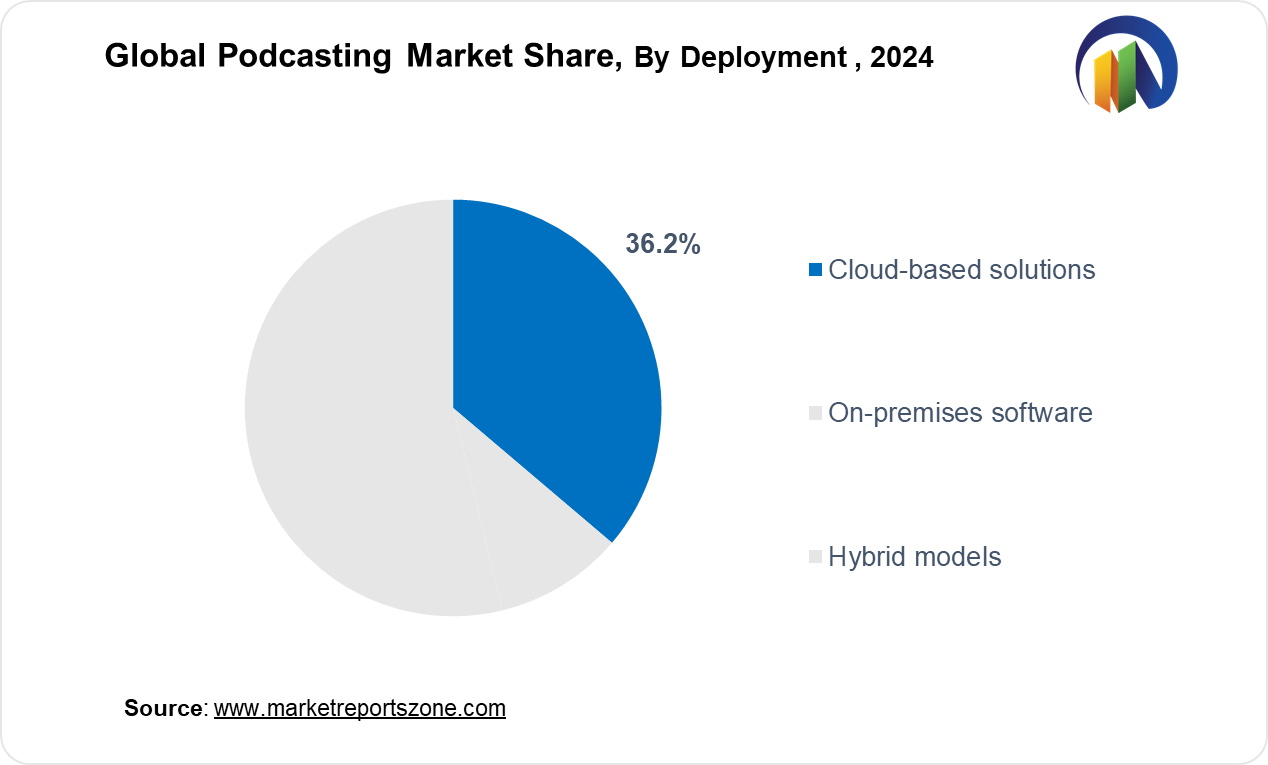
The global podcasting market spans multiple segments, catering to diverse content creators and audiences. In production stages, content creation is booming as influencers, journalists, and businesses launch new podcasts, while post-production tools enhance audio quality. Distribution platforms are expanding, ensuring seamless access across streaming services. Analytics and monetization are gaining importance, with AI-powered insights helping creators optimize engagement. Deployment trends show a shift towards cloud-based solutions, enabling remote collaborations, while hybrid models offer flexibility. Content type diversity continues to grow, with news and politics podcasts attracting engaged listeners, and true crime podcasts maintaining a loyal following. Comedy and lifestyle podcasts are being leveraged by brands for audience interaction, while educational and business podcasts are gaining traction in corporate training.
Podcast length varies by audience preference, with micro-podcasts delivering quick updates and long-form podcasts providing in-depth storytelling. Real-life examples include sports leagues launching podcasts to keep fans updated, tourism boards using travel podcasts to promote destinations, and wellness brands integrating meditation podcasts into their apps. Technology podcasts are driving discussions on AI and innovation, while entertainment podcasts are expanding into live shows. As the market evolves, new opportunities emerge, driven by technological advancements and changing consumer habits.
Regional Analysis:
The global podcasting landscape is experiencing significant transformations across various segments. In the production stage, AI-driven content creation tools are streamlining processes from scripting to editing, enabling faster and more efficient production cycles. Deployment models are evolving, with cloud-based solutions gaining prominence, allowing creators to collaborate remotely and access advanced features without substantial infrastructure investments. Hybrid models are also emerging, offering flexibility by combining on-premises control with cloud scalability. Content types are diversifying; while genres like news, comedy, and true crime remain popular, there's a noticeable rise in niche podcasts catering to specific interests, reflecting a trend towards specialized content for targeted audiences.
Podcast lengths are adapting to listener preferences; micro-podcasts and short-form content are gaining traction among time-constrained audiences seeking concise information, whereas long-form podcasts continue to attract those interested in in-depth discussions. Recent developments include the integration of video elements into podcasts, enhancing engagement and expanding reach on platforms like YouTube. Additionally, innovative advertising strategies, such as dynamic ad insertion and branded content, are being adopted to improve monetization and provide personalized experiences for listeners. These trends underscore the podcasting industry's adaptability and its commitment to meeting evolving consumer demands.
Podcasting Market Report Scope
| Report Attribute | Details |
|---|---|
| Market Size Value in 2024 | USD 28.14 Billion |
| Revenue Forecast in 2033 | USD 109.62 Billion |
| Growth Rate | CAGR of 16.31% from 2025 to 2033 |
| Historic Period | 2021 - 2024 |
| Forecasted Period | 2025 - 2033 |
| Report Coverage | Revenue forecast, company ranking, competitive landscape, growth factors, and trends |
| Regions Covered | North America; Europe; Asia Pacific; Latin America; Middle East & Africa |
| Countries Covered | U.S.; Canada; Mexico, UK; Germany; France; Spain; Italy; Russia; China; Japan; India; South Korea; Australia; Southeast Asia; Brazil; Argentina; Saudi Arabia; UAE; South Africa |
| Key companies profiled | IBM; Google; Oracle; Microsoft; SAP; SAS; Cloudera; Teradata; Tibco; AWS; Informatic; Impetus; Others |
| Customization | Free report customization (equivalent up to 8 analysts working days) with purchase. Addition or alteration to country, regional & segment scope. |
The Global Podcasting Market report is segmented as follows:
By Production Stage,
- Content creation
- Post-production
- Distribution
- Analytics & monetization
By Deployment,
- Cloud-based solutions
- On-premises software
- Hybrid models
By Content Type,
- News and politics
- Comedy
- Education
- Business
- Health & fitness
- Lifestyle & Hobbies
- Technology
- Sports
- True Crime
- Entertainment
- Travel & tourism
- Other genres
By Podcast Length,
- Micro-podcast
- Short-form podcasts
- Medium-form podcasts
- Long-form podcasts
By Region,
- North America
- U.S.
- Canada
- Mexico
- Europe
- UK
- Germany
- France
- Spain
- Italy
- Russia
- Rest of Europe
- Asia Pacific
- China
- Japan
- India
- South Korea
- Australia
- Southeast Asia
- Rest of Asia Pacific
- Latin America
- Brazil
- Argentina
- Rest of Latin America
- Middle East & Africa
- Saudi Arabia
- UAE
- South Africa
- Rest of Middle East & Africa
Key Market Players,
Frequently Asked Questions
How big is the Podcasting Market market?
The Global Podcasting Market was valued at USD 28.14 Billion in 2024 and is projected to reach USD 109.62 Billion by 2033.
What is the Podcasting Market market growth?
The Global Podcasting Market is expected to grow at a compounded annual growth rate of 16.31% between 2024 and 2033.
Which region has the largest market share in Podcasting Market market?
The North America holds the largest market share in the global Podcasting Market in 2024.
Who are the key players in Podcasting Market market?
Key players profiled in the global Podcasting market are IBM; Google; Oracle; Microsoft; SAP; SAS; Cloudera; Teradata; Tibco; AWS; Informatic; Impetus; Others.