
Global Mobile Hotspot Router Market - Size and Forecast Analysis, 2021-2035
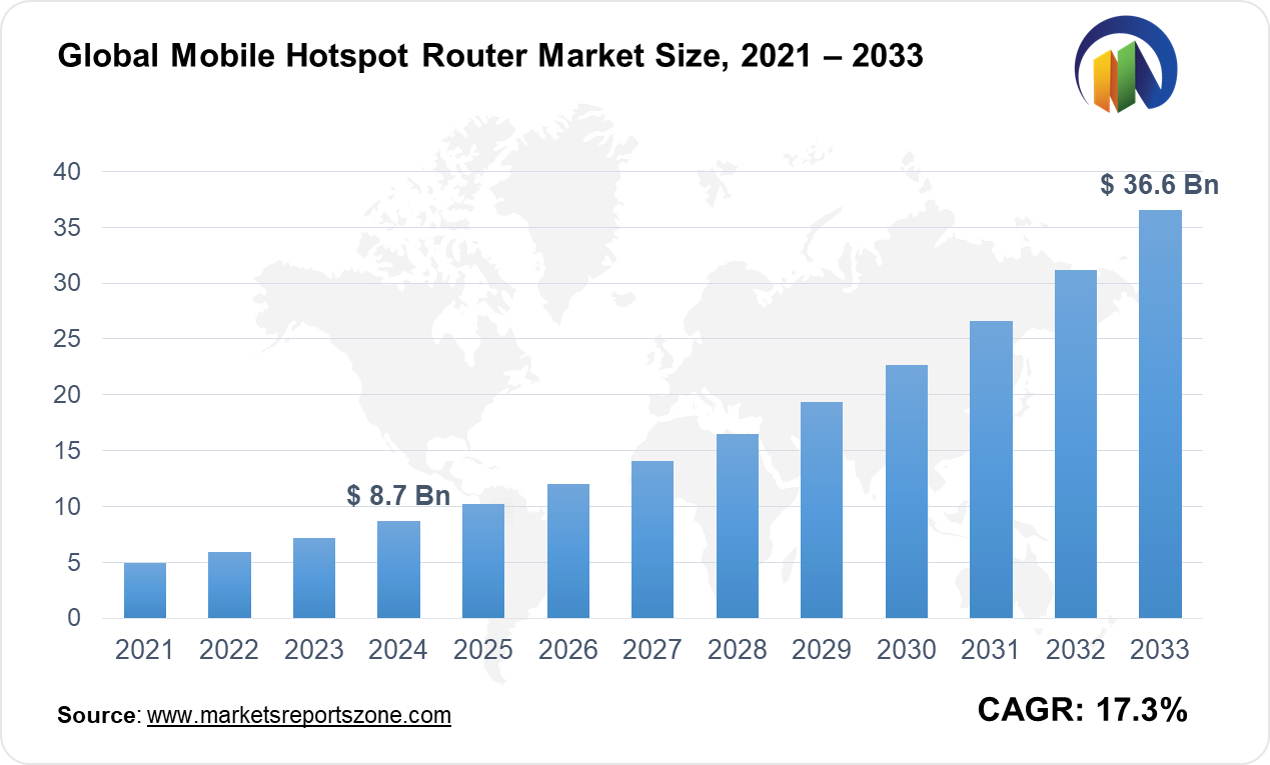
The Global Mobile Hotspot Router Market was valued at USD 8.7 Billion in 2024 and is projected to reach USD 36.6 Billion by 2033 at a CAGR of around 17.3% between 2024 and 2033. The global mobile hotspot router market is driven by increasing remote work adoption and the rising use of smart devices. More professionals rely on stable internet for remote tasks. Demand for seamless connectivity in travel and outdoor activities has also surged. However, cybersecurity risks act as a major restraint. Data breaches and hacking threats discourage some users. Despite this, new opportunities are emerging. Integration of 5G technology is enhancing speed and reliability. Faster connections are ensuring better user experience. Another opportunity lies in the growing demand for IoT connectivity. Smart homes, connected vehicles, and industrial automation require reliable mobile hotspots. For example, logistics companies equip fleet vehicles with routers for real-time tracking. Event organizers use mobile hotspots to ensure stable internet at large gatherings.
Travelers also depend on portable routers in remote locations. The market is evolving with innovative features like cloud-based management and AI-driven network optimization. Compact and high-speed devices are being developed to meet modern needs. Mobile gaming, video streaming, and business applications are becoming more efficient. Affordability and accessibility are being improved by manufacturers. As digital transformation continues, mobile hotspot routers are playing a crucial role in seamless connectivity across various industries and everyday scenarios.
Driver: Remote Work Boom Fuels Demand
The rise of remote work has significantly driven the demand for mobile hotspot routers. Professionals now work from various locations, requiring stable internet beyond traditional home broadband. Many digital nomads rely on portable hotspots in co-working spaces, cafes, or while traveling. Companies with hybrid work models equip employees with mobile routers to ensure seamless connectivity during virtual meetings. Freelancers and gig workers, such as graphic designers and content creators, depend on high-speed internet to upload large files without interruptions. In rural areas with limited broadband access, mobile hotspots serve as a primary internet source for remote workers. Emergency responders also utilize these routers to stay connected in disaster-stricken regions. Sales representatives traveling for business meetings use mobile hotspots to access cloud-based presentations and CRM tools. Educational institutions have adopted these devices to support remote learning, helping students attend online classes from any location. The demand has further surged as businesses prioritize digital transformation, making reliable internet access essential for productivity. Mobile hotspot routers are no longer just travel accessories but have become crucial for professional efficiency. With the remote work culture expanding globally, the need for high-speed, portable internet solutions continues to grow rapidly.
Key Insights:
- In 2018, Bharat Sanchar Nigam Limited (BSNL) was commissioned to establish 25,000 Wi-Fi hotspots across rural India, with an investment of ₹942 crore.
- The Indian government, in 2018, allocated ₹10,000 crore to set up 500,000 Wi-Fi hotspots, aiming to provide broadband access to 50 million rural citizens.
- The Department of Telecommunications projected that establishing 1 crore public Wi-Fi hotspots could generate 2-3 crore job opportunities in India.
- The Karnataka government, in collaboration with ACT Fibernet, launched 100 public Wi-Fi hotspots in Bangalore's Malleshwaram area to enhance digital connectivity.
- Boingo Wireless operates networks in 60% of North America's top 50 airports and over 40% of the world's top 50 airports, reaching more than 1.4 billion passengers annually.
- TP-Link holds 65% of the U.S. home and small business router , highlighting its significant presence in the sector.
Segment Analysis:
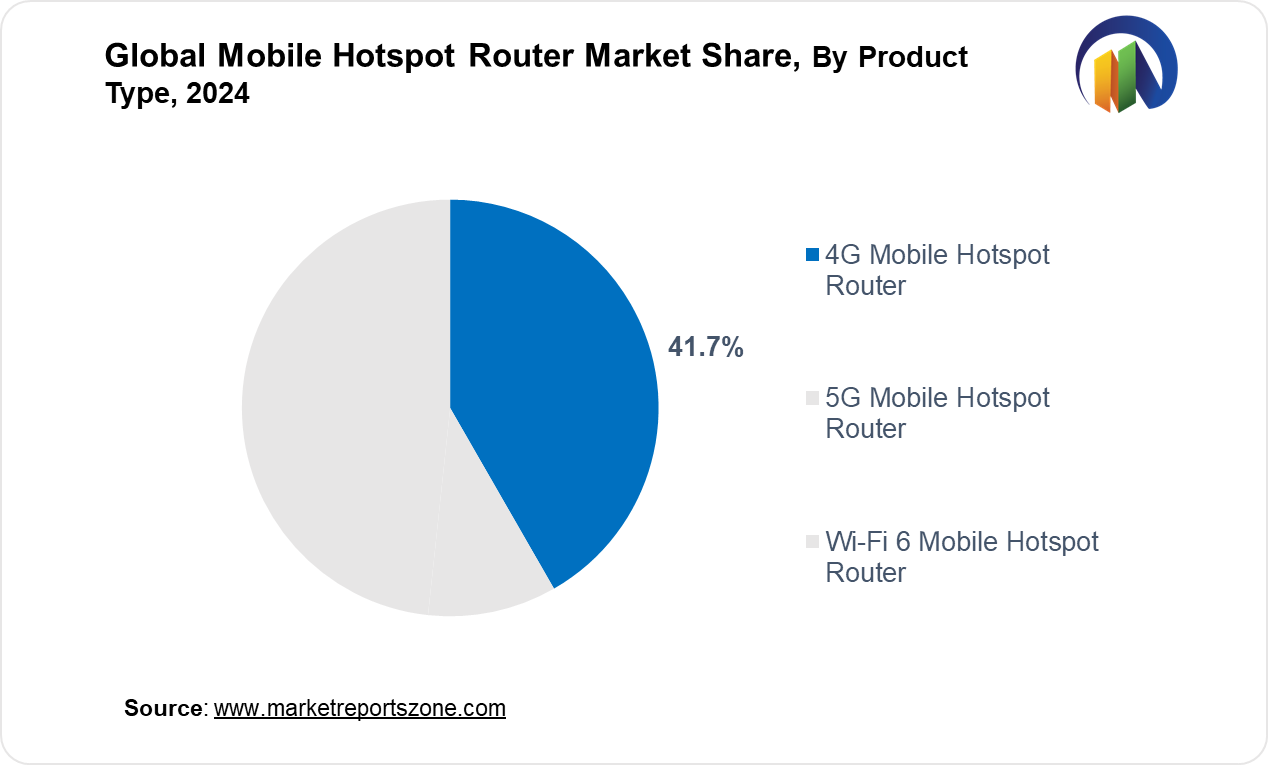
The mobile hotspot router market is segmented by product type, application, and end user. 4G mobile hotspot routers remain widely used due to affordability, while 5G models are gaining traction for faster speeds. Wi-Fi 6 routers offer improved efficiency, making them ideal for high-bandwidth applications. Personal users rely on these routers for entertainment, remote learning, and smart home connectivity. Businesses use them to support hybrid work models and maintain backup internet during outages. Travelers benefit from portable routers to stay connected in foreign countries without expensive roaming charges. Emergency connectivity remains crucial for disaster response teams, enabling real-time communication in remote areas. Consumers increasingly use these devices for gaming, streaming, and home automation. Enterprises deploy mobile hotspots to ensure reliable internet for field operations, outdoor events, and remote offices. For example, photographers upload high-resolution images instantly from outdoor shoots using portable Wi-Fi 6 routers. Healthcare providers in rural areas use 5G routers for telemedicine consultations. Construction companies equip sites with mobile hotspots to enable real-time project collaboration. Event planners deploy high-speed routers at music festivals to support live streaming and ticketing systems. As digital dependence grows, mobile hotspot routers continue to evolve to meet diverse connectivity needs across industries.
Regional Analysis:
The mobile hotspot router market is expanding across all major regions, driven by different connectivity needs. In North America, high remote work adoption and smart home integration fuel demand. Businesses equip employees with portable routers for seamless operations. Travelers use these devices in national parks where traditional networks are weak. In Europe, strong digital infrastructure supports widespread adoption. Remote learning institutions deploy routers to students in rural areas. Event organizers rely on high-speed mobile hotspots for live broadcasting at major sports tournaments. In Asia-Pacific, rapid urbanization and rising smartphone penetration drive growth. Small businesses use mobile routers for payment processing in street markets. Delivery services depend on portable Wi-Fi for real-time tracking. In Latin America, limited broadband availability boosts reliance on mobile hotspots. Remote villages use these devices to connect schools with online resources. Tourism hubs offer hotspot rentals to visitors for navigation and streaming. In the Middle East & Africa, infrastructure gaps make mobile routers essential. Construction firms in desert regions deploy portable hotspots for on-site communication. Emergency responders use them for disaster relief efforts in areas with weak networks. Across all regions, mobile hotspot routers continue to bridge digital gaps, supporting businesses, travelers, and underserved communities worldwide.
Competition Landscape:
The mobile hotspot router market has seen significant advancements driven by key industry players. In February 2023, Huawei introduced three innovative solutions: the FTTR OptiXstar F30, the industry's first commercial 50G PON, and the OptiX Alps-WDM6, aiming to enhance all-optical home networks and ultra-broadband access. NETGEAR, in 2022, launched the M6 mobile hotspot, boasting speeds 20% faster than its predecessor, the M5, achieving up to 2.5 Gbps over 5G and a combined Wi-Fi speed of 3.6 Gbps. In November 2020, Linksys, a division of Belkin International, unveiled the first 5G and Wi-Fi 6 mobile hotspot in Korea and Hong Kong, catering to the growing demand for high-speed mobile connectivity. TP-Link, holding a substantial share of the U.S. home and small business router market, is under U.S. scrutiny due to national security concerns, potentially impacting its market presence. Companies like D-Link Corporation and Alcatel-Lucent (Nokia Corporation) continue to invest in research and development to introduce advanced products with enhanced features, such as higher data speeds and improved security protocols. These developments reflect the industry's commitment to meeting the escalating demand for reliable and fast mobile internet solutions.
Mobile Hotspot Router Market Report Scope
| Report Attribute | Details |
|---|---|
| Market Size Value in 2024 | USD 8.7 Billion |
| Revenue Forecast in 2033 | USD 36.6 Billion |
| Growth Rate | CAGR of 17.3% from 2025 to 2033 |
| Historic Period | 2021 - 2024 |
| Forecasted Period | 2025 - 2033 |
| Report Coverage | Revenue forecast, company ranking, competitive landscape, growth factors, and trends |
| Regions Covered | North America; Europe; Asia Pacific; Latin America; Middle East & Africa |
| Countries Covered | U.S.; Canada; Mexico, UK; Germany; France; Spain; Italy; Russia; China; Japan; India; South Korea; Australia; Southeast Asia; Brazil; Argentina; Saudi Arabia; UAE; South Africa |
| Key companies profiled | Huawei Technologies Co., Ltd.; Novatel Wireless, Inc.; NETGEAR; TP-Link Technologies Co., Ltd.; Belkin International, Inc.; Internet on the Go; Karma Mobility, Inc.; D-Link Corporation; XCom Global, Inc.; Alcatel |
| Customization | Free report customization (equivalent up to 8 analysts working days) with purchase. Addition or alteration to country, regional & segment scope. |
The Global Mobile Hotspot Router Market report is segmented as follows:
By Product Type,
- 4G Mobile Hotspot Router
- 5G Mobile Hotspot Router
- Wi-Fi 6 Mobile Hotspot Router
By Application,
- Personal Use
- Business Use
- Travelers
- Emergency Connectivity
By End User,
- Consumers
- Enterprises
By Region,
- North America
- U.S.
- Canada
- Mexico
- Europe
- UK
- Germany
- France
- Spain
- Italy
- Russia
- Rest of Europe
- Asia Pacific
- China
- Japan
- India
- South Korea
- Australia
- Southeast Asia
- Rest of Asia Pacific
- Latin America
- Brazil
- Argentina
- Rest of Latin America
- Middle East & Africa
- Saudi Arabia
- UAE
- South Africa
- Rest of Middle East & Africa
Key Market Players,
- Huawei Technologies Co., Ltd.
- Novatel Wireless, Inc.
- NETGEAR
- TP-Link Technologies Co., Ltd.
- Belkin International, Inc.
- Internet on the Go
- Karma Mobility, Inc.
- D-Link Corporation
- XCom Global, Inc.
- Alcatel
Frequently Asked Questions
How big is the Mobile Hotspot Router market?
The Global Mobile Hotspot Router Market was valued at USD 8.7 Billion in 2024 and is projected to reach USD 36.6 Billion by 2033.
What is the Mobile Hotspot Router market growth?
The Global Mobile Hotspot Router Market is expected to grow at a compounded annual growth rate of 17.3% between 2024 and 2033.
Which region has the largest market share in Mobile Hotspot Router market?
The Asia Pacific holds the largest market share in the global Mobile Hotspot Router Market in 2024.
Who are the key players in Mobile Hotspot Router market?
Key players profiled in the global Mobile Hotspot Router market are Huawei Technologies Co., Ltd.; Novatel Wireless, Inc.; NETGEAR; TP-Link Technologies Co., Ltd.; Belkin International, Inc.; Internet on the Go; Karma Mobility, Inc.; D-Link Corporation; XCom Global, Inc.; Alcatel.