
Global Intra-body Ultradound Imaging and Sensing Market - Size and Forecast Analysis, 2021-2035
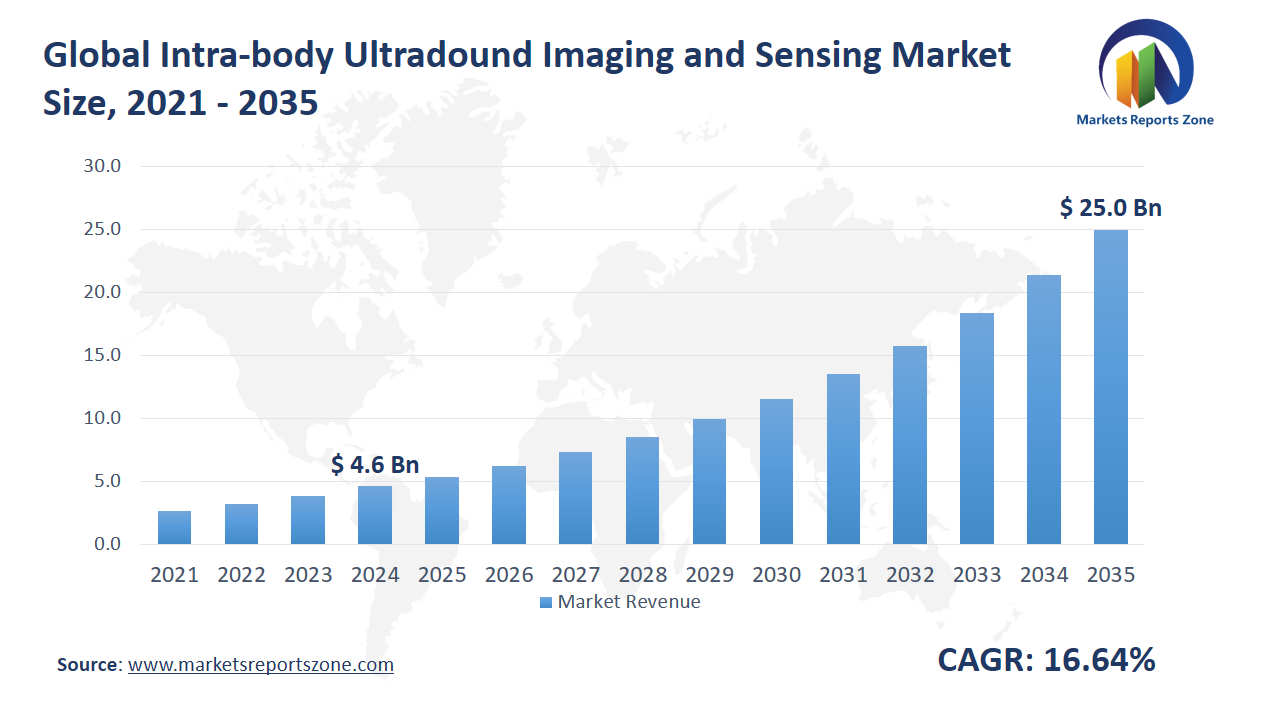
Global Intra-body Ultradound Imaging and Sensing Market Size is expected to reach USD 24.98 Billion by 2035 from USD 4.59 Billion in 2024, with a CAGR of around 16.64% between 2024 and 2035. The global intra-body ultrasound imaging and sensing market is experiencing growth driven by two primary factors. First, technological advancements have led to the development of portable and handheld ultrasound devices, enhancing accessibility in remote and underserved areas. For instance, the introduction of pocket-sized ultrasound devices has enabled healthcare providers to perform diagnostics at the patient's bedside, improving patient outcomes in rural communities. Second, the increasing prevalence of chronic diseases necessitates early and accurate diagnostics, prompting healthcare facilities to adopt advanced ultrasound systems. However, the market faces a significant restraint due to the high cost of sophisticated ultrasound equipment, which can limit adoption in cost-sensitive regions. Opportunities arise from the integration of artificial intelligence (AI) into ultrasound systems, enhancing image analysis and diagnostic accuracy. Additionally, the expansion of telemedicine services offers potential for remote ultrasound diagnostics, allowing specialists to assist in real-time imaging interpretations from distant locations. These factors collectively shape the evolving landscape of the intra-body ultrasound imaging and sensing market.
Driver: Handheld Ultrasound: Portable Care Revolution
The rise of portable and handheld ultrasound devices has transformed how diagnostics are delivered in modern healthcare. These compact tools have been designed to fit in a pocket but provide image quality once limited to large hospital machines. In rural clinics and mobile health camps, such devices have been used to detect internal injuries, monitor pregnancies, and guide catheter placements without needing patients to travel long distances. For instance, in disaster-stricken zones, emergency responders have used handheld ultrasound to assess internal bleeding and guide treatment decisions right on site. In home healthcare, nurses have carried portable scanners to monitor heart conditions or check fluid buildup in elderly patients. This ease of use has helped in providing faster, more accurate assessments, especially where immediate hospital access is unavailable. In developing nations, community health workers have been trained to use these devices to identify complications in pregnant women, ensuring timely referrals and reducing maternal risk. These innovations have not only improved patient outcomes but have also reduced pressure on crowded hospitals. By bringing diagnostics closer to patients, handheld ultrasound technology has truly opened the door to more inclusive and proactive healthcare.
Key Insights:
The adoption rate of intra-body ultrasound imaging in minimally invasive surgical procedures is approximately 25%, driven by its precision and real-time feedback.
In 2023, major medical device companies invested around $50 million in research and development for advanced intra-body ultrasound imaging technologies.
The total number of intra-body ultrasound imaging systems sold globally reached approximately 5,000 units in 2024.
The penetration rate of intra-body ultrasound imaging in urology applications is estimated to be about 30%, reflecting its use in procedures like kidney stone removal.
The average annual growth rate for intra-body ultrasound imaging adoption has been reported at around 7% since 2022.
By the end of 2024, the cumulative number of medical facilities equipped with intra-body ultrasound imaging capabilities worldwide is expected to exceed 1,000.
The use of intra-body ultrasound imaging in oncology for tumor ablation and biopsy guidance accounts for approximately 20% of its total applications.
Innovations in intra-body ultrasound imaging, such as improved sensor technologies, have increased its use in cardiovascular interventions by approximately 15% annually.
Segment Analysis:
The intra-body ultrasound imaging and sensing market is growing steadily due to its role in improving minimally invasive diagnostics. Devices for intra-body pressure reading have been used during cardiac catheterization to detect pressure gradients in coronary arteries, helping in decision-making during angioplasty. Intra-body temperature reading has played a key role during ablation procedures for atrial fibrillation, where accurate thermal monitoring prevents tissue damage. Intra-body EM tracking has been relied upon during complex endoscopic interventions, guiding the precise placement of tools in delicate anatomical regions. Coronary intravascular ultrasound (IVUS) has helped cardiologists visualize artery walls and plaque buildup in high-risk patients, enabling accurate stent placement. In peripheral IVUS, blockages in leg arteries have been assessed more clearly, leading to better outcomes in patients with peripheral artery disease. Intracardiac Echo (ICE) has been commonly used in electrophysiology labs to guide left atrial appendage closures and transseptal punctures without external imaging reliance. Radial and linear endobronchial ultrasound (EBUS) techniques have supported pulmonologists in diagnosing lung cancers and lymph node involvement with real-time imaging and needle guidance. Together, these technologies have enhanced diagnostic accuracy, minimized complications, and accelerated recovery, showcasing how innovation is reshaping clinical workflows and outcomes across various specialties.
Regional Analysis:
North America has been witnessing steady growth in intra-body ultrasound imaging and sensing due to the rising demand for real-time diagnostics in advanced cardiac and pulmonary care. In Canada, radial EBUS has been widely adopted in oncology departments to assist in early detection of mediastinal tumors. Europe has shown strong uptake, especially in Germany and the Netherlands, where intracardiac echo is often used during mitral valve repairs to reduce complications. In the UK, linear EBUS has supported early staging of non-small cell lung cancer with high precision. In Asia-Pacific, countries like Japan and South Korea have embraced EM tracking technologies during minimally invasive urological and gastroenterological procedures. In China, increased hospital investments have led to wider deployment of IVUS for coronary interventions in tier-one cities. In Latin America, particularly Brazil, peripheral IVUS has become popular in large urban hospitals to manage diabetes-related vascular complications. The Middle East and Africa have begun integrating pressure and temperature reading devices into cardiac centers, especially in UAE and South Africa. These regions are focusing on expanding capabilities through mobile diagnostic units and collaborations with global suppliers. The rise in chronic disease burden, combined with infrastructure upgrades, is driving innovation and adoption across global healthcare landscapes.
Competitive Scenario:
The intra-body ultrasound imaging and sensing market has witnessed notable advancements driven by key industry players focusing on innovation and strategic collaborations. GE HealthCare has integrated artificial intelligence into its ultrasound systems, exemplified by the Venue Family's AI-driven Caption Guidance, which assists clinicians in capturing diagnostic-quality cardiac images at the point of care. Additionally, GE HealthCare's acquisition of Intelligent Ultrasound's clinical AI business aims to enhance real-time image recognition capabilities, particularly in women's health imaging. Konica Minolta Healthcare has introduced the PocketPro H2, a wireless handheld ultrasound device optimized for musculoskeletal and pain management applications, offering high-quality imaging in a portable format. These developments reflect a broader industry trend towards enhancing diagnostic accuracy and accessibility through technological innovation and strategic partnerships.
Intra-body Ultradound Imaging and Sensing Market Report Scope
| Report Attribute | Details |
|---|---|
| Market Size Value in 2024 | USD 4.59 Billion |
| Revenue Forecast in 2035 | USD 24.98 Billion |
| Growth Rate | CAGR of 16.64% from 2025 to 2035 |
| Historic Period | 2021 - 2024 |
| Forecasted Period | 2025 - 2035 |
| Report Coverage | Revenue forecast, company ranking, competitive landscape, growth factors, and trends |
| Regions Covered | North America; Europe; Asia Pacific; Latin America; Middle East & Africa |
| Countries Covered | U.S.; Canada; Mexico, UK; Germany; France; Spain; Italy; Russia; China; Japan; India; South Korea; Australia; Southeast Asia; Brazil; Argentina; Saudi Arabia; UAE; South Africa |
| Key companies profiled | General Electric (GE); Philips; Siemens; TOSHIBA; Hitachi Medical; Mindray; Sonosite (FUJIFILM); Esaote; Samsung Medison; Konica Minolta; SonoScape |
| Customization | Free report customization (equivalent up to 8 analysts working days) with purchase. Addition or alteration to country, regional & segment scope. |
The Global Intra-body Ultradound Imaging and Sensing Market report is segmented as follows:
By Type,
- Intra-body Pressure Reading
- Intra-body Temperature Reading
- Intra-body EM Tracking
By Application,
- Coronary Intravascular Ultrasound (IVUS)
- Peripheral IVUS
- Intracardiac Echo (ICE)
- Radial Endobronchial Ultrasound (EBUS)
- Linear EBUS
By Region,
- North America
- U.S.
- Canada
- Mexico
- Europe
- UK
- Germany
- France
- Spain
- Italy
- Russia
- Rest of Europe
- Asia Pacific
- China
- Japan
- India
- South Korea
- Australia
- Southeast Asia
- Rest of Asia Pacific
- Latin America
- Brazil
- Argentina
- Rest of Latin America
- Middle East & Africa
- Saudi Arabia
- UAE
- South Africa
- Rest of Middle East and Africa
Key Market Players,
- General Electric (GE)
- Philips
- Siemens
- TOSHIBA
- Hitachi Medical
- Mindray
- Sonosite (FUJIFILM)
- Esaote
- Samsung Medison
- Konica Minolta
- SonoScape
Frequently Asked Questions
How big is the Intra-body Ultradound Imaging and Sensing market?
Global Intra-body Ultradound Imaging and Sensing Market Size was valued at USD 4.59 Billion in 2024 and is projected to reach at USD 24.98 Billion in 2035.
What is the Intra-body Ultradound Imaging and Sensing market growth?
Global Intra-body Ultradound Imaging and Sensing Market is expected to grow at a CAGR of around 16.64% during the forecasted year.
Which region has the largest market share in Intra-body Ultradound Imaging and Sensing market?
North America, Asia Pacific and Europe are major regions in the global Intra-body Ultradound Imaging and Sensing Market.
Who are the key players in Intra-body Ultradound Imaging and Sensing market?
Key players analyzed in the global Intra-body Ultradound Imaging and Sensing Market are General Electric (GE); Philips; Siemens; TOSHIBA; Hitachi Medical; Mindray; Sonosite (FUJIFILM); Esaote; Samsung Medison; Konica Minolta; SonoScape and so on.