
Global Intervertebral Disc Retractors Market - Size and Forecast Analysis, 2021-2035
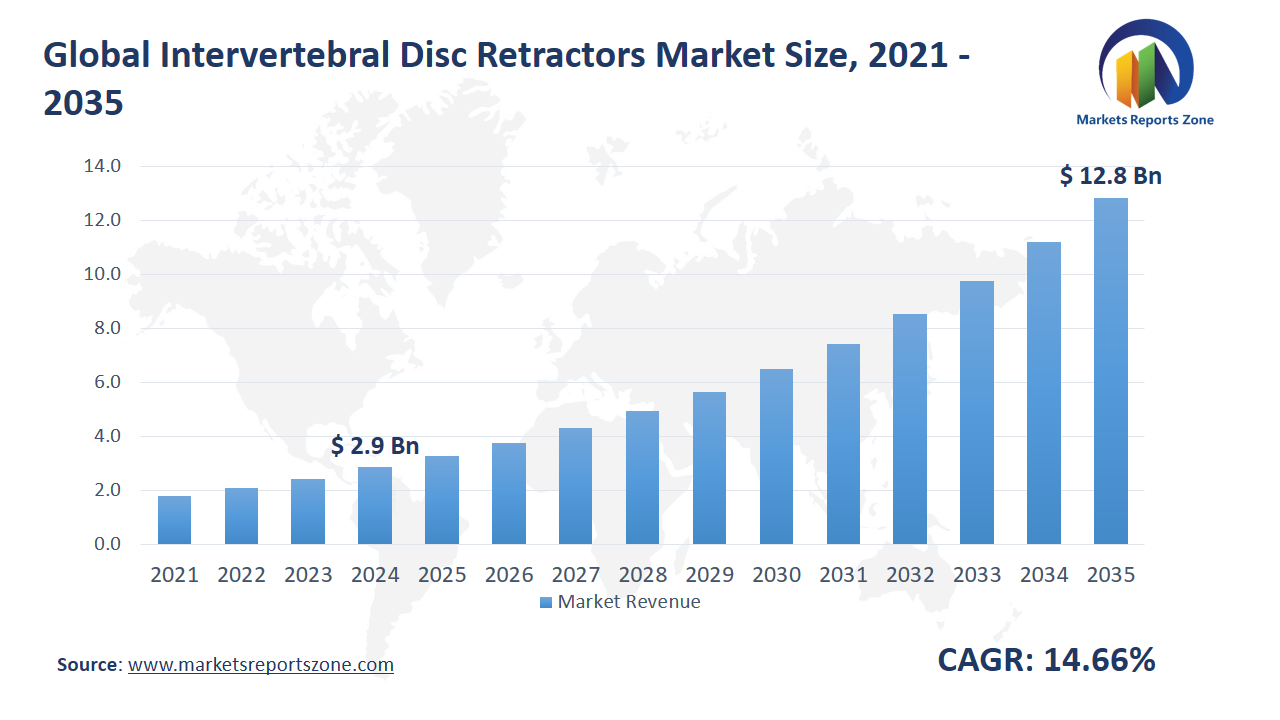
Global Intervertebral Disc Retractors Market Size is expected to reach USD 12.85 Billion by 2035 from USD 2.85 Billion in 2024, with a CAGR of around 14.66% between 2024 and 2035. The global intervertebral disc retractors market is expanding, driven by the increasing prevalence of spinal disorders and technological advancements in surgical instruments. An aging population contributes to a higher incidence of conditions like herniated discs, leading to more surgical interventions. Innovations, such as minimally invasive techniques, have enhanced surgical precision and patient recovery times. For instance, hospitals adopting advanced retractors with ergonomic designs have reported improved surgical outcomes. However, the high cost of these sophisticated instruments poses a significant restraint, limiting accessibility in cost-sensitive regions. Opportunities arise from the growing demand for minimally invasive procedures, encouraging manufacturers to develop cost-effective solutions. Additionally, emerging markets with improving healthcare infrastructure present potential for market expansion. Collaborations between medical device companies and healthcare providers in these regions have facilitated the introduction of advanced surgical tools, broadening the market's reach.
Driver: Aging Population Fuels Surgical Demand
A steady rise in the aging population has significantly driven the demand for intervertebral disc retractors. As people age, degenerative spine conditions become more frequent, with problems like disc herniation, spinal stenosis, and osteoarthritis occurring more commonly. These disorders often lead to chronic back pain, affecting mobility and quality of life. In response, surgical interventions are being increasingly opted for, especially when conservative treatments fail. For example, in urban eldercare hospitals, a notable rise in lumbar decompression and spinal fusion surgeries has been reported. During these surgeries, retractors play a vital role in providing clear access to the spine while protecting surrounding tissues. Elderly patients, who may not tolerate long procedures or large incisions well, benefit from minimally invasive techniques enabled by advanced retractors. In several community hospitals, compact and lightweight retractor systems have been introduced to reduce surgical trauma and speed up recovery. With more people living longer and seeking active lifestyles, demand for efficient and safe spinal surgeries is being consistently seen. This demographic shift has placed focus on improving spinal care infrastructure and tools, leading to broader adoption of innovative retraction devices globally. As the elderly population grows, this driver is expected to remain strong.
Key Insights:
The adoption rate of intervertebral disc retractors in spinal surgeries is approximately 30%, driven by their role in enhancing surgical precision and reducing tissue damage.
In 2023, major medical device companies invested around $15 million in research and development for advanced intervertebral disc retraction systems.
The total number of intervertebral disc retractors sold globally reached approximately 50,000 units in 2024.
The penetration rate of intervertebral disc retractors in orthopedic and neurosurgical procedures is estimated to be about 40%, reflecting their specialized use in these fields.
The average annual growth rate for the adoption of intervertebral disc retractors has been reported at around 5% since 2022, driven by advancements in minimally invasive surgical techniques.
By the end of 2024, the cumulative number of spinal surgeries performed using intervertebral disc retractors worldwide is expected to exceed 200,000 procedures.
The use of intervertebral disc retractors in training programs for surgeons accounts for approximately 20% of their total applications, highlighting their educational value.
The integration of intervertebral disc retractors into robotic-assisted surgeries has increased by approximately 15% annually, driven by the demand for precision and reduced recovery times.
Segment Analysis:
Lateral retractors have gained significant importance in spinal surgeries, particularly for minimally invasive procedures. These retractors allow precise access to the intervertebral disc space without causing much disruption to surrounding tissues. In hospitals, especially those with advanced neurosurgical departments, lateral retractors are commonly used during lateral lumbar interbody fusion procedures. For instance, in high-volume orthopedic hospitals, surgeons often rely on lateral retraction systems to improve visualization and reduce surgical time. This not only minimizes complications but also helps patients recover faster, especially those with degenerative disc diseases. In smaller clinics, lateral retractors are being adopted due to their compact design and adaptability to outpatient procedures. A growing number of spine specialists in urban clinics now perform day-care lumbar interventions using portable lateral retractors that require less setup time. With spinal conditions becoming more prevalent among working professionals due to sedentary lifestyles, more clinics are expanding their surgical capabilities. In both hospital and clinic settings, these retractors are helping improve outcomes in spinal decompression and fusion surgeries. Their ability to support minimally invasive techniques while maintaining surgical precision makes them a preferred choice. As the healthcare system increasingly focuses on efficiency and faster recovery, the demand for lateral retractors across medical settings is steadily increasing.
Regional Analysis:
In North America, intervertebral disc retractors are being widely used in specialized spine centers where elderly patients often undergo complex spinal procedures, particularly in urban hospitals across the U.S. In Canada, their usage has been growing in outpatient surgical centers for treating sports-related spinal injuries. In Europe, countries like Germany and the UK have integrated these tools into minimally invasive surgical protocols, especially in academic hospitals where medical students are trained in advanced spinal techniques. Scandinavian nations are also seeing wider adoption due to their focus on high-tech, precision-based surgery. In Asia-Pacific, particularly in Japan and South Korea, robotic-assisted spinal surgeries are using disc retractors to ensure safe and consistent access, while in India, large government hospitals are employing them in procedures for patients with traumatic spinal injuries. In Latin America, orthopedic hospitals in Brazil are using locally manufactured retractors to reduce surgical costs and increase accessibility for the middle-income population. In Mexico, private clinics are offering spine surgeries using retractors as part of their growing medical tourism programs. In the Middle East and Africa, countries like the UAE are equipping their new specialty hospitals with advanced retractors, while in South Africa, teaching hospitals are integrating them into training modules for spine surgery residents.
Competitive Scenario:
The intervertebral disc retractor market has seen significant activity among key players focusing on expansion and innovation. RTI Surgical has strategically acquired Paradigm Spine, integrating the Coflex® Interlaminar Stabilization® device into its spine portfolio, enhancing treatment options for lumbar spinal stenosis. Stryker has expanded its vascular device offerings by acquiring Inari Medical for $4.9 billion, aiming to improve treatments for venous thromboembolism. TeDan Surgical Innovations has broadened its global footprint by establishing TeDan Surgical Innovations GmbH in Germany, facilitating closer support and development in the European market. These developments reflect a dynamic market where companies are actively pursuing growth through acquisitions and international expansion, aiming to enhance their product offerings and meet the evolving needs of spinal surgery.
Intervertebral Disc Retractors Market Report Scope
| Report Attribute | Details |
|---|---|
| Market Size Value in 2024 | USD 2.85 Billion |
| Revenue Forecast in 2035 | USD 12.85 Billion |
| Growth Rate | CAGR of 14.66% from 2025 to 2035 |
| Historic Period | 2021 - 2024 |
| Forecasted Period | 2025 - 2035 |
| Report Coverage | Revenue forecast, company ranking, competitive landscape, growth factors, and trends |
| Regions Covered | North America; Europe; Asia Pacific; Latin America; Middle East & Africa |
| Countries Covered | U.S.; Canada; Mexico, UK; Germany; France; Spain; Italy; Russia; China; Japan; India; South Korea; Australia; Southeast Asia; Brazil; Argentina; Saudi Arabia; UAE; South Africa |
| Key companies profiled | RTI Surgical; NSI Health Systems; Becton Dickinson; Stryker; Aesculap; TeDan Surgical Innovations; SpineCraft; Medfix International; Thompson Surgical; Life Spine; Invuity; Stryker; Innomed |
| Customization | Free report customization (equivalent up to 8 analysts working days) with purchase. Addition or alteration to country, regional & segment scope. |
The Global Intervertebral Disc Retractors Market report is segmented as follows:
By Type,
- Lateral Retractors
By Application,
- Hospital
- Clinic
By Region,
- North America
- U.S.
- Canada
- Mexico
- Europe
- UK
- Germany
- France
- Spain
- Italy
- Russia
- Rest of Europe
- Asia Pacific
- China
- Japan
- India
- South Korea
- Australia
- Southeast Asia
- Rest of Asia Pacific
- Latin America
- Brazil
- Argentina
- Rest of Latin America
- Middle East & Africa
- Saudi Arabia
- UAE
- South Africa
- Rest of Middle East and Africa
Key Market Players,
- RTI Surgical
- NSI Health Systems
- Becton Dickinson
- Stryker
- Aesculap
- TeDan Surgical Innovations
- SpineCraft
- Medfix International
- Thompson Surgical
- Life Spine
- Invuity
- Stryker
- Innomed
Frequently Asked Questions
How big is the Intervertebral Disc Retractors market?
Global Intervertebral Disc Retractors Market Size was valued at USD 2.85 Billion in 2024 and is projected to reach at USD 12.85 Billion in 2035.
What is the Intervertebral Disc Retractors market growth?
Global Intervertebral Disc Retractors Market is expected to grow at a CAGR of around 14.66% during the forecasted year.
Which region has the largest market share in Intervertebral Disc Retractors market?
North America, Asia Pacific and Europe are major regions in the global Intervertebral Disc Retractors Market.
Who are the key players in Intervertebral Disc Retractors market?
Key players analyzed in the global Intervertebral Disc Retractors Market are RTI Surgical; NSI Health Systems; Becton Dickinson; Stryker; Aesculap; TeDan Surgical Innovations; SpineCraft; Medfix International; Thompson Surgical; Life Spine; Invuity; Stryker; Innomed and so on.