
Global Hydraulics Braking Market - Size and Forecast Analysis, 2021-2035
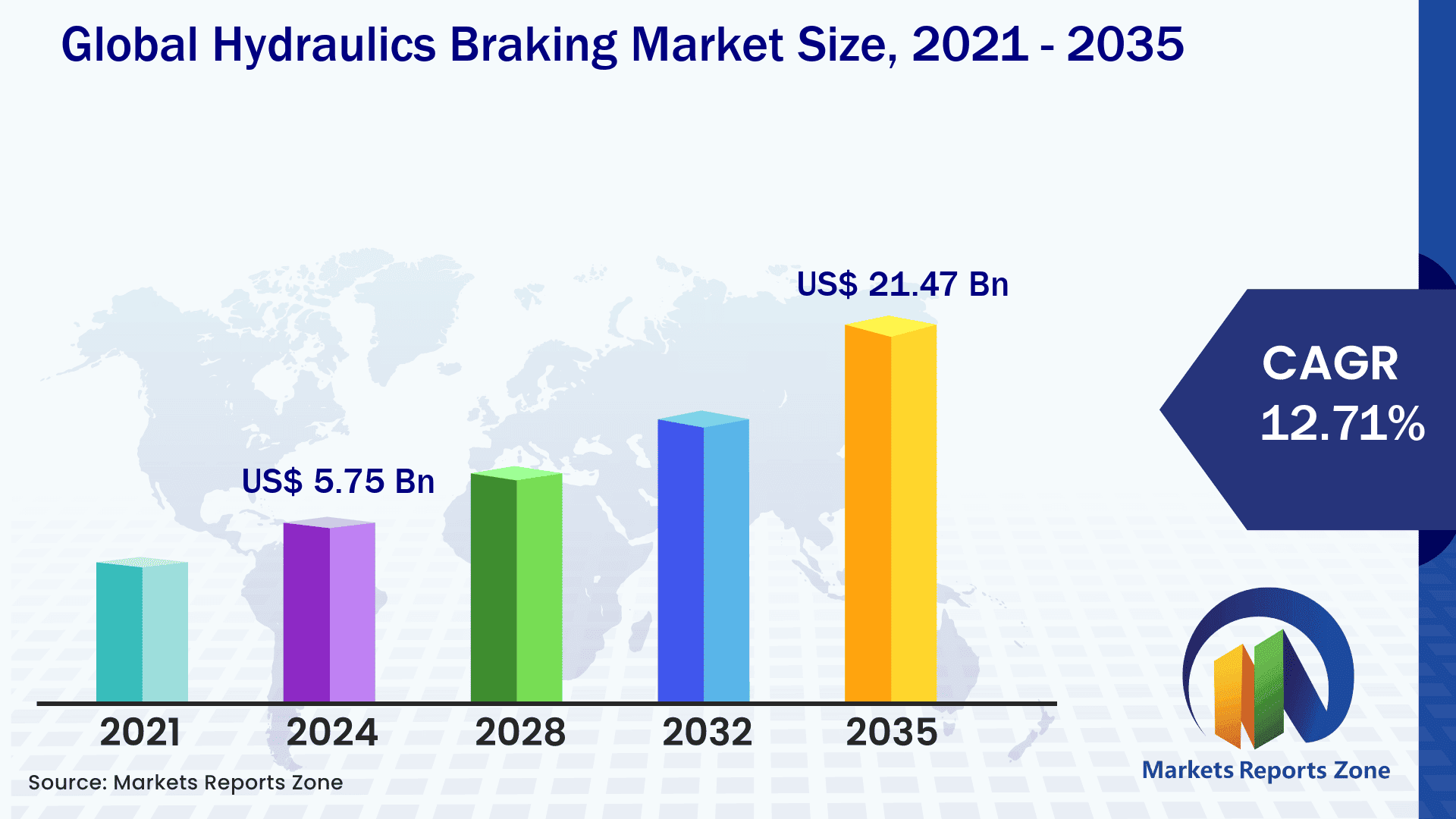
Global Hydraulics Braking Market Size is expected to reach USD 21.47 Billion by 2035 from USD 5.75 Billion in 2024, with a CAGR of around 12.71% between 2024 and 2035. The global hydraulics braking market is driven by increasing vehicle production and stringent safety regulations. More cars and commercial vehicles are being manufactured, boosting the demand for reliable braking systems. Governments worldwide are enforcing strict safety norms, pushing automakers to adopt advanced hydraulic brakes. However, high manufacturing and maintenance costs act as a major restraint. Expensive components and complex systems increase the overall vehicle cost, limiting market growth in price-sensitive regions. Despite this, opportunities exist in the rising adoption of electric vehicles (EVs) and advancements in smart braking technology. EV manufacturers integrate hydraulic braking systems with regenerative braking to enhance efficiency. Additionally, intelligent braking solutions, such as electronic stability control and anti-lock braking systems (ABS), are gaining traction. Real-world examples include Tesla's use of hydraulic brakes in EVs for improved performance. Similarly, Volvo’s advanced braking technology enhances safety in heavy-duty trucks. The demand for hydraulic braking systems is further fueled by growth in the construction and agriculture sectors, where heavy machinery requires efficient braking mechanisms. With continued innovations and increasing safety awareness, the market is expected to expand further. However, cost challenges must be addressed to ensure widespread adoption across all vehicle segments.
Driver: Rising Vehicle Production Boosts Demand
The increasing production of vehicles worldwide is driving the demand for hydraulic braking systems. As more cars, trucks, and two-wheelers hit the roads, the need for efficient and reliable braking technology grows. Automakers focus on safety and performance, making hydraulic brakes a preferred choice due to their superior stopping power. With urbanization and rising disposable incomes, vehicle ownership is increasing, especially in emerging markets. This surge directly impacts the demand for advanced braking systems. In the commercial sector, logistics and e-commerce growth fuel the production of heavy-duty trucks and delivery vans, all requiring robust braking solutions. Companies like Ford and Toyota equip their vehicles with hydraulic braking systems to ensure better control and safety. Additionally, motorcycles from brands like Ducati and Kawasaki integrate advanced hydraulic disc brakes for improved rider security. The expansion of ride-hailing services further contributes to vehicle production, increasing the adoption of high-performance brakes. Even in motorsports, racing cars rely on hydraulic brakes for precision and control at high speeds. As automotive production continues to rise, the hydraulic braking market is set to grow, ensuring safer and more efficient driving experiences across various vehicle categories.
Key Insights:
- Approximately 85% of passenger vehicles worldwide utilize hydraulic braking systems.
-
In 2022, automotive manufacturers collectively invested around $5 billion in the development and enhancement of braking technologies.
-
Over 100 million hydraulic braking units were produced globally in the last fiscal year.
-
The commercial vehicle sector has an 80% penetration rate of hydraulic braking systems.
-
The motorcycle industry reports that 90% of new models are equipped with hydraulic disc brakes.
-
Heavy machinery industries, including construction and agriculture, have adopted hydraulic brakes in 75% of their equipment.
-
Electric vehicle manufacturers have integrated hydraulic braking systems into 70% of their models to ensure optimal safety and performance.
Segment Analysis:
The hydraulic braking market is segmented by type into failsafe and active brakes, each serving crucial safety functions. Failsafe brakes engage automatically in emergencies, preventing accidents in critical situations. These are widely used in commercial vehicles like trucks and buses, where heavy loads require enhanced stopping power. Companies like Mercedes-Benz integrate failsafe braking in their heavy-duty trucks for better control. Active brakes, on the other hand, provide real-time braking adjustments, improving efficiency and performance. Passenger cars, such as those from BMW and Audi, utilize active hydraulic braking systems to enhance safety and driving comfort. By application, commercial vehicles dominate due to the rising demand for logistics and public transportation. Fleet operators rely on hydraulic braking for durability and reliability under heavy usage. Meanwhile, passenger cars are witnessing increased adoption of hydraulic braking due to growing safety regulations and consumer awareness. Modern SUVs and sedans from brands like Hyundai and Honda feature advanced braking systems to prevent collisions and ensure smoother rides. The growing preference for high-performance vehicles further boosts demand for sophisticated hydraulic brakes. With continuous advancements in braking technology, both commercial and passenger segments are poised for significant expansion, ensuring safer mobility across industries.
Regional Analysis:
The global hydraulic braking market shows diverse growth trends across different regions. In North America, stringent safety regulations and rising demand for high-performance vehicles drive adoption. Automakers like General Motors and Ford integrate advanced hydraulic brakes to enhance safety and efficiency. In Europe, the presence of luxury and sports car manufacturers, including Porsche and Ferrari, fuels innovation in braking systems. The shift towards electric and hybrid vehicles further increases the need for reliable hydraulic brakes. Asia-Pacific dominates the market due to massive automotive production in countries like China, Japan, and India. Companies like Tata Motors and Toyota focus on integrating hydraulic braking in both passenger and commercial vehicles to meet growing transportation demands. Latin America sees rising adoption due to increasing vehicle sales and infrastructure development. Brands like Volkswagen manufacture affordable cars with hydraulic braking to cater to middle-class consumers. In the Middle East & Africa, commercial vehicle demand is high, especially in the oil, gas, and construction industries. Companies like Ashok Leyland provide trucks with robust hydraulic braking systems to handle rough terrains and heavy loads. With continuous advancements and regional demand shifts, hydraulic braking technology is expanding across all regions, ensuring safer and more efficient mobility worldwide.
Competitive Scenario:
The hydraulic braking market continues to evolve with advancements from key players. Svendborg is expanding its footprint in industrial braking, focusing on heavy-duty applications like wind energy and mining. Whitedriveproducts enhances hydraulic brake components with improved efficiency, catering to off-highway and agricultural machinery. Continental Automotive is integrating smart braking solutions, combining hydraulic systems with electronic stability controls for modern vehicles. Bepco strengthens its aftermarket presence by supplying high-quality hydraulic brake parts to tractors and heavy equipment. Demco Products has launched innovative trailer braking systems, ensuring better safety in towing applications. W.C. Branham develops compact hydraulic braking solutions for automation and industrial machinery, enhancing precision and durability. EBC Brakes is focusing on high-performance braking solutions, introducing advanced hydraulic disc brake technology for motorcycles and racing vehicles. Hanning & Kahl continues its expertise in rail and public transport braking, integrating energy-efficient hydraulic systems for metro and tram networks. Recent developments include improved material technologies, digital monitoring of braking systems, and the use of eco-friendly hydraulic fluids. As companies push for safer and more efficient braking, innovation remains at the core of market growth, ensuring better performance across automotive, industrial, and transportation sectors.
Hydraulics Braking Market Report Scope
| Report Attribute | Details |
|---|---|
| Market Size Value in 2024 | USD 5.75 Billion |
| Revenue Forecast in 2035 | USD 21.47 Billion |
| Growth Rate | CAGR of 12.71% from 2025 to 2035 |
| Historic Period | 2021 - 2024 |
| Forecasted Period | 2025 - 2035 |
| Report Coverage | Revenue forecast, company ranking, competitive landscape, growth factors, and trends |
| Regions Covered | North America; Europe; Asia Pacific; Latin America; Middle East & Africa |
| Countries Covered | U.S.; Canada; Mexico, UK; Germany; France; Spain; Italy; Russia; China; Japan; India; South Korea; Australia; Southeast Asia; Brazil; Argentina; Saudi Arabia; UAE; South Africa |
| Key companies profiled | Svendborg; Whitedriveproducts; Continental Automotive; Bepco; Demco Products; W.C. Branham; EBC Brakes; Hanning & Kahl |
| Customization | Free report customization (equivalent up to 8 analysts working days) with purchase. Addition or alteration to country, regional & segment scope. |
The Global Hydraulics Braking Market report is segmented as follows:
By Type,
- Failsafe brakes
- Active brakes
By Application,
- Commercial Vehicles
- Passenger Car
By Region,
- North America
- U.S.
- Canada
- Mexico
- Europe
- UK
- Germany
- France
- Spain
- Italy
- Russia
- Rest of Europe
- Asia Pacific
- China
- Japan
- India
- South Korea
- Australia
- Southeast Asia
- Rest of Asia Pacific
- Latin America
- Brazil
- Argentina
- Rest of Latin America
- Middle East & Africa
- Saudi Arabia
- UAE
- South Africa
- Rest of Middle East and Africa
Key Market Players,
- Svendborg
- Whitedriveproducts
- Continental Automotive
- Bepco
- Demco Products
- W.C. Branham
- EBC Brakes
- Hanning & Kahl
Frequently Asked Questions
How big is the Hydraulics Braking market?
Global Hydraulics Braking Market Size was valued at USD 5.75 Billion in 2024 and is projected to reach at USD 21.47 Billion in 2035.
What is the Hydraulics Braking market growth?
Global Hydraulics Braking Market is expected to grow at a CAGR of around 12.71% during the forecasted year.
Which region has the largest market share in Hydraulics Braking market?
North America, Asia Pacific and Europe are major regions in the global Hydraulics Braking Market.
Who are the key players in Hydraulics Braking market?
Key players analyzed in the global Hydraulics Braking Market are Svendborg; Whitedriveproducts; Continental Automotive; Bepco; Demco Products; W.C. Branham; EBC Brakes; Hanning & Kahl and so on.