
Global Hormonal Contraceptive Market - Size and Forecast Analysis, 2021-2035
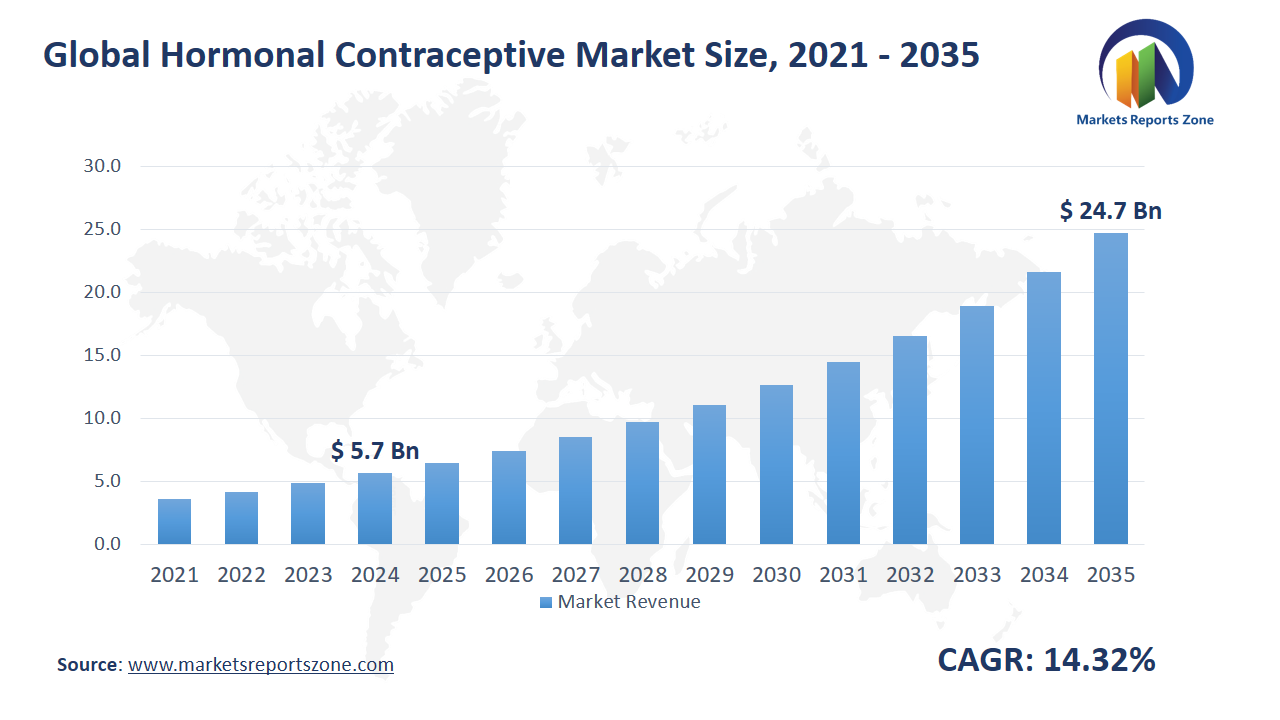
Global Hormonal Contraceptive Market Size is expected to reach USD 24.74 Billion by 2035 from USD 5.67 Billion in 2024, with a CAGR of around 14.32% between 2024 and 2035. Rising awareness of reproductive health has been recognized as a major driver for the hormonal contraceptive market. Access to birth control pills, patches, and implants has been promoted through educational programs and government initiatives. Increased participation of women in the workforce has also boosted demand. Family planning has been prioritized in urban households to balance careers and personal lives. For example, many young couples in South Korea and Brazil have opted for long-acting contraceptives to delay parenthood. However, side effects and health concerns have remained a restraint. Hormonal imbalances, weight gain, and mood swings have been reported by users, which has created hesitancy in adoption. On the other hand, growing availability in rural areas has created new opportunities. Mobile health clinics in parts of Africa and Southeast Asia have introduced hormonal contraceptives to underserved communities. Another opportunity has been found in the development of male hormonal contraceptives. Early trials have been conducted in the U.S. and Europe, showing promising results. Such alternatives have been welcomed by couples looking to share contraceptive responsibilities. With the evolving perception around reproductive choices, demand is expected to rise further. More inclusive health policies and innovations are likely to shape the next wave of hormonal contraceptive adoption
Driver: Empowered Women, Growing Contraceptive Demand
Increased participation of women in the workforce has significantly driven the demand for hormonal contraceptives. With more women building careers and delaying motherhood, the need for effective birth control methods has risen. This shift is not just seen in major metropolitan cities but also in smaller urban clusters where women are entering fields traditionally dominated by men. For instance, in tech hubs like Bangalore and Dublin, young professionals are opting for birth control pills and hormonal IUDs to better align family planning with career goals. Similarly, in industries like hospitality and aviation, where irregular schedules are common, women have relied on hormonal patches and implants to avoid pregnancy while managing demanding routines. The ability to plan pregnancies around career milestones has allowed many to pursue higher education, leadership roles, and global job opportunities without compromise. Supportive workplace cultures and access to healthcare through employer-provided insurance have further fueled this trend. As society continues to evolve toward gender equality, the role of hormonal contraceptives is becoming more central to women's autonomy. The demand is no longer seen as a health choice alone, but as a critical tool in economic empowerment and life planning for millions of women around the world.
Key Insights:
The adoption rate of hormonal contraceptives among sexually active young women in the U.S. is approximately 80%, reflecting their widespread use for family planning.
In 2023, the U.S. government invested around $50 million in initiatives aimed at improving access to reproductive health services, including hormonal contraceptives.
The total number of hormonal contraceptive prescriptions filled globally reached approximately 100 million in 2024.
The penetration rate of hormonal contraceptives in the healthcare sector is estimated to be about 70%, driven by their effectiveness and accessibility.
Major pharmaceutical companies have collectively invested over $500 million in research and development for advanced hormonal contraceptive formulations over the past three years.
The average annual growth rate for hormonal contraceptive prescriptions has been reported at around 4% since 2022.
By the end of 2024, the cumulative number of women using hormonal contraceptives worldwide is expected to exceed 500 million.
The use of hormonal contraceptives in managing menstrual health issues accounts for approximately 30% of their total applications, highlighting their broader health benefits beyond family planning.
Segment Analysis:
The hormonal contraceptive market has evolved across type and application segments, offering greater flexibility and control. Oral contraceptive pills remain widely used due to their ease of use and accessibility. Young adults in college towns and urban areas often prefer them for routine birth control, with family doctors frequently recommending them during general check-ups. Injectable birth control has been favored in rural clinics where access to monthly prescriptions is limited. In regions like sub-Saharan Africa and parts of Southeast Asia, community health workers administer injections as part of outreach programs. Emergency contraceptive pills are frequently used in situations where regular methods fail or are missed, with pharmacies in busy city centers reporting high demand during weekends and holidays. Vaginal rings and transdermal patches offer longer-term convenience and are increasingly adopted by working women and new mothers seeking discreet options with minimal daily involvement. In terms of application, hospitals remain essential for initial prescriptions, especially for injectables and first-time users requiring guidance. However, household use is rapidly growing, driven by telehealth services and e-commerce pharmacies delivering products directly to homes. This trend has allowed busy professionals and remote area residents to manage contraception with privacy and ease, making the segment highly adaptive to modern lifestyles.
Regional Analysis:
The hormonal contraceptive market shows varied dynamics across regions, shaped by cultural norms, healthcare access, and government support. In North America, wide insurance coverage and education programs have boosted usage, especially among young adults. Women in suburban areas often subscribe to online services delivering monthly pills discreetly. In Europe, support from national healthcare systems has led to increased adoption of newer methods like vaginal rings and patches. Countries like Sweden and the Netherlands encourage school-level awareness, leading to informed decisions early on. In Asia-Pacific, rising awareness in countries like India and the Philippines is driving demand, with injectable contraceptives being preferred in low-income rural belts due to fewer visits required. In Latin America, the market is expanding through community health initiatives. In Brazil and Colombia, public clinics promote emergency contraceptives during outreach campaigns, targeting underserved communities. Meanwhile, in the Middle East & Africa, the market remains fragmented. Cultural resistance slows growth in some areas, but NGOs and public health drives have started making an impact, especially in urban centers of Kenya and South Africa. Here, contraceptives are integrated into broader maternal health programs, making access easier for young mothers. These regional patterns underline how accessibility, policy, and social attitudes define growth paths in this market.
Competitive Scenario:
The hormonal contraceptive market has experienced notable advancements driven by key industry players focusing on innovation and accessibility. Bayer AG has expanded its digital health initiatives to enhance patient access and support for hormonal contraceptive users. Merck & Co. has introduced a new hormonal contraceptive pill offering extended cycle options for improved convenience and effectiveness. Pfizer Inc. has launched a new hormonal intrauterine device (IUD) with advanced features and a longer duration of contraceptive protection. Teva Pharmaceutical Industries has expanded its portfolio to include hormonal contraceptive patches, providing women with more choices for contraception. Afaxys, Inc. has introduced a low-dose oral contraceptive aimed at offering effective birth control with fewer side effects. Organon Group has acquired rights to Mercilon and Marvelon, combined oral hormonal daily contraceptive pills, to enhance its product offerings in specific regions. These developments reflect a collective industry effort to provide innovative and accessible contraceptive solutions, empowering individuals with effective tools for reproductive health management.
Hormonal Contraceptive Market Report Scope
| Report Attribute | Details |
|---|---|
| Market Size Value in 2024 | USD 5.67 Billion |
| Revenue Forecast in 2035 | USD 24.74 Billion |
| Growth Rate | CAGR of 14.32% from 2025 to 2035 |
| Historic Period | 2021 - 2024 |
| Forecasted Period | 2025 - 2035 |
| Report Coverage | Revenue forecast, company ranking, competitive landscape, growth factors, and trends |
| Regions Covered | North America; Europe; Asia Pacific; Latin America; Middle East & Africa |
| Countries Covered | U.S.; Canada; Mexico, UK; Germany; France; Spain; Italy; Russia; China; Japan; India; South Korea; Australia; Southeast Asia; Brazil; Argentina; Saudi Arabia; UAE; South Africa |
| Key companies profiled | Ansell Limited; Bayer AG; Church & Dwight Co; Johnson & Johnson; Mayer Laboratories; Merck & Co; Mylan N.V.; Pfizer; Teva Pharmaceutical Industries; The Female Health Company; Organon International; Afaxys |
| Customization | Free report customization (equivalent up to 8 analysts working days) with purchase. Addition or alteration to country, regional & segment scope. |
The Global Hormonal Contraceptive Market report is segmented as follows:
By Type,
- Oral Contraceptive Pills
- Injectable Birth Control
- Emergency Contraceptive Pills
- Vaginal Rings
- Transdermal Patches
By Application,
- Hospitals
- Household
By Region,
- North America
- U.S.
- Canada
- Mexico
- Europe
- UK
- Germany
- France
- Spain
- Italy
- Russia
- Rest of Europe
- Asia Pacific
- China
- Japan
- India
- South Korea
- Australia
- Southeast Asia
- Rest of Asia Pacific
- Latin America
- Brazil
- Argentina
- Rest of Latin America
- Middle East & Africa
- Saudi Arabia
- UAE
- South Africa
- Rest of Middle East and Africa
Key Market Players,
- Ansell Limited
- Bayer AG
- Church & Dwight Co
- Johnson & Johnson
- Mayer Laboratories
- Merck & Co
- Mylan N.V.
- Pfizer
- Teva Pharmaceutical Industries
- The Female Health Company
- Organon International
- Afaxys
Frequently Asked Questions
How big is the Hormonal Contraceptive market?
Global Hormonal Contraceptive Market Size was valued at USD 5.67 Billion in 2024 and is projected to reach at USD 24.74 Billion in 2035.
What is the Hormonal Contraceptive market growth?
Global Hormonal Contraceptive Market is expected to grow at a CAGR of around 14.32% during the forecasted year.
Which region has the largest market share in Hormonal Contraceptive market?
North America, Asia Pacific and Europe are major regions in the global Hormonal Contraceptive Market.
Who are the key players in Hormonal Contraceptive market?
Key players analyzed in the global Hormonal Contraceptive Market are Ansell Limited; Bayer AG; Church & Dwight Co; Johnson & Johnson; Mayer Laboratories; Merck & Co; Mylan N.V.; Pfizer; Teva Pharmaceutical Industries; The Female Health Company; Organon International; Afaxys and so on.