
Global Heart Catheterization Market - Size and Forecast Analysis, 2021-2035
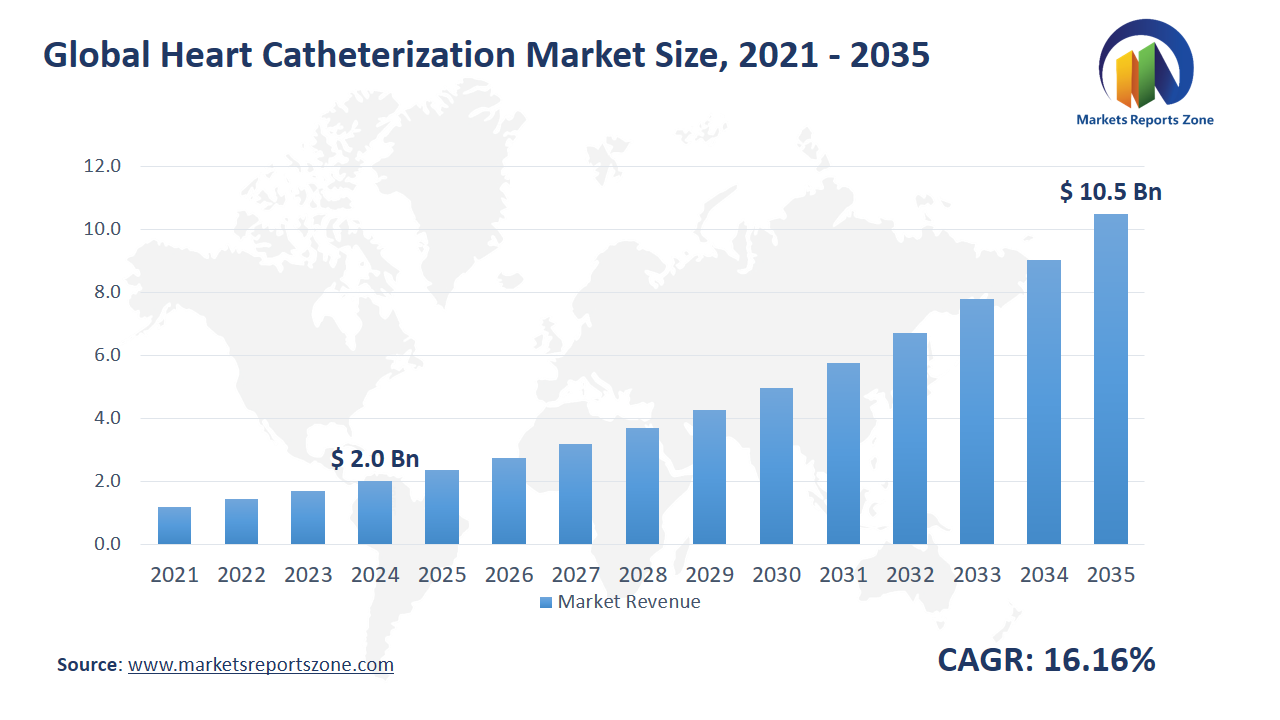
Global Heart Catheterization Market Size is expected to reach USD 10.5 Billion by 2035 from USD 2.02 Billion in 2024, with a CAGR of around 16.16% between 2024 and 2035. The global heart catheterization market has been driven by the increasing prevalence of cardiovascular diseases and advancements in catheterization techniques. As heart conditions have become more common, the need for diagnostic and therapeutic procedures has risen. Minimally invasive techniques have been preferred for their reduced recovery times. However, high costs associated with these procedures have restrained widespread adoption, especially in regions with limited healthcare funding. Despite this, opportunities have emerged with the integration of telemedicine and remote monitoring, allowing for better patient management post-procedure. Additionally, emerging markets have presented growth potential as healthcare infrastructures improve. For instance, in India, the expansion of cardiac care centers has facilitated access to catheterization services for rural populations. Similarly, in Brazil, public health initiatives have increased the availability of heart catheterization in government hospitals, addressing the needs of underserved communities
Driver: Rising Heart Disease Drives Demand
One major driver of the heart catheterization market has been the growing burden of cardiovascular diseases worldwide. As lifestyles have shifted toward increased sedentary behavior and diets high in fat and sugar, heart-related conditions have surged. This rise has led to greater demand for timely diagnosis and treatment, with catheterization becoming a central part of cardiac care. The procedure allows doctors to assess blocked arteries, valve defects, or heart function with minimal invasiveness. In the UK, a middle-aged man experiencing chest tightness underwent a quick catheterization that revealed a 90% blockage, leading to an immediate intervention that likely prevented a heart attack. In Japan, elderly patients with irregular heartbeat have been routinely monitored and treated using catheter-based techniques, avoiding open-heart surgery and reducing recovery times. Hospitals have increasingly prioritized these methods for their accuracy and safety. Even in regions with advanced healthcare systems, catheterization has remained vital for both emergency and preventive care. As awareness campaigns continue to stress the importance of early detection, more people are being referred for catheter-based diagnostics. With heart disease still leading global health concerns, the need for efficient and minimally invasive solutions like catheterization is only expected to rise further in the years ahead.
Key Insights:
The adoption rate of heart catheterization procedures in the management of coronary artery disease is approximately 50% among eligible patients globally.
In 2023, the U.S. government allocated around $30 million for research initiatives aimed at improving cardiac catheterization techniques and outcomes.
The total number of cardiac catheterizations performed worldwide reached approximately 2.5 million procedures in 2024.
The penetration rate of cardiac catheterization in the diagnosis of structural heart diseases is estimated to be about 70%.
Major medical device companies have collectively invested over $500 million in developing advanced catheterization systems over the past three years.
The average annual growth rate for cardiac catheterization procedures has been reported at around 5% since 2022.
By the end of 2024, the cumulative number of catheterization labs worldwide is expected to exceed 10,000 facilities.
The use of cardiac catheterization in emergency settings accounts for approximately 40% of all procedures, highlighting its critical role in urgent care.
Segment Analysis:
The heart catheterization market includes various catheter types such as angiography, guiding, pulmonary artery, PTCA balloon, and IVUS catheters, each used across diagnosis, treatment, and monitoring. Angiography catheters have been widely used to visualize coronary blockages, especially in patients with unclear chest pain. A patient in Germany underwent an angiography that revealed subtle narrowing missed in non-invasive scans. Guiding catheters have supported stent placements by providing stability and access to complex vascular paths, especially in multi-vessel disease cases. In Singapore, a cardiac team used a guiding catheter to place two overlapping stents in a narrow artery bend. Pulmonary artery catheters have been used in critical care to monitor heart function in real time, especially after major surgeries. In Canada, a post-bypass patient was closely monitored using a pulmonary catheter to detect pressure changes. PTCA balloon catheters have played a major role in reopening blocked arteries without surgery. In South Africa, a patient with a heart attack received emergency angioplasty using a balloon catheter within an hour of arrival. IVUS catheters have offered detailed imaging from inside arteries, helping guide complex interventions. For monitoring and follow-up, all catheter types have helped track healing and detect complications early, improving patient recovery and reducing long-term risks.
Regional Analysis:
The heart catheterization market has shown varied trends across North America, Europe, Asia-Pacific, Latin America, and the Middle East & Africa, shaped by regional healthcare infrastructure and disease burden. In North America, early adoption of advanced catheter technologies has been seen, with hybrid cath labs enabling quicker transitions between diagnosis and treatment. In a U.S. hospital, a patient was diagnosed with coronary artery disease and treated in the same session using balloon catheterization. Europe has prioritized patient safety and quality care, with many public hospitals integrating intravascular ultrasound for precise imaging. A clinic in Sweden used IVUS to tailor a stent size to a patient’s artery, avoiding repeat procedures. Asia-Pacific has experienced a rapid surge in cardiac cases, prompting increased use of angiography and guiding catheters. In a busy hospital in the Philippines, mobile cath labs were introduced to bring diagnostics to remote areas. Latin America has emphasized affordability and public access, with government-run facilities offering PTCA procedures. In Mexico, a retired teacher received a subsidized angioplasty after diagnosis through a local outreach program. In the Middle East & Africa, rising private investments have enabled growth. In the UAE, a private cardiac center treated a stroke patient with catheter-based clot retrieval, improving survival rates dramatically.
Competitive Scenario:
In the dynamic heart catheterization market, leading companies have recently introduced significant innovations and faced regulatory challenges. Abbott has initiated clinical studies for its Volt™ PFA System and TactiFlex™ Duo Ablation Catheter, aiming to enhance atrial fibrillation treatments with advanced pulsed field ablation technologies. Additionally, Abbott received FDA clearance for the Advisor™ HD Grid X Mapping Catheter, improving cardiac mapping precision. Boston Scientific expanded its FARAPULSE™ Pulsed Field Ablation System by launching the FARAWAVE™ NAV Ablation Catheter and FARAVIEW™ Software, integrating navigation and visualization capabilities to streamline ablation procedures. However, Boston Scientific faced a Class I recall of its POLARx Cryoablation Balloon Catheters due to reports of serious esophageal injuries. Teleflex broadened its interventional cardiology portfolio with FDA clearance of the Ringer™ Perfusion Balloon Catheter, designed to maintain coronary blood flow during prolonged inflations. The company also launched the Arrow™ VPS Rhythm™ DLX Device and NaviCurve™ Stylet in Canada, enhancing PICC insertion procedures. Conversely, Teleflex encountered a Class I recall of its intra-aortic balloon catheter kits due to potential overtwisting issues. These developments underscore the industry's commitment to advancing cardiac care through innovation while navigating regulatory landscapes.
Heart Catheterization Market Report Scope
| Report Attribute | Details |
|---|---|
| Market Size Value in 2024 | USD 2.02 Billion |
| Revenue Forecast in 2035 | USD 10.5 Billion |
| Growth Rate | CAGR of 16.16% from 2025 to 2035 |
| Historic Period | 2021 - 2024 |
| Forecasted Period | 2025 - 2035 |
| Report Coverage | Revenue forecast, company ranking, competitive landscape, growth factors, and trends |
| Regions Covered | North America; Europe; Asia Pacific; Latin America; Middle East & Africa |
| Countries Covered | U.S.; Canada; Mexico, UK; Germany; France; Spain; Italy; Russia; China; Japan; India; South Korea; Australia; Southeast Asia; Brazil; Argentina; Saudi Arabia; UAE; South Africa |
| Key companies profiled | Boston Scientific; Cordis(Cardinal health); Abbott; BBRAUN; Medtronic; Terumo; Teleflex; C. R. Bard; Edwards; Cook; Merit Medical; Biotronik; St.Jude Medical; BALT; Osypka AG; Japan Lifeline; ACT; Lepu; Microport; SCW Medicath |
| Customization | Free report customization (equivalent up to 8 analysts working days) with purchase. Addition or alteration to country, regional & segment scope. |
The Global Heart Catheterization Market report is segmented as follows:
By Type,
- Angiography Catheters
- Guiding Catheters
- Pulmonary Artery Catheters
- PTCA Balloon Catheters
- Intravascular Ultrasound (IVUS) Catheters
By Application,
- Diagnosis
- Treatment
- Monitor
By Region,
- North America
- U.S.
- Canada
- Mexico
- Europe
- UK
- Germany
- France
- Spain
- Italy
- Russia
- Rest of Europe
- Asia Pacific
- China
- Japan
- India
- South Korea
- Australia
- Southeast Asia
- Rest of Asia Pacific
- Latin America
- Brazil
- Argentina
- Rest of Latin America
- Middle East & Africa
- Saudi Arabia
- UAE
- South Africa
- Rest of Middle East and Africa
Key Market Players,
- Boston Scientific
- Cordis(Cardinal health)
- Abbott
- BBRAUN
- Medtronic
- Terumo
- Teleflex
- C. R. Bard
- Edwards
- Cook
- Merit Medical
- Biotronik
- St.Jude Medical
- BALT
- Osypka AG
- Japan Lifeline
- ACT
- Lepu
- Microport
- SCW Medicath
Frequently Asked Questions
How big is the Heart Catheterization market?
Global Heart Catheterization Market Size was valued at USD 2.02 Billion in 2024 and is projected to reach at USD 10.5 Billion in 2035.
What is the Heart Catheterization market growth?
Global Heart Catheterization Market is expected to grow at a CAGR of around 16.16% during the forecasted year.
Which region has the largest market share in Heart Catheterization market?
North America, Asia Pacific and Europe are major regions in the global Heart Catheterization Market.
Who are the key players in Heart Catheterization market?
Key players analyzed in the global Heart Catheterization Market are Boston Scientific; Cordis(Cardinal health); Abbott; BBRAUN; Medtronic; Terumo; Teleflex; C. R. Bard; Edwards; Cook; Merit Medical; Biotronik; St.Jude Medical; BALT; Osypka AG; Japan Lifeline; ACT; Lepu; Microport; SCW Medicath and so on.