
Global Embedded Software Market - Size and Forecast Analysis, 2021-2035
The Global Embedded Software Market size was valued at USD 19.46 Billion in 2024 and is projected to reach USD 46.15 Billion by 2033 at a CAGR of around 10.07% between 2024 and 2033. The global embedded software market is driven by the rising adoption of IoT devices and the increasing demand for automation. IoT integration in smart homes, wearables, and industrial applications has expanded. Automation in automotive, healthcare, and manufacturing has also increased. However, security vulnerabilities in embedded systems act as a major restraint. Cyber threats pose risks to sensitive data and system operations. Despite this, opportunities exist in AI-powered embedded solutions and the growth of 5G networks. AI integration enhances decision-making in automotive, robotics, and healthcare devices. 5G enables faster data transmission, improving real-time embedded applications.
In real life, IoT-based embedded software is used in smart thermostats, improving energy efficiency. Automated driver assistance systems (ADAS) in vehicles rely on embedded software for real-time decision-making. Security risks have been highlighted in medical devices, where hacking threats can compromise patient safety. AI-driven medical imaging systems utilize embedded software to detect diseases faster. The rollout of 5G has enabled smart city projects with embedded applications in traffic management and public safety. As industries advance, embedded software innovation continues to shape connectivity, intelligence, and automation in everyday life. The market remains dynamic, with continuous technological advancements driving future growth.

Driver: IoT Boom Transforming Embedded Software
The rising adoption of IoT devices has fueled the growth of embedded software. Everyday objects are becoming smarter with interconnected systems. Home appliances, industrial machines, and medical equipment now rely on embedded software for seamless functionality. Smart refrigerators track groceries and suggest shopping lists. Wearable fitness trackers monitor health metrics in real time. In industrial settings, predictive maintenance systems use embedded software to detect equipment failures before they occur. Smart farming solutions utilize IoT-powered embedded software to optimize irrigation and crop health. In the healthcare sector, remote patient monitoring devices continuously collect vital signs, improving diagnosis accuracy.
Retail stores use smart shelves with embedded sensors to track inventory automatically. Even public transportation benefits, with smart ticketing systems ensuring smooth passenger flow. The demand for embedded software rises as businesses and consumers seek efficiency. IoT-driven automation minimizes human intervention and reduces errors. As cities move towards smart infrastructure, embedded software plays a critical role in managing energy consumption, traffic flow, and public services. With new IoT innovations emerging daily, the embedded software market is set for rapid growth. This technology continues to revolutionize industries, making life smarter, safer, and more efficient.
Key Insights:
- The global adoption rate of embedded software in automotive electronic control units (ECUs) has surpassed 80%, driven by advancements in autonomous and electric vehicles.
- Investment in embedded software by leading semiconductor companies exceeded $5 billion in the last fiscal year, focusing on AI-driven and IoT-enabled systems.
- Governments worldwide have allocated over $2 billion in funding for embedded system R&D, particularly for defense, healthcare, and smart city applications.
- The penetration of embedded software in industrial automation has crossed 70%, enabling robotics, predictive maintenance, and real-time monitoring.
- The annual production of embedded microcontrollers, essential for embedded software applications, has exceeded 30 billion units, reflecting strong demand across industries.
- The consumer electronics industry integrates embedded software in over 90% of smart home devices, wearables, and connected appliances.
- The adoption of embedded software in medical devices has risen to 60%, enhancing remote monitoring, diagnostics, and surgical robotics.
- The embedded software market in aerospace and defense has seen investments exceeding $3 billion, focusing on avionics, autonomous drones, and secure communication systems.
Segment Analysis:
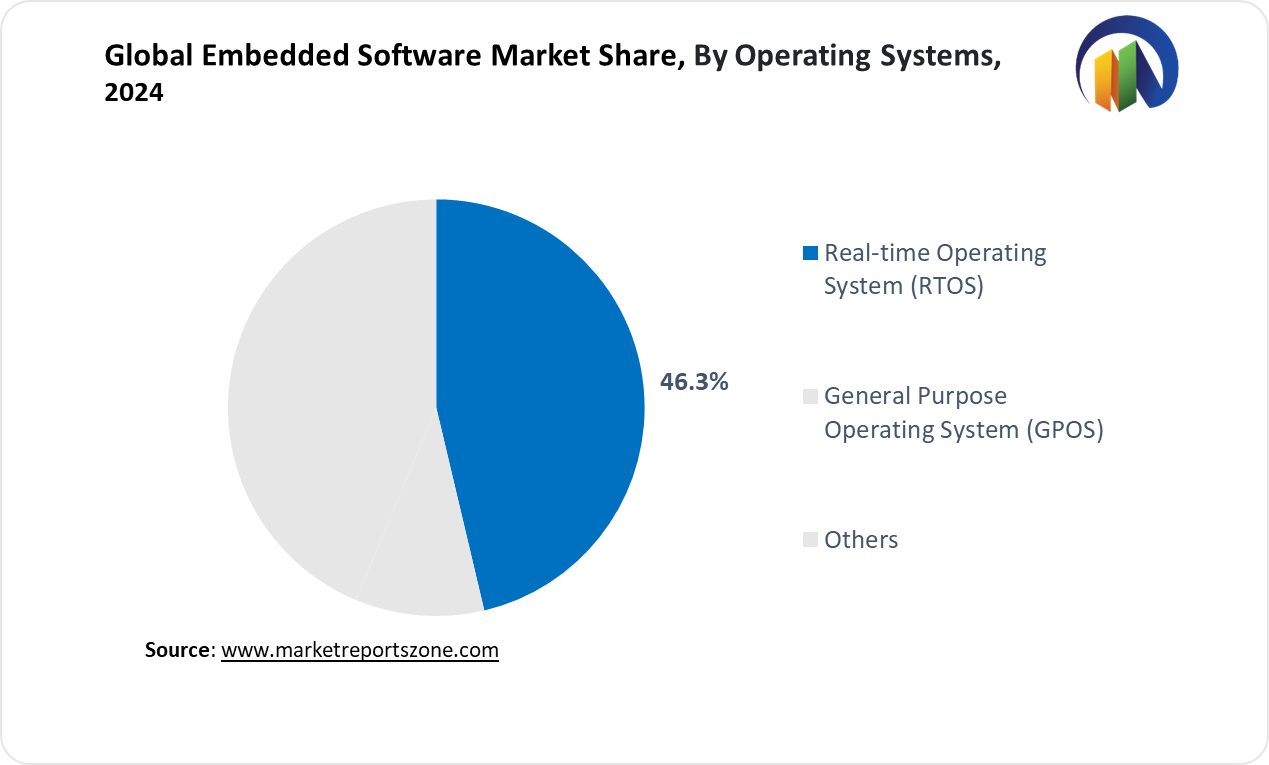
The global embedded software market is segmented by operating systems, functions, and applications, each playing a crucial role in modern technology. Real-time operating systems (RTOS) dominate industries requiring precision, such as automotive and healthcare, where real-time data processing is critical. General-purpose operating systems (GPOS) power consumer electronics like smart TVs and gaming consoles, ensuring smooth user experiences. Standalone systems function independently, seen in digital cameras and washing machines. Real-time systems operate with strict timing constraints, as used in anti-lock braking systems (ABS) in cars. Network systems support connected devices, enabling smart grids for efficient energy distribution. Mobile systems drive smartphones and tablets, enhancing connectivity and app performance.
Automotive applications rely on embedded software for engine control, infotainment, and self-driving features. Consumer electronics, including voice assistants and smart speakers, integrate advanced embedded solutions for seamless operations. Manufacturing benefits from automated robotic arms that improve production efficiency. Healthcare applications include insulin pumps and pacemakers, ensuring patient safety. Military and defense leverage embedded software in radar systems and unmanned aerial vehicles (UAVs) for surveillance. IT and telecom rely on embedded software for 5G infrastructure and network security. Across industries, embedded software continues to innovate, driving automation, intelligence, and efficiency.
Regional Analysis:
he embedded software market is growing across all major regions, driven by technological advancements and industry demands. North America leads in innovation, with strong adoption in autonomous vehicles and aerospace. Self-driving trucks in logistics use embedded software for navigation and obstacle detection. Europe focuses on industrial automation and smart manufacturing, where embedded software powers robotic assembly lines in automotive plants. Asia-Pacific sees rapid growth due to high consumer electronics demand, with smart air conditioners and AI-powered washing machines relying on embedded software for energy efficiency.
Latin America is expanding in telecom and healthcare, where smart meters help optimize electricity usage, and digital health kiosks assist in remote medical diagnostics. The Middle East & Africa are investing in smart infrastructure, with embedded software enabling intelligent traffic management in major cities and automated irrigation systems in agriculture. Across all regions, governments and industries invest in R&D to enhance embedded technology capabilities. Advancements in AI, IoT, and 5G further accelerate adoption. Companies continuously develop new embedded solutions to improve efficiency and automation. As industries evolve, embedded software remains a fundamental component of innovation, driving seamless connectivity, smart functionality, and improved operational performance worldwide.
Competition Landscape:
Leading companies in the embedded software market continue to drive innovation across industries with cutting-edge advancements. Green Hills Software enhances real-time operating systems for aerospace and automotive safety. HCL expands embedded solutions for industrial automation and connected healthcare. IBM integrates AI-driven embedded software into smart manufacturing and edge computing. Infineon advances automotive embedded security, ensuring safe EV and ADAS operations. Intel develops next-generation embedded processors, improving performance in IoT and AI applications. Intellias accelerates automotive software development, supporting autonomous vehicle projects. Microchip Technology enhances embedded controllers for industrial and consumer electronics. Microsoft strengthens IoT-based embedded software for cloud-connected devices.
National Instruments optimizes embedded software for automated testing in aerospace and telecom. NXP Semiconductors pushes automotive and industrial automation with secure embedded solutions. Renesas Electronics advances embedded AI in robotics and smart infrastructure. Siemens enhances industrial automation with embedded software for digital twin technology. STMicroelectronics innovates embedded microcontrollers for medical devices and energy-efficient systems. Texas Instruments drives embedded solutions for EVs and renewable energy. Wind River Systems strengthens real-time embedded OS for mission-critical applications. Companies continue expanding R&D, partnerships, and acquisitions to meet rising demand, ensuring embedded software remains vital for technological evolution.
Embedded Software Market Report Scope
| Report Attribute | Details |
|---|---|
| Market Size Value in 2024 | USD 19.46 Billion |
| Revenue Forecast in 2033 | USD 46.15 Billion |
| Growth Rate | CAGR of 10.07% from 2025 to 2033 |
| Historic Period | 2021 - 2024 |
| Forecasted Period | 2025 - 2033 |
| Report Coverage | Revenue forecast, company ranking, competitive landscape, growth factors, and trends |
| Regions Covered | North America; Europe; Asia Pacific; Latin America; Middle East & Africa |
| Countries Covered | U.S.; Canada; Mexico, UK; Germany; France; Spain; Italy; Russia; China; Japan; India; South Korea; Australia; Southeast Asia; Brazil; Argentina; Saudi Arabia; UAE; South Africa |
| Key companies profiled | Green Hills Software; HCL; IBM; Infineon; Intel; Intellias; Microchip Technology; Microsoft; National Instruments; NXP Semiconductors; Renesas Electronics; Siemens; STMicroelectronics; Texas Instruments; Wind River Systems; Others |
| Customization | Free report customization (equivalent up to 8 analysts working days) with purchase. Addition or alteration to country, regional & segment scope. |
The Global Embedded Software Market report is segmented as follows:
By Operating Systems,
- Real-time Operating System (RTOS)
- General Purpose Operating System (GPOS)
- Others
By Functions,
- Standalone System
- Real-time System
- Network System
- Mobile System
By Application,
- Automotive
- Consumer Electronics
- Manufacturing
- Healthcare
- Military & Defense
- IT & Telecom
- Others
By Region,
- North America
- U.S.
- Canada
- Mexico
- Europe
- UK
- Germany
- France
- Spain
- Italy
- Russia
- Rest of Europe
- Asia Pacific
- China
- Japan
- India
- South Korea
- Australia
- Southeast Asia
- Rest of Asia Pacific
- Latin America
- Brazil
- Argentina
- Rest of Latin America
- Middle East & Africa
- Saudi Arabia
- UAE
- South Africa
- Rest of Middle East & Africa
Key Market Players,
- Green Hills Software
- HCL
- IBM
- Infineon
- Intel
- Intellias
- Microchip Technology
- Microsoft
- National Instruments
- NXP Semiconductors
- Renesas Electronics
- Siemens
- STMicroelectronics
- Texas Instruments
- Wind River Systems
- Others
Frequently Asked Questions
How big is the Embedded Software market?
The Global Embedded Software Market size was valued at USD 19.46 Billion in 2024 and is projected to reach USD 46.15 Billion by 2033.
What is the Embedded Software market growth?
The Global Embedded Software Market is expected to grow at a compounded annual growth rate of 10.07% between 2024 and 2033.
Which region has the largest market share in Embedded Software market?
he North America holds the largest market share in the global Embedded Software Market in 2024.
Who are the key players in Embedded Software market?
Key players profiled in the global Embedded Software market are Green Hills Software; HCL; IBM; Infineon; Intel; Intellias; Microchip Technology; Microsoft; National Instruments; NXP Semiconductors; Renesas Electronics; Siemens; STMicroelectronics; Texas Instruments; Wind River Systems; Others.