
Global Data Center Blade Server Market - Size and Forecast Analysis, 2021-2035
The Global Data Center Blade Server Market size was valued at USD 18.56 Billion in 2024 and is projected to reach USD 42.81 Billion by 2033 at a CAGR of around 9.73% between 2024 and 2033. The global data center blade server market is driven by rising cloud adoption and growing demand for energy-efficient solutions. Cloud service providers deploy blade servers to optimize space and power usage. Enterprises shift workloads to hybrid cloud environments, boosting blade server adoption. However, high initial investment acts as a restraint. Businesses hesitate due to expensive hardware and setup costs. Despite this, two major opportunities exist. First, edge computing growth is increasing demand for compact and high-performance blade servers. Telecom companies integrate these servers for low-latency applications like autonomous vehicles and smart cities. Second, AI and big data analytics require high-density computing, creating demand for blade servers with advanced GPU integration.
Financial institutions use them for real-time fraud detection and predictive analytics. Major players continuously innovate to enhance efficiency and processing power. Hyperscalers expand data centers, further driving market growth. Sustainability concerns push manufacturers to develop energy-efficient blade servers. Governments incentivize green IT infrastructure, accelerating adoption. As digital transformation accelerates, demand for high-performance computing increases. The healthcare sector also relies on blade servers for AI-driven diagnostics and patient data management. While cost remains a challenge, advancements in modular server technology reduce expenses over time, making adoption more feasible across industries.

Driver: Cloud Adoption Fueling Blade Server Growth
The rise of cloud computing is driving demand for blade servers in data centers. Businesses are shifting operations to the cloud to improve scalability and efficiency. Blade servers, known for their compact design and high processing power, are essential for cloud infrastructure. Companies like e-commerce giants deploy these servers to handle millions of transactions daily. Streaming platforms use them to deliver seamless video content worldwide. Cloud gaming services rely on them for low-latency gameplay experiences. Startups and enterprises prefer hybrid cloud models, integrating blade servers for workload management.
Government agencies store vast amounts of citizen data on cloud-based blade servers for security and accessibility. Educational institutions run virtual learning platforms efficiently using these servers. Social media companies use them to process and store user-generated content at massive scales. Airlines depend on cloud-powered blade servers for real-time flight scheduling and ticketing systems. Businesses leverage private cloud setups with blade servers for enhanced data security and compliance. The demand is further accelerated by increasing digital services and remote work adoption. As cloud infrastructure expands, blade servers remain a critical component, ensuring speed, reliability, and seamless connectivity across industries. Their role in supporting digital transformation makes them indispensable for modern enterprises.
Key Insights:
- A major telecommunications provider reported a 30% increase in blade server deployments for edge computing initiatives in their annual report.
- Government infrastructure projects allocated $500 million towards data center upgrades, including blade server installations, as per their annual budget.
- An industry association noted a 25% adoption rate of blade servers in financial institutions for high-frequency trading.
- A large cloud service provider's annual report indicated the deployment of several thousand blade server units for their expanded data center footprint.
- The healthcare sector showed a 15% penetration rate of blade servers for managing electronic health records, according to hospital association data.
- A technology hardware company disclosed a 40% rise in blade server shipments to research and development facilities in their annual report.
- Educational institutions reported a 20% increase in blade server usage for high-performance computing clusters in their annual reports.
Segment Analysis:
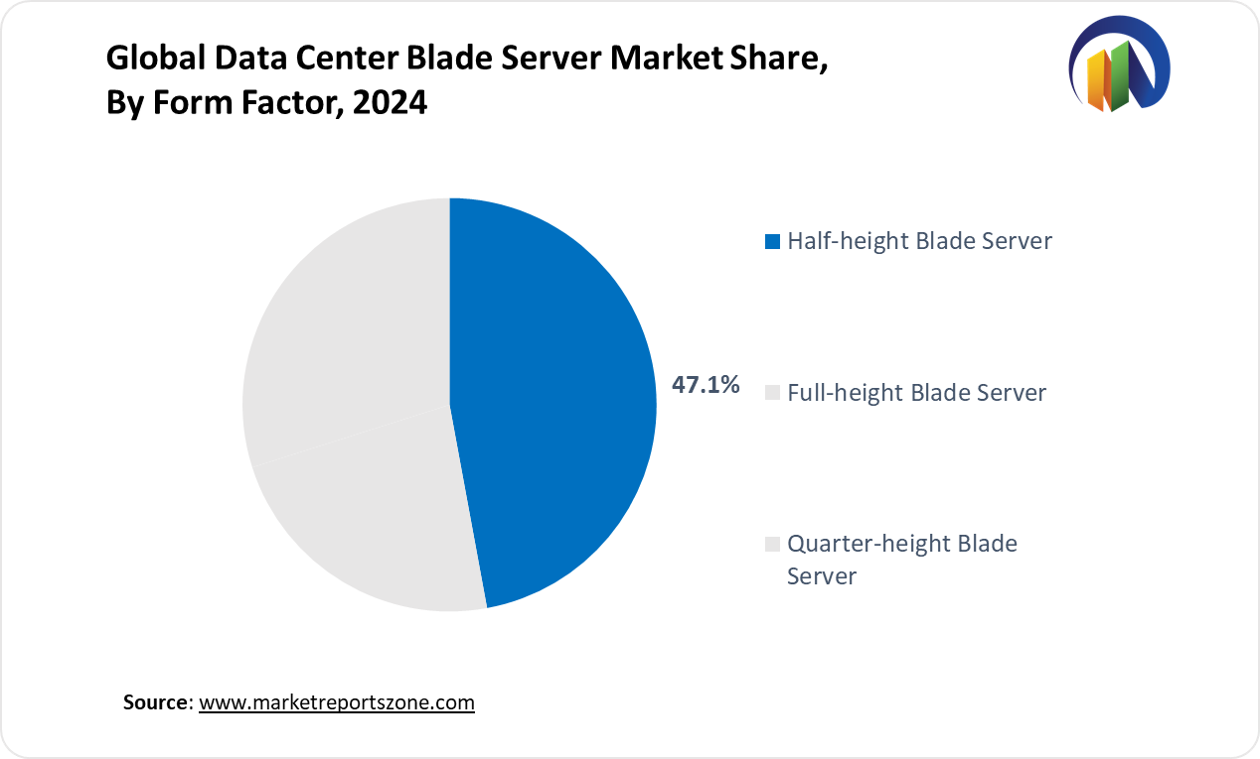
The data center blade server market is diverse, segmented by form factor, channel, application, and end-use. Half-height blade servers are widely used in enterprises for balanced performance and space efficiency. Full-height variants are preferred in AI-driven workloads, such as deep learning models used by pharmaceutical companies for drug discovery. Quarter-height servers find application in edge computing, enabling low-latency processing for autonomous vehicle networks. Direct sales dominate large-scale deployments, while resellers and system integrators cater to mid-sized businesses looking for customized solutions. In applications, virtualization and cloud computing drive demand as e-learning platforms scale their infrastructure.
High-performance computing supports scientific research, with meteorological organizations using blade servers for climate modeling. Storage and backup remain crucial, with media firms archiving vast digital content libraries. Web hosting providers depend on these servers for seamless online platform management. Database management sees adoption in retail for real-time inventory tracking. AI and machine learning workloads require optimized processing, with financial institutions using them for algorithmic trading. Among end-users, BFSI secures transactions, healthcare processes patient data, and energy firms optimize grid management. IT & telecom industries expand data infrastructure, while government & defense ensure secure data storage. Blade servers continue evolving, adapting to industry needs.
Regional Analysis:
The data center blade server market varies across regions, influenced by technological advancements, digital transformation, and industry demand. North America leads with rapid cloud adoption, with hyperscalers expanding data centers to support streaming platforms and e-commerce giants. Financial institutions rely on blade servers for fraud detection and high-frequency trading. In Europe, strict data regulations drive demand for private cloud solutions, with healthcare firms using blade servers for AI-driven diagnostics. Automotive manufacturers integrate them for smart factory automation and vehicle telematics. The Asia-Pacific region sees explosive growth due to rising internet penetration, with telecom providers deploying blade servers for 5G infrastructure.
E-commerce platforms scale operations with these servers to handle peak traffic during major sales events. In Latin America, growing digital banking fuels adoption, with fintech startups leveraging blade servers for secure transactions and AI-driven customer insights. Government initiatives push smart city development, requiring edge computing solutions. The Middle East & Africa region sees rising demand as oil and gas companies use blade servers for predictive maintenance and real-time data analytics. Expanding cloud service providers invest in data centers to support regional enterprises. As digital economies grow, blade servers remain crucial in enhancing efficiency, scalability, and innovation across industries.
Competitive Scenario:
The data center blade server market is witnessing significant advancements driven by major industry players. Dell Technologies has experienced a substantial increase in its AI server backlog, reaching $9 billion, with plans to ship $15 billion worth of AI servers this year. Cisco Systems has entered the AI server market by integrating Nvidia chips into its data center servers, aiming to compete with established providers. Super Micro Computer's stock has surged, positioning it as a top performer in the S&P 500, due to optimism surrounding potential lucrative AI server contracts. Hewlett Packard Enterprise (HPE) continues to innovate in cloud hardware designs through initiatives like Project Olympus, collaborating with the Open Compute Project to enhance data center efficiency.
IBM focuses on high-performance computing solutions, catering to the growing demands of AI and big data analytics. Lenovo is expanding its server portfolio to support diverse workloads, including edge computing and AI applications. Huawei and Inspur are strengthening their positions in the Asia-Pacific region, addressing the increasing need for scalable and efficient data center infrastructures. Oracle is enhancing its cloud services by integrating advanced blade server technologies to improve performance and reliability. These developments underscore the industry's commitment to meeting the evolving demands of modern data centers, emphasizing scalability, efficiency, and support for emerging technologies.
Data Center Blade Server Market Report Scope
| Report Attribute | Details |
|---|---|
| Market Size Value in 2024 | USD 18.56 Billion |
| Revenue Forecast in 2033 | USD 42.81 Billion |
| Growth Rate | CAGR of 9.73% from 2025 to 2033 |
| Historic Period | 2021 - 2024 |
| Forecasted Period | 2025 - 2033 |
| Report Coverage | Revenue forecast, company ranking, competitive landscape, growth factors, and trends |
| Regions Covered | North America; Europe; Asia Pacific; Latin America; Middle East & Africa |
| Countries Covered | U.S.; Canada; Mexico, UK; Germany; France; Spain; Italy; Russia; China; Japan; India; South Korea; Australia; Southeast Asia; Brazil; Argentina; Saudi Arabia; UAE; South Africa |
| Key companies profiled | Cisco Systems, Inc.; Dell Inc.; FUJITSU; Hewlett Packard Enterprise Development LP; Huawei; IBM; INSPUR Co., Ltd.; Lenovo; Oracle; Super Micro Computer, Inc.; Others |
| Customization | Free report customization (equivalent up to 8 analysts working days) with purchase. Addition or alteration to country, regional & segment scope. |
The Global Data Center Blade Server Market report is segmented as follows:
By Form Factor,
- Half-height Blade Server
- Full-height Blade Server
- Quarter-height Blade Server
By Channel,
- Direct
- Reseller
- Systems Integrator
- Others
By Application,
- Virtualization and Cloud Computing
- High-performance Computing (HPC)
- Storage and Backup
- Web Hosting
- Database Management
- AI and Machine Learning Workloads
By End-use,
- BFSI
- Healthcare
- Energy
- IT & Telecom
- Government & Defense
- Others
By Region,
- North America
- U.S.
- Canada
- Mexico
- Europe
- UK
- Germany
- France
- Spain
- Italy
- Russia
- Rest of Europe
- Asia Pacific
- China
- Japan
- India
- South Korea
- Australia
- Southeast Asia
- Rest of Asia Pacific
- Latin America
- Brazil
- Argentina
- Rest of Latin America
- Middle East & Africa
- Saudi Arabia
- UAE
- South Africa
- Rest of Middle East & Africa
Key Market Players,
- Cisco Systems, Inc.
- Dell Inc.
- FUJITSU
- Hewlett Packard Enterprise Development LP
- Huawei
- IBM
- INSPUR Co., Ltd.
- Lenovo
- Oracle
- Super Micro Computer, Inc.
- Others
Frequently Asked Questions
How big is the Data Center Blade Server market?
The Global Data Center Blade Server Market was valued at USD 18.56 Billion in 2024 and is projected to reach USD 42.81 Billion by 2033.
What is the Data Center Blade Server market growth?
The Global Data Center Blade Server Market is expected to grow at a compounded annual growth rate of 9.73% between 2024 and 2033.
Which region has the largest market share in Data Center Blade Server market?
The North America holds the largest market share in the global Data Center Blade Server Market in 2024.
Who are the key players in Data Center Blade Server market?
Key players profiled in the global Data Center Blade Server market are Cisco Systems, Inc.; Dell Inc.; FUJITSU; Hewlett Packard Enterprise Development LP; Huawei; IBM; INSPUR Co., Ltd.; Lenovo; Oracle; Super Micro Computer, Inc.; Others.