
Global Conductive Stainless Fibers Market - Size and Forecast Analysis, 2021-2035
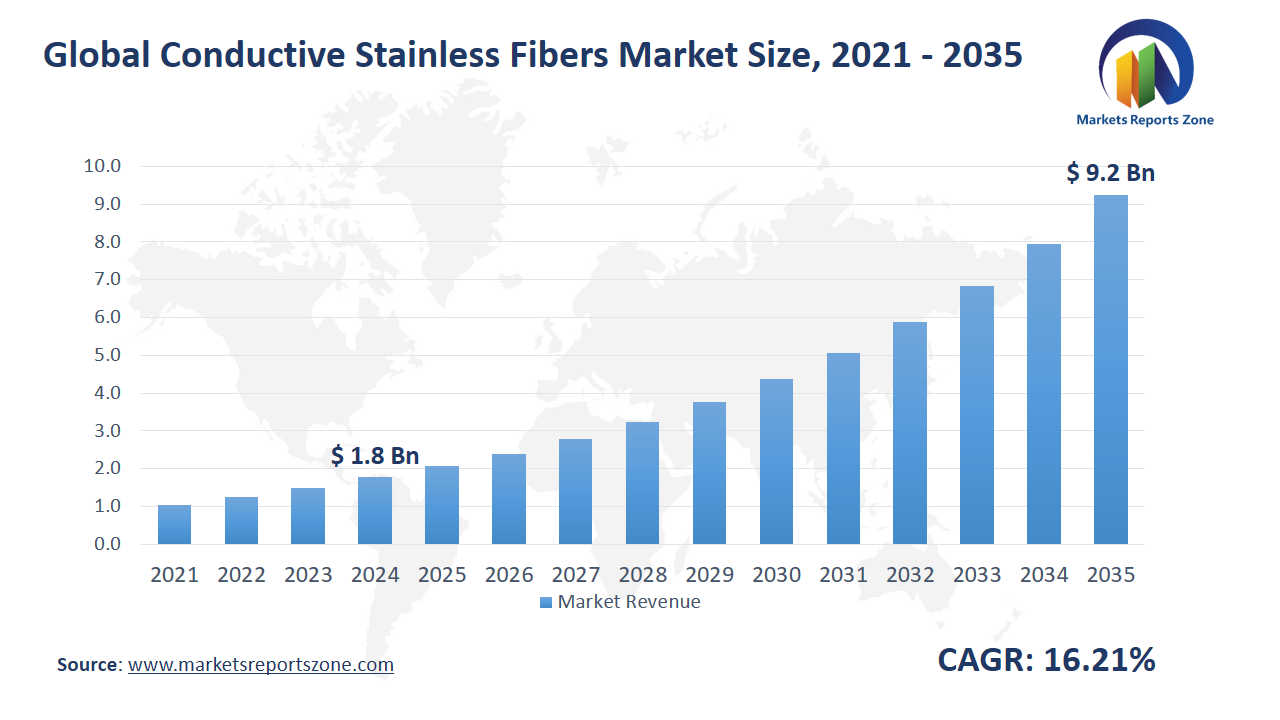
Global Conductive Stainless Fibers Market Size is expected to reach USD 9.28 Billion by 2035 from USD 1.77 Billion in 2024, with a CAGR of around 16.21% between 2024 and 2035. The global conductive stainless fibers market has been driven by increasing demand for EMI shielding and the rise of smart textiles. With growing electronic interference in medical and defense applications, these fibers have been used to prevent equipment malfunction. For example, in hospital ICUs, cables and sensors are shielded using conductive fibers to avoid signal distortion. In smart clothing, these fibers have been embedded in fabrics to transmit data and monitor vital signs. However, high production costs have remained a major restraint. Complex manufacturing processes and material expenses have made mass adoption difficult in cost-sensitive industries. Despite this, significant opportunities have emerged with the rise of wearable electronics. Sportswear brands have started experimenting with conductive stainless fibers for temperature and fitness monitoring. Another opportunity has been seen in automotive interiors. Touch-sensitive seats and EMI-protected components have been developed using these fibers to improve passenger safety and comfort. As electric vehicles increase, the need for interference-resistant materials has also grown. With expanding demand from industries focused on safety, connectivity, and performance, the market is shifting. The potential for lightweight, flexible, and highly conductive fibers continues to attract innovation, making them valuable across technology, healthcare, defense, and transportation sectors.
Driver: Smart Textiles Fuel Fiber Demand
One of the strongest drivers for the conductive stainless fibers market has been the rapid growth of smart textiles. These advanced fabrics, designed to interact with their environment or user, rely heavily on conductive materials to function. Conductive stainless fibers have been used in smart textiles due to their strength, flexibility, and excellent electrical conductivity. In fitness apparel, these fibers have enabled real-time tracking of muscle activity, heart rate, and hydration levels without the need for bulky sensors. For example, athletic gear embedded with stainless fibers can send biometric data to a connected app, giving athletes live feedback during training. In the healthcare sector, smart garments with conductive stainless fibers have been used for remote patient monitoring. These garments detect vital signs such as breathing patterns and body temperature, helping doctors monitor patients without the need for physical visits. Additionally, in workplace safety, uniforms with stainless fibers have been developed to alert workers to hazardous gas levels or excessive heat exposure. As the world moves toward more connected, wearable technology, the role of conductive stainless fibers becomes even more critical. Their integration into smart textiles is transforming how humans interact with clothing, making garments both functional and intelligent.
Key Insights:
- Over 40% of wearable electronics manufacturers have adopted conductive stainless fibers in their product lines for enhanced functionality and durability.
- A leading textile technology firm invested USD 120 million in expanding its production capacity for conductive stainless fibers in 2023.
- Approximately 15,000 tons of conductive stainless fibers were produced globally by major industry players in the last year.
- The adoption rate in defense and aerospace applications has reached nearly 35%, mainly for EMI shielding and sensor integration.
- Government-backed innovation funds in Asia allocated over USD 90 million toward R&D of conductive textiles and fibers in the past two years.
- Automotive industry penetration stands at around 28%, with applications in seat sensors, heated surfaces, and touch-responsive controls.
- A global apparel brand integrated conductive stainless fibers into 12% of its new performance wear collections, focusing on fitness tracking features.
- Environmental testing labs reported a 22% rise in demand for conductive fibers used in antistatic garments and contamination control gear.
Segment Analysis:
The conductive stainless fibers market has been segmented by type and application, each meeting distinct industrial demands. Long fibers have been widely used in electronic and automotive industries due to their strength and ability to form woven structures. For example, they’ve been integrated into touchscreen-compatible gloves used by technicians in high-voltage environments. Short fibers, on the other hand, have found applications where blending into materials is essential. In the chemical industry, short fibers have been mixed into protective garments to reduce static discharge risks during handling of volatile substances. In the pharmaceutical industry, both types have been used to ensure antistatic protection in cleanroom environments. Manufacturing suits lined with these fibers help prevent contamination and static buildup during the packaging of sensitive drugs. In the food industry, conductive stainless fibers have been included in conveyor belt coatings to minimize static-related product adhesion and improve hygiene. Other industries, like printing and textile manufacturing, have used these fibers to dissipate electrostatic charges that can interfere with equipment. As safety standards and automation grow across sectors, the need for antistatic, conductive materials has risen. Both long and short fiber types continue to play critical roles in improving safety, precision, and efficiency in diverse and demanding industrial environments.
Regional Analysis:
The conductive stainless fibers market has grown across all five regions, each responding to unique industrial demands. In North America, the focus has been on electronics manufacturing and defense. Companies have integrated these fibers into wearable technology for soldiers, improving real-time communication and monitoring in the field. Europe has seen strong adoption in the automotive sector, where conductive fibers have been used in seat sensors and heating systems in electric vehicles. In the Asia-Pacific region, rapid industrialization has led to increased use of these fibers in consumer electronics and smart home products. For instance, home appliance manufacturers have added conductive stainless fibers to improve EMI shielding in compact, high-functioning devices. Latin America has adopted the fibers more gradually, with their application primarily in the food industry to reduce static during automated packaging processes. In the Middle East and Africa, demand has been growing in the chemical and oil sectors, where protective clothing with embedded conductive fibers has been used to prevent electrostatic hazards. Across all regions, innovation in material science and rising safety standards have pushed manufacturers to include these fibers in more product designs, making them an essential component in industries that prioritize performance,
Competitive Scenario:
Leading players in the conductive stainless fibers market such as TEIJIN, TORAY, Kuraray, ICI, Mitsubishi Rayon, KB Seiren, and BASF have been actively shaping innovation and adoption across industries. TEIJIN has focused on integrating conductive fibers into advanced textile composites for use in industrial safety gear and smart uniforms. TORAY has expanded its R&D in flexible electronic fabrics, with recent efforts aimed at enhancing conductivity without compromising softness or wearability. Kuraray has developed hybrid fibers that blend stainless steel with synthetic polymers, making them suitable for applications in both medical textiles and EMI shielding. ICI has turned attention toward creating specialty fibers for high-performance laboratory clothing used in pharmaceutical cleanrooms. Mitsubishi Rayon has introduced conductive fibers into its carbon fiber product lines, offering solutions for aerospace and automotive applications where conductivity and structural strength are both needed. KB Seiren has worked on textile finishes that improve the bonding of conductive fibers to synthetic fabrics, increasing durability during repeated use and washing. BASF has collaborated with textile partners to develop coatings and treatments that enhance the conductivity of stainless fibers, especially for use in antistatic packaging and electronics assembly lines. Together, these companies are driving practical, scalable solutions in wearable tech, industrial safety, and advanced manufacturing.
Conductive Stainless Fibers Market Report Scope
| Report Attribute | Details |
|---|---|
| Market Size Value in 2024 | USD 1.77 Billion |
| Revenue Forecast in 2035 | USD 9.28 Billion |
| Growth Rate | CAGR of 16.21% from 2025 to 2035 |
| Historic Period | 2021 - 2024 |
| Forecasted Period | 2025 - 2035 |
| Report Coverage | Revenue forecast, company ranking, competitive landscape, growth factors, and trends |
| Regions Covered | North America; Europe; Asia Pacific; Latin America; Middle East & Africa |
| Countries Covered | U.S.; Canada; Mexico, UK; Germany; France; Spain; Italy; Russia; China; Japan; India; South Korea; Australia; Southeast Asia; Brazil; Argentina; Saudi Arabia; UAE; South Africa |
| Key companies profiled | TEIJIN; TORAY; Kuraray; ICI; Mitsubishi Rayon; KB Seiren; BASF |
| Customization | Free report customization (equivalent up to 8 analysts working days) with purchase. Addition or alteration to country, regional & segment scope. |
The Global Conductive Stainless Fibers Market report is segmented as follows:
By Type,
- Long Fiber
- Short Fiber
By Application,
- Electronic Industry
- Chemical Industry
- Pharmaceutical Industry
- Food Industry
- Other Industries
By Region,
- North America
- U.S.
- Canada
- Mexico
- Europe
- UK
- Germany
- France
- Spain
- Italy
- Russia
- Rest of Europe
- Asia Pacific
- China
- Japan
- India
- South Korea
- Australia
- Southeast Asia
- Rest of Asia Pacific
- Latin America
- Brazil
- Argentina
- Rest of Latin America
- Middle East & Africa
- Saudi Arabia
- UAE
- South Africa
- Rest of Middle East and Africa
Key Market Players,
Frequently Asked Questions
How big is the Conductive Stainless Fibers market?
Global Conductive Stainless Fibers Market Size was valued at USD 1.77 Billion in 2024 and is projected to reach at USD 9.28 Billion in 2035.
What is the Conductive Stainless Fibers market growth?
Global Conductive Stainless Fibers Market is expected to grow at a CAGR of around 16.21% during the forecasted year.
Which region has the largest market share in Conductive Stainless Fibers market?
North America, Asia Pacific and Europe are major regions in the global Conductive Stainless Fibers Market.
Who are the key players in Conductive Stainless Fibers market?
Key players analyzed in the global Conductive Stainless Fibers Market are TEIJIN; TORAY; Kuraray; ICI; Mitsubishi Rayon; KB Seiren; BASF and so on.