Global Compound Management Market - Size and Forecast Analysis, 2021-2035
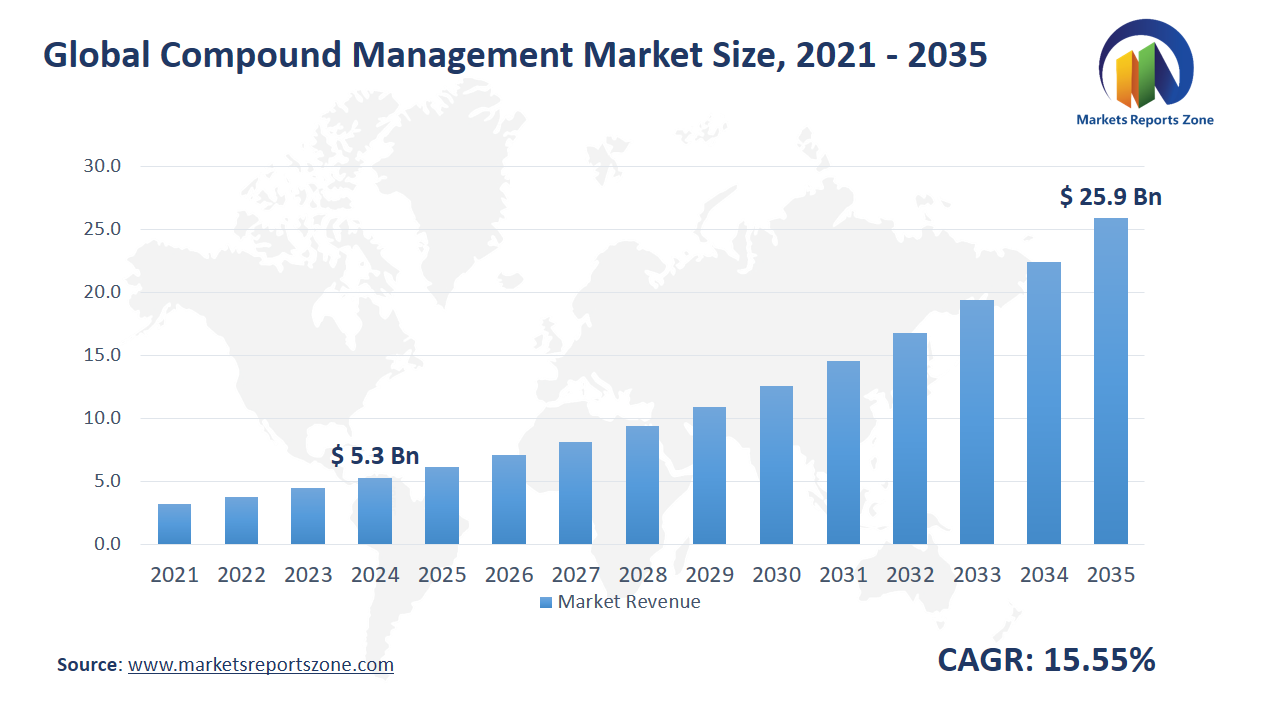
Global Compound Management Market Size is expected to reach USD 25.91 Billion by 2035 from USD 5.28 Billion in 2024, with a CAGR of around 15.55% between 2024 and 2035. The global compound management market has been driven by the increasing demand for high-throughput screening and the growing focus on personalized medicine. High-throughput screening has been widely adopted in pharmaceutical research to accelerate drug discovery. This has led to the increased use of compound management systems that can efficiently store, retrieve, and track large chemical libraries. For example, pharmaceutical companies have relied on automated compound management solutions to process millions of compounds in drug testing. The focus on personalized medicine has also boosted the market, as tailored treatments require precise management of chemical compounds based on patient-specific data. However, high costs associated with implementing compound management systems act as a restraint. Small and medium-sized research firms face challenges in affording such advanced solutions, limiting market expansion. Despite this, opportunities have emerged in the integration of AI and machine learning with compound management systems. These technologies have been used to improve compound selection and optimize drug discovery processes. Additionally, the growing interest in sustainable chemistry presents another opportunity. Companies are increasingly seeking compound management systems that can handle green chemistry processes and environmentally friendly compounds. For instance, research institutions are using compound management platforms to store and manage bio-based chemicals for eco-friendly drug development.
Driver: High-Throughput Screening Accelerates Drug Discovery
One of the key drivers of the compound management market has been the rise in high-throughput screening (HTS) for drug discovery. HTS allows researchers to test thousands of compounds in a short time to identify potential drug candidates. This speed is essential in pharmaceutical development, where time-to-market is crucial for staying competitive. For instance, large pharmaceutical companies have used HTS to quickly screen chemical libraries for possible treatments against diseases like cancer and Alzheimer’s. A notable example is a global pharmaceutical firm that employed HTS to rapidly test compounds for their ability to target specific cancer cells, resulting in the discovery of novel molecules that led to new cancer treatments. Compound management systems play a critical role in HTS by organizing and tracking vast amounts of data, ensuring that the right compounds are accessible and ready for testing at the right time. In some cases, automated platforms have been integrated with robotic systems to manage and process compound libraries at an unprecedented scale. This not only accelerates the screening process but also reduces human error and enhances data accuracy. As pharmaceutical companies continue to rely on HTS for faster drug development, the demand for efficient compound management solutions has steadily increased, driving market growth.
Key Insights:
- Over 50% of pharmaceutical companies have implemented compound management systems for high-throughput screening in their R&D departments.
- In 2023, a major pharmaceutical company invested USD 150 million in upgrading its compound management infrastructure to improve drug discovery capabilities.
- Approximately 8 million compounds were processed annually by top-tier pharmaceutical companies through automated compound management systems.
- The penetration rate of compound management systems in academic research institutions has reached about 35%, particularly in universities focused on drug discovery.
- A biotech firm reported an 18% increase in compound library size after adopting an advanced compound management platform in the last year.
- More than 60% of top pharmaceutical and biotech companies have integrated AI-driven compound management systems to optimize screening and selection processes.
- In 2023, government funding for drug discovery and related compound management initiatives totaled approximately USD 500 million across global health agencies.
- The adoption rate of compound management solutions in emerging markets, such as India and China, has grown by 25% over the past two years, driven by increasing investment in research and development.
Segment Analysis:
The compound management market has been segmented by type and application, each catering to specific industry needs. Automated storage systems have gained traction, especially in biopharma and pharmaceutical companies, where vast libraries of compounds need to be stored efficiently for research purposes. These systems allow for quick retrieval and organization, reducing time and human error. For example, automated storage solutions are commonly used in pharmaceutical research labs to handle large volumes of drug candidates in high-throughput screening. Decappers are another key segment, commonly used in biobank and pharma companies for the fast and accurate removal of vial caps. This technology streamlines the process of accessing stored compounds and samples, ensuring that precious materials are handled with care. Software solutions, essential in all segments, have been crucial in managing the data associated with compound storage and testing. These systems offer centralized databases for tracking compound information and test results, which is particularly useful in contract research organizations (CROs). CROs use software to efficiently manage client data and streamline research processes, particularly for clinical trials. Biopharma companies rely on these software platforms to track the testing and analysis of compounds in drug development. In all these segments, technological advancements have enabled faster, more accurate research, improving overall productivity and efficiency.
Regional Analysis:
The global compound management market has exhibited varied growth across five regions, each with distinct demands and applications. In North America, the pharmaceutical industry has driven substantial adoption, with major drug discovery centers in the U.S. integrating automated compound management systems for efficiency. For instance, large-scale pharmaceutical trials have relied on these systems for accurate compound tracking. In Europe, biopharma companies have been at the forefront, with increasing emphasis on personalized medicine, leading to higher demand for compound management platforms that can handle complex data. In Asia-Pacific, rapid growth in the biotechnology sector has propelled market expansion. Biobanks in China and Japan, for example, have implemented advanced storage solutions to manage large biological sample collections for clinical research. Latin America has seen a gradual increase in the use of compound management technologies, particularly in Brazil, where pharmaceutical companies are modernizing their infrastructure to support research and development. The Middle East & Africa has focused on improving healthcare systems and increasing clinical research, with compound management systems being adopted in select research institutions for better sample handling. In each region, the integration of automation, software, and data management systems has helped streamline drug development processes, catering to the growing demand for efficient compound tracking and storage solutions.
Competitive Scenario:
Brooks Life Sciences, Tecan, Hamilton Company, TTP Group, Labcyte, and Biosero are leading players in the compound management market, each contributing with innovative solutions that cater to various industries. Brooks Life Sciences has been expanding its reach in the biobank sector by offering advanced storage solutions and high-throughput screening platforms. Recently, they unveiled a fully automated system designed to handle large-scale sample storage and retrieval. Tecan, known for its expertise in laboratory automation, has continued to innovate in liquid handling and robotic platforms, offering advanced systems that streamline compound management for pharmaceutical companies. Hamilton Company has focused on providing precise liquid handling solutions, with recent advancements in microplate handling systems designed for high-throughput screening applications. TTP Group has introduced customizable compound management systems, specifically for the growing biopharma market, which enables faster, more efficient drug discovery. Labcyte has pioneered acoustic liquid handling technology, improving accuracy in compound preparation and reducing sample wastage in pharmaceutical R&D. Biosero, a leader in lab automation software, has launched new workflow management solutions that integrate seamlessly with compound management platforms, enhancing data tracking and operational efficiency. Each of these companies is playing a crucial role in the evolution of compound management, offering solutions that address the increasing complexity and scale of research in biopharma and related fields.
Compound Management Market Report Scope
| Report Attribute | Details |
|---|---|
| Market Size Value in 2024 | USD 5.28 Billion |
| Revenue Forecast in 2035 | USD 25.91 Billion |
| Growth Rate | CAGR of 15.55% from 2025 to 2035 |
| Historic Period | 2021 - 2024 |
| Forecasted Period | 2025 - 2035 |
| Report Coverage | Revenue forecast, company ranking, competitive landscape, growth factors, and trends |
| Regions Covered | North America; Europe; Asia Pacific; Latin America; Middle East & Africa |
| Countries Covered | U.S.; Canada; Mexico, UK; Germany; France; Spain; Italy; Russia; China; Japan; India; South Korea; Australia; Southeast Asia; Brazil; Argentina; Saudi Arabia; UAE; South Africa |
| Key companies profiled | Brooks Life Sciences; Tecan; Hamilton Company; TTP Group; Labcyte; Biosero |
| Customization | Free report customization (equivalent up to 8 analysts working days) with purchase. Addition or alteration to country, regional & segment scope. |
The Global Compound Management Market report is segmented as follows:
By Type,
- Automated Storage
- Decapper
- Software
By Application,
- Biopharma Companies
- Biobank
- Pharma Companies
- CRO
By Region,
- North America
- U.S.
- Canada
- Mexico
- Europe
- UK
- Germany
- France
- Spain
- Italy
- Russia
- Rest of Europe
- Asia Pacific
- China
- Japan
- India
- South Korea
- Australia
- Southeast Asia
- Rest of Asia Pacific
- Latin America
- Brazil
- Argentina
- Rest of Latin America
- Middle East & Africa
- Saudi Arabia
- UAE
- South Africa
- Rest of Middle East and Africa
Key Market Players,
- Brooks Life Sciences
- Tecan
- Hamilton Company
- TTP Group
- Labcyte
- Biosero
Frequently Asked Questions
How big is the Compound Management market?
Global Compound Management Market Size was valued at USD 5.28 Billion in 2024 and is projected to reach at USD 25.91 Billion in 2035.
What is the Compound Management market growth?
Global Compound Management Market is expected to grow at a CAGR of around 15.55% during the forecasted year.
Which region has the largest market share in Compound Management market?
North America, Asia Pacific and Europe are major regions in the global Compound Management Market.
Who are the key players in Compound Management market?
Key players analyzed in the global Compound Management Market are Brooks Life Sciences; Tecan; Hamilton Company; TTP Group; Labcyte; Biosero and so on.