Global Color Developer Market - Size and Forecast Analysis, 2021-2035
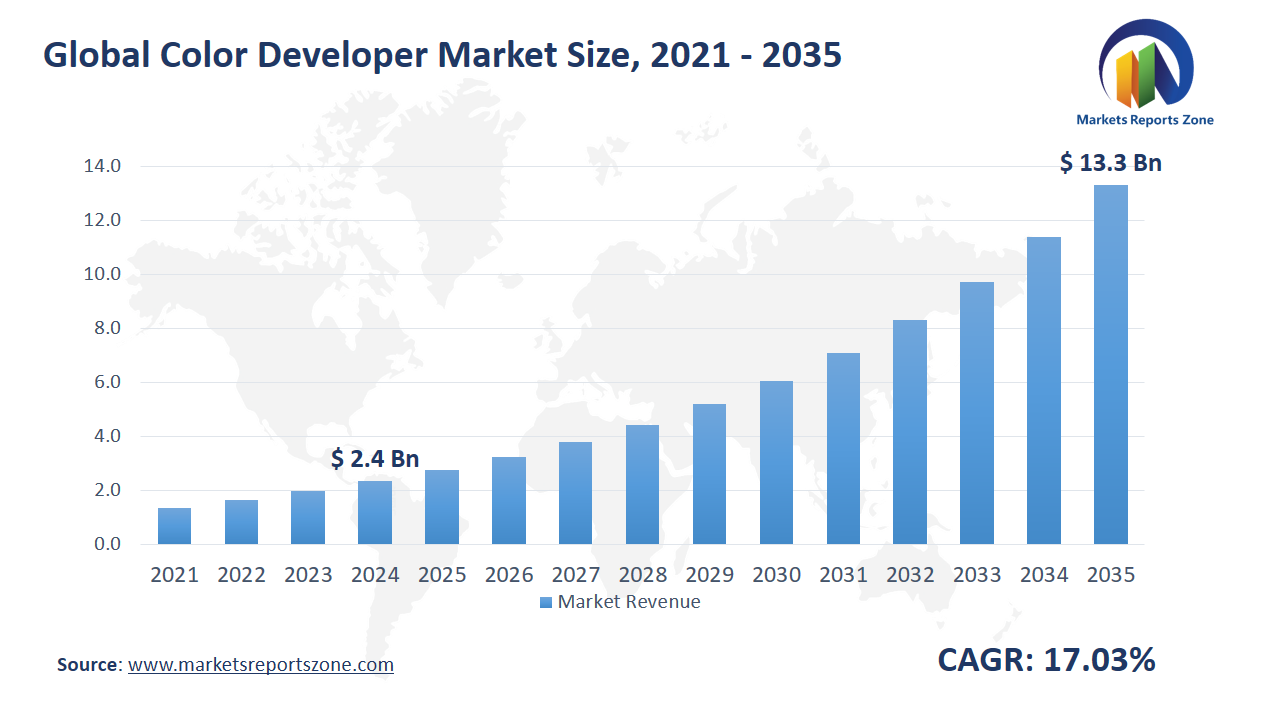
Global Color Developer Market Size is expected to reach USD 13.36 Billion by 2035 from USD 2.36 Billion in 2024, with a CAGR of around 17.03% between 2024 and 2035. The global color developer market has been driven by rising demand in packaging and thermal paper industries. Growth in point-of-sale and label printing has increased the use of color developers in thermal papers. These materials have been widely used in receipts, tickets, and shipping labels. Strong demand from the packaging sector has also contributed to growth. Color developers have been applied in smart packaging to highlight tamper evidence and freshness indicators. However, environmental concerns over chemical toxicity have posed a restraint. Many traditional color developers have been restricted due to their potential health and ecological impact. As a result, regulatory compliance has been made stricter in various regions. Despite this, opportunities have been created by the development of eco-friendly alternatives. New formulations using less harmful chemicals have been introduced and adopted in food-safe packaging. Another opportunity has emerged from the electronics sector. Color developers have been integrated into temperature-sensitive labels and security features for electronic components. For example, warranty seals on circuit boards and RFID labels have used color-changing elements based on developer technology. These innovations have expanded market applications. With ongoing research and sustainable product trends, the market has been reshaped toward safer and more versatile solutions for modern industry needs.
Driver: Thermal Paper Usage Drives Demand
One of the major drivers of the color developer market has been the rising use of thermal paper in retail, logistics, and service industries. Color developers are essential for thermal printing, as they react with heat to form visible text or images. With the growth of digital billing and point-of-sale transactions, thermal receipts have become standard in retail and hospitality environments. In logistics, tracking labels and barcoded tickets have been printed using thermal paper for accuracy and speed. These papers are lightweight, cost-effective, and require no ink, making them ideal for high-volume applications. For example, fast-food restaurants print thousands of order receipts daily using thermal printers, all of which rely on color developers for image development. In healthcare, wristbands and patient labels are often made from thermal paper for clear, smudge-proof identification. As businesses increasingly automate processes and focus on operational efficiency, the demand for reliable thermal printing has risen sharply. This growth has directly pushed the need for high-performance color developers that ensure print clarity and long-term legibility. With sectors like e-commerce, transportation, and healthcare expanding rapidly, the reliance on thermal printing solutions continues to rise, reinforcing the critical role of color developers in daily operations across industries.
Key Insights:
- Over 70% of retail and hospitality businesses have adopted thermal paper using color developers for billing and receipt printing.
- A leading chemical manufacturer invested USD 120 million in 2023 to expand its color developer production facility in Asia
- Approximately 1.9 million tons of thermal paper containing color developers were used globally in packaging and labeling sectors last year.
- More than 60% penetration of color developers has been observed in logistics and warehouse labeling applications.
- A European packaging company reported a 15% increase in demand for eco-friendly color developers in food-grade labeling.
- Over 45% of printed medical wristbands and patient tracking tags now use color developer-based thermal technology.
- A major electronics brand invested USD 85 million in R&D to develop tamper-proof labels using color-developer chemistry.
- In 2023, over 400 billion thermal receipts were printed globally, all requiring active color developers for image formation.
Segment Analysis:
The color developer market has been segmented by type and application, with each segment contributing uniquely to overall demand. Type I has been used in sensitive printing tasks where fine image detail and clarity are crucial. It has been widely adopted in official documents, legal records, and government-issued tickets. For example, parking tickets and toll receipts have used Type I for high contrast and durability in varied conditions. Type II has found broader use in everyday commercial printing where moderate image resolution is sufficient. It has been commonly applied in retail billing, transit passes, and fast-moving consumer goods packaging. Under application segmentation, Application I has shown strong adoption in food and beverage packaging. Color developers have been used in temperature-sensitive freshness labels that change color when a product expires or is exposed to heat. For instance, ready-to-eat meal packs often use these labels to signal safe consumption. Application II has been prominent in healthcare and pharmaceuticals. Color developers have supported patient monitoring tags, prescription labels, and test result printouts. Hospitals have used thermal tags on blood bags to track usage timelines. Each type and application has shaped how industries depend on color developers to ensure accuracy, efficiency, and real-time visual communication in high-volume settings.
Regional Analysis:
The global color developer market has seen varied growth across five regions: North America, Europe, Asia-Pacific, Latin America, and the Middle East & Africa. In North America, the demand for color developers has been driven by the increasing use of thermal paper in retail and healthcare. For example, pharmacies have adopted color-developing labels for prescription bottles to indicate medicine expiration dates. Europe has focused on sustainability, with eco-friendly color developers becoming popular in the packaging industry, particularly for perishable goods. Supermarkets in this region have used color-changing labels for fruits and vegetables to indicate freshness. In Asia-Pacific, rapid urbanization and industrial expansion have fueled growth. Thermal printing has been widely adopted for logistics in countries like China and Japan, with color developers used in barcodes and packaging labels for electronics and consumer goods. Latin America has experienced steady growth in the adoption of color developers, with the retail sector using thermal labels for inventory management and pricing. Brazil’s e-commerce boom has led to increased demand for color-developing packaging. The Middle East & Africa has focused on high-security applications, with color developers integrated into warranty seals for electronic products and luxury items. In all regions, the use of color developers continues to evolve, with new applications emerging in packaging, retail, and security sectors.
Competitive Scenario:
Fisher Scientific, BASF, Dow Chemical, and DuPont have each made significant strides in the color developer market, focusing on innovation and expanding their product offerings. Fisher Scientific has continued to support the laboratory and healthcare industries by offering specialized color developers for medical test prints and diagnostic devices. They recently introduced new formulations that improve the sensitivity and accuracy of color development in clinical applications. BASF has been driving sustainability efforts, focusing on creating eco-friendly and non-toxic color developer solutions. The company has made progress with plant-based alternatives in packaging, which has been adopted by several food industry leaders for freshness monitoring labels. Dow Chemical has expanded its reach in the industrial sector, introducing more durable color developers that are widely used in high-temperature applications like automotive and electronics labels. Their focus on chemical stability and long-term performance has made their products popular in manufacturing settings. DuPont, a key player in advanced materials, has focused on integrating color developer technology into high-security applications. Their latest innovation involves color-changing labels used in electronics packaging, providing added protection against counterfeiting. Each of these companies has positioned itself to lead in different niches, from healthcare to sustainability and security, and continues to drive the development of color developers across multiple industries.
Color Developer Market Report Scope
| Report Attribute | Details |
|---|---|
| Market Size Value in 2024 | USD 2.36 Billion |
| Revenue Forecast in 2035 | USD 13.36 Billion |
| Growth Rate | CAGR of 17.03% from 2025 to 2035 |
| Historic Period | 2021 - 2024 |
| Forecasted Period | 2025 - 2035 |
| Report Coverage | Revenue forecast, company ranking, competitive landscape, growth factors, and trends |
| Regions Covered | North America; Europe; Asia Pacific; Latin America; Middle East & Africa |
| Countries Covered | U.S.; Canada; Mexico, UK; Germany; France; Spain; Italy; Russia; China; Japan; India; South Korea; Australia; Southeast Asia; Brazil; Argentina; Saudi Arabia; UAE; South Africa |
| Key companies profiled | Fisher Scientific; Basf; Dow Chemical; DuPont |
| Customization | Free report customization (equivalent up to 8 analysts working days) with purchase. Addition or alteration to country, regional & segment scope. |
The Global Color Developer Market report is segmented as follows:
By Type,
- Type I
- Type II
By Application,
- Application I
- Application II
By Region,
- North America
- U.S.
- Canada
- Mexico
- Europe
- UK
- Germany
- France
- Spain
- Italy
- Russia
- Rest of Europe
- Asia Pacific
- China
- Japan
- India
- South Korea
- Australia
- Southeast Asia
- Rest of Asia Pacific
- Latin America
- Brazil
- Argentina
- Rest of Latin America
- Middle East & Africa
- Saudi Arabia
- UAE
- South Africa
- Rest of Middle East and Africa
Key Market Players,
- Fisher Scientific
- Basf
- Dow Chemical
- DuPont
Frequently Asked Questions
How big is the Color Developer market?
Global Color Developer Market Size was valued at USD 2.36 Billion in 2024 and is projected to reach at USD 13.36 Billion in 2035.
What is the Color Developer market growth?
Global Color Developer Market is expected to grow at a CAGR of around 17.03% during the forecasted year.
Which region has the largest market share in Color Developer market?
North America, Asia Pacific and Europe are major regions in the global Color Developer Market.
Who are the key players in Color Developer market?
Key players analyzed in the global Color Developer Market are Fisher Scientific; Basf; Dow Chemical; DuPont and so on.