
Global Box Hearing Aids Market - Size and Forecast Analysis, 2021-2035
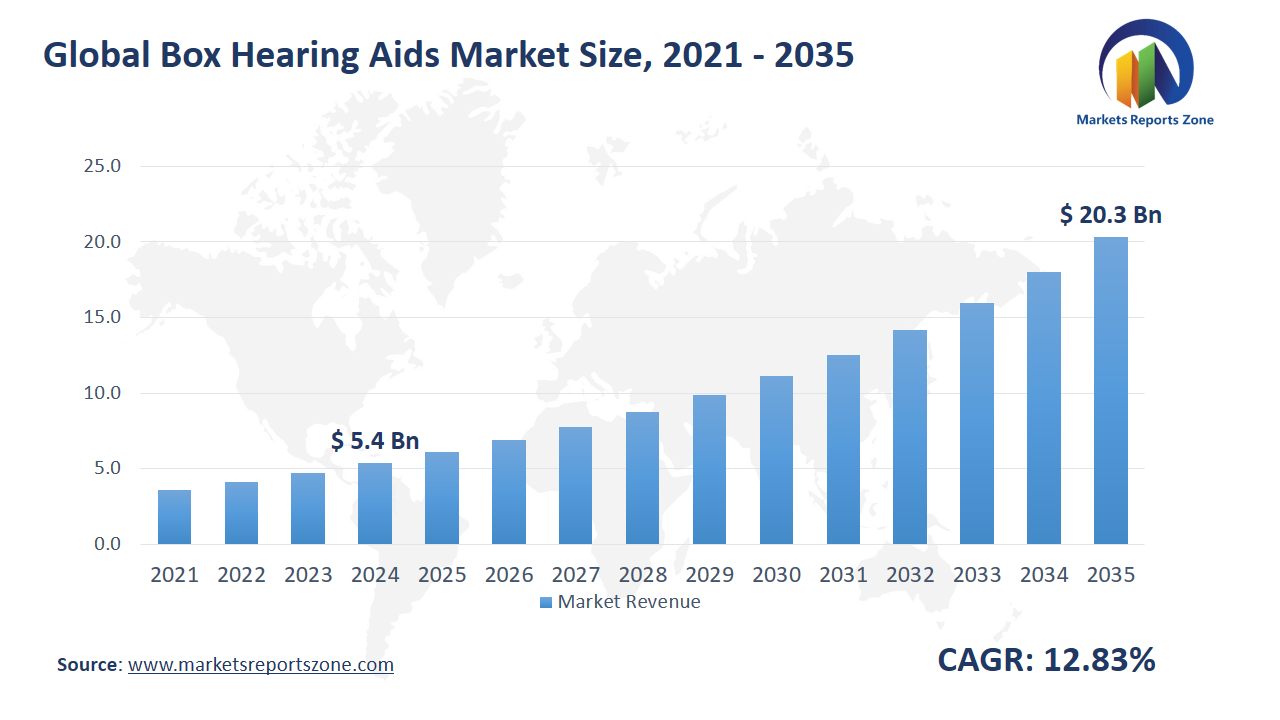
Global Box Hearing Aids Market Size is expected to reach USD 20.38 Billion by 2035 from USD 5.39 Billion in 2024, with a CAGR of around 12.83% between 2024 and 2035. The global box hearing aids market has been propelled by two primary drivers. Firstly, the aging population has increased the prevalence of age-related hearing loss, leading to higher demand for hearing aids. Secondly, technological advancements have enhanced device functionality, making them more appealing to users. However, high costs remain a significant restraint, limiting access for many potential users. Despite this, opportunities have emerged with the introduction of over-the-counter (OTC) hearing aids, which have improved accessibility and affordability. Additionally, innovative solutions from startups in emerging markets have expanded reach to underserved populations. For instance, HearX Group in South Africa has developed smartphone-based audiometers and affordable hearing aids, making hearing care more accessible in Africa. In the United States, Costco has become a favored destination for hearing aids due to its affordable prices and excellent customer service, capturing a significant share of the market. These developments indicate a positive trend towards increased accessibility and adoption of hearing aids globally.
Driver: Aging Ears Need Clearer Sound
Rising cases of age-related hearing loss have strongly driven the demand for box hearing aids worldwide. As people live longer, more seniors have been affected by gradual hearing decline, especially after the age of 60. This condition has led to difficulties in daily communication, isolation, and reduced quality of life. To manage this, many elderly individuals have turned to hearing aids that offer both affordability and ease of use. Box hearing aids, with their simple controls and strong amplification, have been favored in elderly care homes. In Japan, retirement communities have provided residents with basic hearing aids during wellness programs to keep them engaged in group activities. In rural France, community clinics have distributed box-style hearing aids to older adults during mobile health checkups. These devices have allowed users to regain confidence while speaking with family or participating in social events. In cities like Chicago, senior centers have held free hearing screening camps, where affordable box hearing aids have been fitted instantly. This growing aging population has not only increased the need but also highlighted the importance of accessible solutions. As more elderly people seek help for hearing issues, demand for box hearing aids is expected to remain steady and strong.
Key Insights:
- The global hearing aid adoption rate was approximately 24.6% in 2012, with 8.45 million Americans using hearing aids.
- The practical adoption rate for hearing aids in the U.S. is estimated at 51.3%, accounting for those who want or need amplification devices.
- In 2016, 3.65 million hearing aid units were sold in the United States.
- Over 28.8 million U.S. adults could benefit from hearing aids, according to national health statistics.
- The U.S. FDA approved over-the-counter hearing aids in 2022, expanding access to millions of potential users.
- Government healthcare programs in Europe subsidized more than USD 200 million for hearing aid access in 2023.
- The penetration rate of hearing aids among adults with disabling hearing loss worldwide is estimated at 38%.
Segment Analysis:
The box hearing aids market can be analyzed across types and applications, each showing unique usage trends. Behind-the-ear (BTE) hearing aids have been widely used due to their powerful output and ease of handling, especially for users with severe hearing loss. In elderly care facilities in Germany, BTE devices have been provided to seniors who need higher amplification. In-the-ear (ITE) hearing aids, on the other hand, have gained popularity for their discreet design and comfort. In urban clinics in Singapore, adults with moderate hearing loss have preferred ITE models for daily office use. From an application perspective, adults have been the major users, driven by aging and noise-related hearing loss. In busy workspaces across Mumbai, working professionals have adopted simple ITE devices to stay connected during meetings. Among children, BTE aids have remained more common due to their durability and ability to connect with classroom assistive devices. In Australian schools, students with hearing challenges have been supported with brightly colored BTE devices that make them both fun and functional. Pediatric audiologists have recommended BTEs for young users as they grow, offering flexibility in programming and fitting. Together, these segments highlight how hearing aids have been tailored to meet different age and usage needs.
Regional Analysis:
The global box hearing aids market has shown varied growth across North America, Europe, Asia-Pacific, Latin America, and the Middle East & Africa. In North America, awareness and early diagnosis have increased adoption, with local community centers in the U.S. organizing regular hearing camps for seniors. In Europe, supportive public healthcare has enabled broader access; in Sweden, government-funded clinics have provided hearing aids to retirees at no extra cost. Asia-Pacific has seen fast growth due to rising elderly populations and improving healthcare access. In cities like Kuala Lumpur, NGOs have run hearing aid donation drives for low-income seniors. Latin America has witnessed steady adoption driven by charitable initiatives; in Peru, mobile vans equipped with audiology tools have distributed basic hearing aids in mountain villages. In the Middle East & Africa, access remains limited but expanding. In Kenya, local hospitals have partnered with international aid programs to provide basic box hearing aids for children with early hearing loss. Across all regions, affordability and simplicity of box hearing aids have made them suitable for both urban and rural populations. As hearing health gains more recognition globally, usage of these devices has grown steadily, supporting better communication and improved quality of life across diverse communities.
Competitive Scenario:
The global hearing aid market has been significantly influenced by the innovative strides of leading companies. Oticon introduced the Oticon Intent™, the world's first hearing aid equipped with user-intent sensors, utilizing 4D Sensor technology to adapt to users' listening intentions in real-time, enhancing speech clarity and personalization. Phonak unveiled the Audéo Sphere™ Infinio, featuring real-time AI through its proprietary DEEPSONIC chip, which significantly improves speech understanding in noisy environments by separating clear speech from background noise. Starkey launched the Edge AI hearing aids, integrating advanced AI to classify complex soundscapes, enhance speech, and reduce noise in real-time, offering features like fall detection and health tracking through the My Starkey app. ReSound introduced the Vivia, the world's smallest AI-powered hearing aid, delivering superior sound quality in noisy environments and all-day comfort, with its Intelligent Focus feature responding to the direction a person is looking to enhance relevant sounds. Widex's Moment hearing aids have been integrated with Amazon's Fire TV Dual Audio feature, allowing users to stream audio directly to their hearing aids while others listen through the TV speakers, enhancing accessibility. Siemens, through its Signia brand, continues to innovate with features like tinnitus relief and natural sound processing, catering to diverse user needs. These advancements reflect a collective industry focus on leveraging AI and connectivity to enhance user experience, speech clarity, and overall quality of life for individuals with hearing loss.
Box Hearing Aids Market Report Scope
| Report Attribute | Details |
|---|---|
| Market Size Value in 2024 | USD 5.39 Billion |
| Revenue Forecast in 2035 | USD 20.38 Billion |
| Growth Rate | CAGR of 12.83% from 2025 to 2035 |
| Historic Period | 2021 - 2024 |
| Forecasted Period | 2025 - 2035 |
| Report Coverage | Revenue forecast, company ranking, competitive landscape, growth factors, and trends |
| Regions Covered | North America; Europe; Asia Pacific; Latin America; Middle East & Africa |
| Countries Covered | U.S.; Canada; Mexico, UK; Germany; France; Spain; Italy; Russia; China; Japan; India; South Korea; Australia; Southeast Asia; Brazil; Argentina; Saudi Arabia; UAE; South Africa |
| Key companies profiled | Oticon; Siemens; Phonak; Starkey; Widex; ReSound |
| Customization | Free report customization (equivalent up to 8 analysts working days) with purchase. Addition or alteration to country, regional & segment scope. |
The Global Box Hearing Aids Market report is segmented as follows:
By Type,
- Behind-the-ear (BTE) Hearing Aids
- In-the-ear (ITE) Hearing Aids
By Application,
- Child
- Adults
By Region,
- North America
- U.S.
- Canada
- Mexico
- Europe
- UK
- Germany
- France
- Spain
- Italy
- Russia
- Rest of Europe
- Asia Pacific
- China
- Japan
- India
- South Korea
- Australia
- Southeast Asia
- Rest of Asia Pacific
- Latin America
- Brazil
- Argentina
- Rest of Latin America
- Middle East & Africa
- Saudi Arabia
- UAE
- South Africa
- Rest of Middle East and Africa
Key Market Players,
Frequently Asked Questions
How big is the Box Hearing Aids market?
Global Box Hearing Aids Market Size was valued at USD 5.39 Billion in 2024 and is projected to reach at USD 20.38 Billion in 2035.
What is the Box Hearing Aids market growth?
Global Box Hearing Aids Market is expected to grow at a CAGR of around 12.83% during the forecasted year.
Which region has the largest market share in Box Hearing Aids market?
North America, Asia Pacific and Europe are major regions in the global Box Hearing Aids Market.
Who are the key players in Box Hearing Aids market?
Key players analyzed in the global Box Hearing Aids Market are Oticon; Siemens; Phonak; Starkey; Widex; ReSound and so on.