
Global Automotive Head-up Display (HUD) and Instrument Cluster Market - Size and Forecast Analysis, 2021-2035
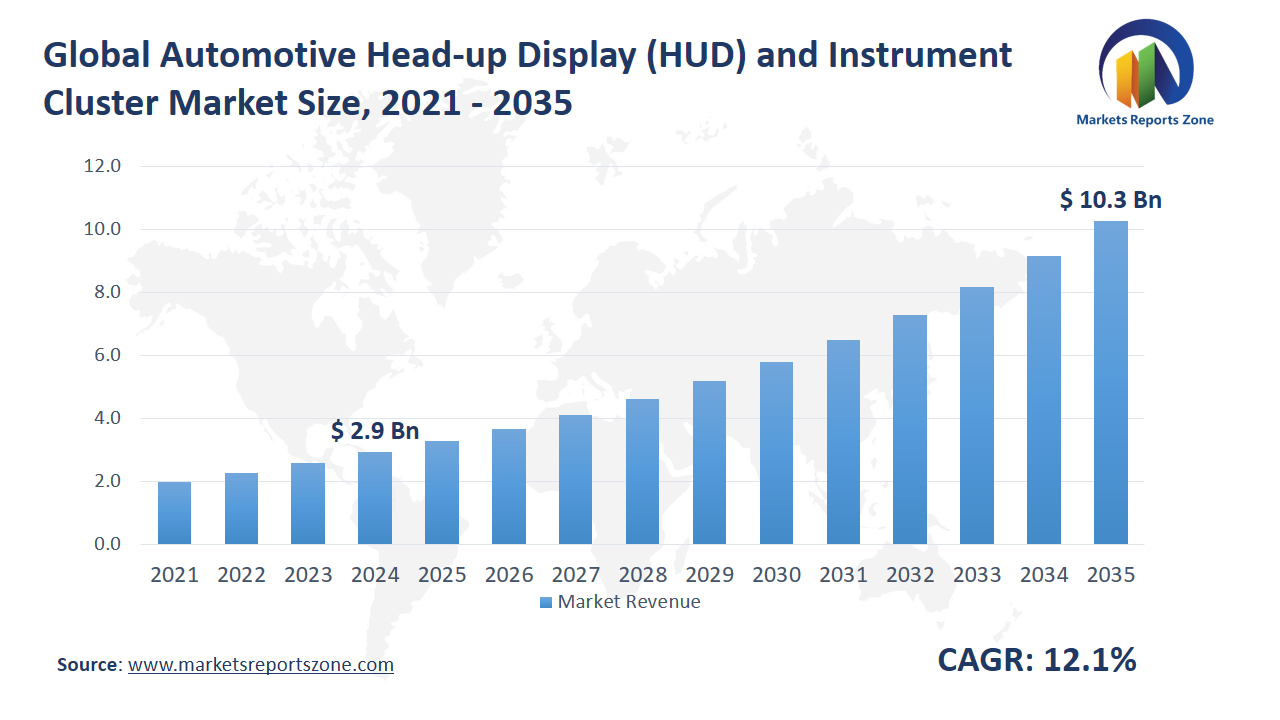
Global Automotive Head-up Display (HUD) and Instrument Cluster Market Size is expected to reach USD 10.29 Billion by 2035 from USD 2.92 Billion in 2024, with a CAGR of around 12.1% between 2024 and 2035. The global automotive head-up display (HUD) and instrument cluster market has been driven by rising demand for driver assistance technologies and growing focus on vehicle safety. Enhanced driving experiences have been enabled by digital displays, which provide real-time data with minimal distraction. HUDs have been used to project speed, navigation, and warnings directly in the driver’s line of sight. However, the high cost of integration has acted as a restraint, especially in entry-level and mid-range vehicles. Despite this, two strong opportunities have emerged. The shift toward connected and autonomous vehicles has created space for advanced display systems that enhance situational awareness. For instance, companies like Lucid Motors have implemented 34-inch curved instrument clusters to offer a futuristic cockpit experience. Another opportunity lies in the integration of augmented reality (AR) HUDs, which offer layered guidance for navigation and hazard detection. AR HUDs have been used in premium vehicles like the Mercedes-Benz S-Class to highlight turns and detect pedestrians. Automakers are also replacing analog clusters with fully digital units in mass-market models. This trend has been seen in models like the Volkswagen ID.4, which features compact digital dashboards. As technology matures, more affordable solutions are expected, driving broader adoption across segments.
Driver: Driver Assistance Fuels Display Demand
The increasing demand for driver assistance technologies has strongly influenced the rise of head-up displays (HUDs) and digital instrument clusters. Modern vehicles are now equipped with a range of safety features such as lane departure warning, adaptive cruise control, and collision alerts. These systems require real-time communication with the driver, and HUDs offer a perfect platform to display this information without causing distraction. Instead of looking down at the dashboard, drivers can now access critical data projected directly onto the windshield. This not only improves reaction time but also enhances overall driving confidence. For instance, Cadillac has integrated HUDs in several models to show traffic signs, directions, and speed, helping drivers stay focused on the road. In digital clusters, brands like Mazda have replaced traditional gauges with customizable displays that adjust to driving modes and user preferences. These upgrades support faster information processing and reduce driver fatigue on long journeys. As more semi-autonomous features are added to vehicles, the need for clear, intuitive visual feedback becomes even more important. The integration of these displays is no longer limited to luxury vehicles. As production costs decrease, driver assistance through advanced display systems is becoming a standard expectation across the automotive market.
Key Insights:
- Over 55% of newly launched premium vehicles are equipped with head-up displays as standard or optional features.
- BMW Group reported an investment of over USD 300 million in digital cockpit and display technology development over the past two years.
- More than 40 million digital instrument clusters were installed globally in passenger vehicles in the last calendar year.
- Approximately 35% penetration rate of head-up displays has been achieved in electric vehicles, driven by user interface innovation.
- Hyundai Motor Company confirmed the installation of HUDs in over 2 million vehicles across its global fleet to date.
- Over USD 500 million was allocated by Japanese automakers collectively to enhance augmented reality HUD systems for next-generation vehicles.
- Around 70% of new vehicles in Europe now feature fully digital instrument clusters, replacing analog gauges.
- General Motors announced integration of next-gen AR HUD systems in upcoming models, with an expected rollout across 80% of its future EV lineup.
Segment Analysis:
The automotive head-up display (HUD) and instrument cluster market is segmented by type into windshield projected HUD, combiner projected HUD, and analog clusters, and by application into passenger and commercial vehicles. Windshield projected HUDs are widely used in premium vehicles, offering a clear, real-time projection directly onto the glass. This technology has been applied in vehicles like the Genesis GV80 to enhance driving focus and reduce eye movement. Combiner projected HUDs, which use a transparent screen between the dashboard and windshield, are more cost-effective and often found in compact and mid-range cars. Mini Cooper, for example, offers this solution to provide vital driving data without cluttering the cabin. In the instrument cluster segment, analog clusters are still used in entry-level models due to their simplicity and lower cost. Vehicles like the Nissan Sunny continue to use analog setups in markets where digital demand is still emerging. In terms of application, passenger vehicles lead the market, driven by demand for tech-enhanced comfort and safety. Commercial vehicles are also seeing gradual adoption, especially in logistics fleets, where basic HUD systems improve driver awareness. As digital interfaces become more user-centric, these segments are expected to evolve, combining safety, style, and smart design across both private and commercial transport.
Regional Analysis:
The automotive head-up display (HUD) and instrument cluster market shows varied development across North America, Europe, Asia-Pacific, Latin America, and the Middle East & Africa. In North America, strong consumer demand for advanced driver assistance features has pushed automakers like Tesla to integrate minimalistic yet highly digital clusters and HUD alternatives in vehicles like the Model S. Europe continues to lead in innovation, with brands like Volvo adopting large digital clusters and HUDs in models such as the XC60, focusing on safety and driver comfort. In Asia-Pacific, rapid growth in connected vehicles and affordability improvements have encouraged adoption, especially in markets like China and South Korea. Kia has introduced compact AR HUDs in newer models to appeal to tech-savvy consumers. Latin America, though still developing in this area, is witnessing gradual inclusion of digital clusters in vehicles like the Chevrolet Onix, catering to growing expectations for tech-driven interfaces. In the Middle East & Africa, luxury imports and government-backed smart mobility initiatives are promoting the use of HUDs in premium cars. Brands like Lexus have seen growing popularity in Gulf countries with models offering windshield HUDs. Overall, regional trends are shaped by consumer demand, regulatory push for safety, and rising interest in intelligent vehicle experiences
Competitive Scenario:
Leading companies in the automotive HUD and instrument cluster market are actively pushing boundaries through innovation and strategic advancements. Continental AG has been developing advanced AR HUDs with extended field views for next-gen vehicles. Nippon and Denso have focused on integrating HUDs with real-time traffic and weather updates to support safer driving in urban environments. Delphi Automotive has expanded its digital cockpit offerings with customizable cluster layouts and improved graphics processing. Bosch has introduced smart cluster systems with predictive display features to enhance user interaction. Visteon Corporation is working on seamless integration between HUDs and infotainment systems, streamlining dashboard functionality. Johnson Controls, Inc. has focused on ergonomic cluster designs to improve visibility and reduce driver strain. Yazaki Corporation continues to refine combiner HUD technology for small and mid-sized vehicles. E-Lead and Springteq Electronics have launched compact HUD units for the aftermarket, making the tech more accessible. Garmin and Pioneer Corp are enhancing HUDs with turn-by-turn navigation overlays and mobile app connectivity. Harman is investing in voice-assisted cluster systems to reduce distractions. Companies like RoadRover Technology, Founder, and Coagent Enterprise are also contributing to the ecosystem with cost-efficient, modular display solutions for EVs and budget vehicles. Collectively, these developments signal a strong move toward intelligent, immersive driving interfaces.
Automotive Head-up Display (HUD) and Instrument Cluster Market Report Scope
| Report Attribute | Details |
|---|---|
| Market Size Value in 2024 | USD 2.92 Billion |
| Revenue Forecast in 2035 | USD 10.29 Billion |
| Growth Rate | CAGR of 12.1% from 2025 to 2035 |
| Historic Period | 2021 - 2024 |
| Forecasted Period | 2025 - 2035 |
| Report Coverage | Revenue forecast, company ranking, competitive landscape, growth factors, and trends |
| Regions Covered | North America; Europe; Asia Pacific; Latin America; Middle East & Africa |
| Countries Covered | U.S.; Canada; Mexico, UK; Germany; France; Spain; Italy; Russia; China; Japan; India; South Korea; Australia; Southeast Asia; Brazil; Argentina; Saudi Arabia; UAE; South Africa |
| Key companies profiled | Continental AG; Nippon; Delphi Automotive; Bosch; Denso; Visteon Corporation; Johnson Controls, Inc; Yazaki Corporation; E-Lead; Garmin; Harman; Pioneer Corp; Coagent Enterprise; Founder; Springteq Electronics; RoadRover Technology |
| Customization | Free report customization (equivalent up to 8 analysts working days) with purchase. Addition or alteration to country, regional & segment scope. |
The Global Automotive Head-up Display (HUD) and Instrument Cluster Market report is segmented as follows:
By Type,
- By Automotive Head-up Display (HUD)
- Windshield Projected HUD
- Combiner Projected HUD
- By Automotive Instrument Cluster
- Analog Cluster
By Application,
- Passenger Vehicle
- Commercial Vehicle
By Region,
- North America
- U.S.
- Canada
- Mexico
- Europe
- UK
- Germany
- France
- Spain
- Italy
- Russia
- Rest of Europe
- Asia Pacific
- China
- Japan
- India
- South Korea
- Australia
- Southeast Asia
- Rest of Asia Pacific
- Latin America
- Brazil
- Argentina
- Rest of Latin America
- Middle East & Africa
- Saudi Arabia
- UAE
- South Africa
- Rest of Middle East and Africa
Key Market Players,
- Continental AG
- Nippon
- Delphi Automotive
- Bosch
- Denso
- Visteon Corporation
- Johnson Controls, Inc
- Yazaki Corporation
- E-Lead
- Garmin
- Harman
- Pioneer Corp
- Coagent Enterprise
- Founder
- Springteq Electronics
- RoadRover Technology
Frequently Asked Questions
How big is the Automotive Head-up Display (HUD) and Instrument Cluster market?
Global Automotive Head-up Display (HUD) and Instrument Cluster Market Size was valued at USD 2.92 Billion in 2024 and is projected to reach at USD 10.29 Billion in 2035.
What is the Automotive Head-up Display (HUD) and Instrument Cluster market growth?
Global Automotive Head-up Display (HUD) and Instrument Cluster Market is expected to grow at a CAGR of around 12.1% during the forecasted year.
Which region has the largest market share in Automotive Head-up Display (HUD) and Instrument Cluster market?
North America, Asia Pacific and Europe are major regions in the global Automotive Head-up Display (HUD) and Instrument Cluster Market.
Who are the key players in Automotive Head-up Display (HUD) and Instrument Cluster market?
Key players analyzed in the global Automotive Head-up Display (HUD) and Instrument Cluster Market are Continental AG; Nippon; Delphi Automotive; Bosch; Denso; Visteon Corporation; Johnson Controls, Inc; Yazaki Corporation; E-Lead; Garmin; Harman; Pioneer Corp; Coagent Enterprise; Founder; Springteq Electronics; RoadRover Technology and so on.