
Global Automatic Vehicle Identification (AVI) Market - Size and Forecast Analysis, 2021-2035
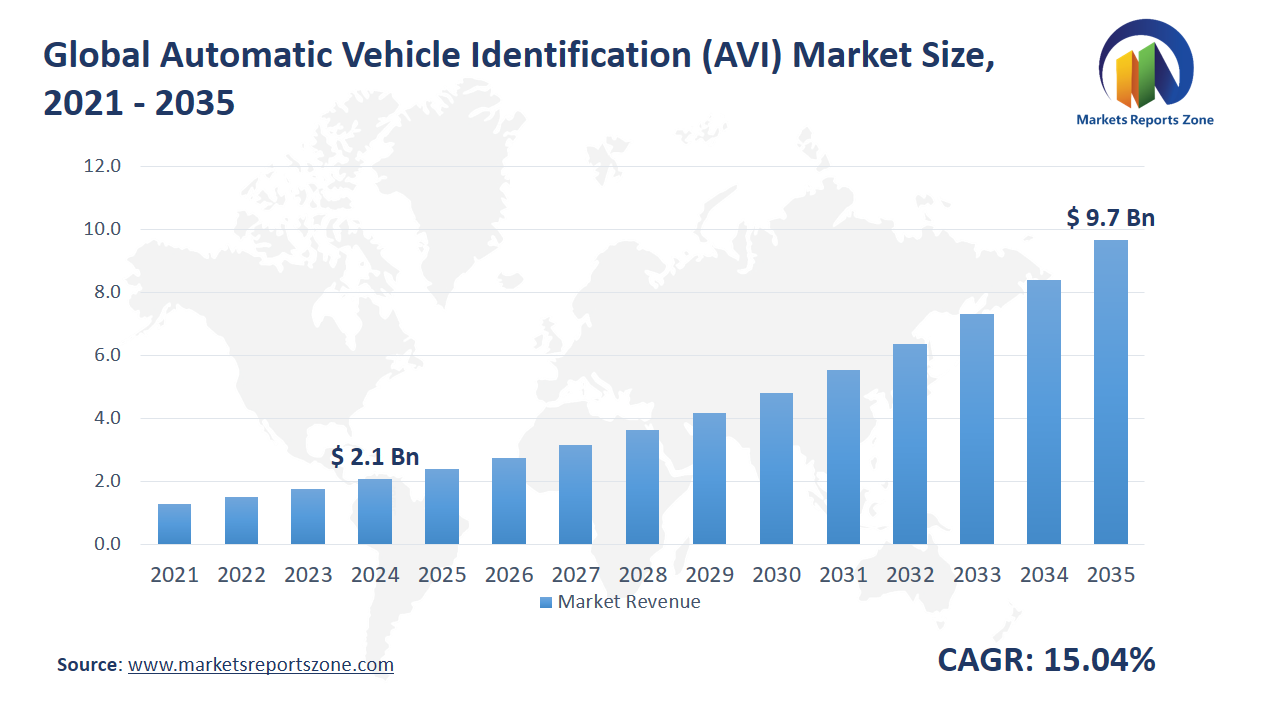
Global Automatic Vehicle Identification (AVI) Market Size is expected to reach USD 9.69 Billion by 2035 from USD 2.07 Billion in 2024, with a CAGR of around 15.04% between 2024 and 2035. The Global Automatic Vehicle Identification (AVI) Market is being driven by the increasing need for efficient toll collection and enhanced traffic management. AVI systems are being widely adopted in smart cities to automate tolling processes, reducing traffic congestion and human error. For instance, in countries like the United States, toll booths have been replaced by automated systems that recognize vehicles and charge tolls seamlessly. Another driver is the rise in demand for improved security. AVI technology is being utilized for tracking vehicles in real time, especially in high-security areas like airports or government buildings. However, the high initial cost of AVI system installation remains a significant restraint. Many regions, especially in developing countries, are hesitant to invest due to these upfront expenses. Despite this, opportunities exist in the growing demand for contactless solutions. As the need for touch-free transactions increases, AVI systems are being seen as ideal for seamless and hygienic tolling or parking. Furthermore, the expansion of e-commerce provides opportunities for AVI technology in logistics and fleet management. AVI systems are being used to track vehicles and manage deliveries, improving efficiency and reducing costs. These opportunities highlight the potential for AVI growth despite challenges posed by installation costs.
Driver: Smart Cities Boosting AVI Adoption
The rise of smart cities is a major driver behind the growing adoption of Automatic Vehicle Identification (AVI) systems. As urban areas become more technologically advanced, the need for efficient and seamless transportation management has increased. AVI systems play a crucial role in this transformation by automating processes like toll collection, parking management, and traffic flow control. For example, in Singapore, an integrated AVI system has been implemented to manage both road tolling and congestion pricing. This system automatically identifies vehicles and charges them based on usage, reducing congestion and ensuring smoother traffic movement. Similarly, in Barcelona, AVI technology is used for smart parking solutions. Vehicles are automatically identified as they enter and exit parking lots, improving space utilization and reducing the time spent searching for parking. The ability to collect data in real time has also improved city planning, allowing authorities to monitor traffic patterns and make data-driven decisions. As more cities adopt smart infrastructure, AVI technology is expected to become a core component, helping manage transportation systems more efficiently and sustainably. This trend highlights the growing importance of AVI in creating smarter, more connected urban environments.
Key Insights:
- Adoption rate of AVI systems in government-managed tolling infrastructure reached approximately 60% in major metropolitan areas.
- Over USD 500 million was invested by governments globally in smart transportation systems, including AVI technologies, in the last fiscal year.
- More than 2 million AVI-enabled vehicles were deployed in urban areas across Europe in the past two years.
- The penetration rate of AVI systems in commercial fleet management across North America is estimated to be over 45%.
- In Asia-Pacific, the adoption rate of AVI systems in parking management solutions has seen a growth of 30% year-over-year.
- A significant increase in government spending is expected in Latin America, with USD 200 million allocated toward upgrading transportation infrastructure to include AVI technologies.
- The number of units of AVI technology sold worldwide has crossed 500,000 units in the last two years, especially for tolling and fleet management purposes.
- Around 35% of all tolling systems globally have now shifted to fully automated AVI-based operations, especially in highly congested areas.
Segment Analysis:
The Automatic Vehicle Identification (AVI) market is evolving through different segments, including by type and application. Fixed AVI systems are widely used in locations where vehicles are consistently monitored, such as toll booths, highways, and entry points to secure facilities. These systems provide continuous, automated vehicle identification, making toll collection and security monitoring more efficient. For example, fixed systems are often seen at major highway toll plazas in countries like Japan, where they ensure smooth, cashless transactions. On the other hand, mobile AVI systems are increasingly gaining traction for their flexibility. These systems are mounted on vehicles, such as police cars or traffic monitoring units, and can be used for real-time vehicle identification on the go. This capability is ideal for law enforcement agencies that need to track stolen vehicles or monitor traffic flow across large areas. In terms of application, traffic management continues to be a major use case for AVI technology. By automating vehicle identification, cities can improve traffic flow, reduce congestion, and enhance overall road safety. Similarly, AVI technology is playing a growing role in parking management, allowing for seamless entry and exit from parking facilities. This is especially common in airports and shopping centers, where efficient parking is critical for a smooth customer experience. These segments highlight the diverse applications and increasing reliance on AVI systems.
Regional Analysis:
The Automatic Vehicle Identification (AVI) market is experiencing different growth trajectories across regions. In North America, AVI systems are widely used in toll collection and law enforcement, with cities like Chicago implementing these systems to monitor vehicle movement and enhance traffic management. In Europe, AVI technology is expanding in smart city initiatives, particularly in cities like Paris, where it is used for congestion charging and urban traffic monitoring. The Asia-Pacific region is witnessing rapid adoption, driven by urbanization and the demand for efficient transportation systems. Countries like China are using AVI technology for smart transportation networks and advanced tolling systems on highways. The Middle East is embracing AVI for high-tech solutions, with Dubai using the technology for vehicle tracking in public transportation and security applications. Latin America, while still in the early stages of AVI adoption, is seeing growing interest, particularly in countries like Brazil where the technology is used for efficient parking management and tolling systems on major roads. In Africa, AVI adoption is slower but gaining momentum, with South Africa exploring its potential for traffic management in urban areas. As each region adapts AVI to its unique needs, the technology is becoming a key player in transforming global transportation and security systems.
Competitive Scenario:
The companies leading the Automatic Vehicle Identification (AVI) market, such as Siemens, Bosch, and 3M, continue to push the boundaries of technology. Siemens and Bosch are enhancing their contributions to smart city infrastructure with AVI systems, providing intelligent traffic management solutions and efficient toll collection mechanisms. 3M, with its advanced sensor technology, is focusing on improving the accuracy and speed of vehicle identification, which is critical for both parking and tolling applications. Vigilant Solutions and Vysionics, known for their cutting-edge license plate recognition technology, are expanding their portfolios in the law enforcement sector, helping with crime prevention and vehicle tracking. ARH and CA Traffic are advancing automated tolling solutions, implementing systems that allow for seamless, congestion-free travel. Digital Recognition Systems and FLIR Systems are incorporating AI and thermal imaging into their AVI offerings, improving performance in adverse weather and lighting conditions. Companies like Image Sensing Systems and NDI Recognition Systems are focusing on integrating their technologies into broader urban infrastructure projects, optimizing parking and traffic flow. LILIN and TitanHz are moving into more advanced surveillance solutions, offering integrated systems that combine security and vehicle monitoring. FIDA Systems Ltd. and Selex ES are also expanding into new markets, providing tailored AVI solutions for government and commercial applications. These companies are collectively driving significant innovation and the adoption of AVI technologies worldwide.
Automatic Vehicle Identification (AVI) Market Report Scope
| Report Attribute | Details |
|---|---|
| Market Size Value in 2024 | USD 2.07 Billion |
| Revenue Forecast in 2035 | USD 9.69 Billion |
| Growth Rate | CAGR of 15.04% from 2025 to 2035 |
| Historic Period | 2021 - 2024 |
| Forecasted Period | 2025 - 2035 |
| Report Coverage | Revenue forecast, company ranking, competitive landscape, growth factors, and trends |
| Regions Covered | North America; Europe; Asia Pacific; Latin America; Middle East & Africa |
| Countries Covered | U.S.; Canada; Mexico, UK; Germany; France; Spain; Italy; Russia; China; Japan; India; South Korea; Australia; Southeast Asia; Brazil; Argentina; Saudi Arabia; UAE; South Africa |
| Key companies profiled | Siemens; Bosch; 3M; Vigilant Solutions; Vysionics; ARH; CA Traffic; Digital Recognition Systems; FLIR Systems; Image Sensing Systems; NDI Recognition Systems; LILIN; TitanHz; FIDA Systems Ltd.; Selex ES |
| Customization | Free report customization (equivalent up to 8 analysts working days) with purchase. Addition or alteration to country, regional & segment scope. |
The Global Automatic Vehicle Identification (AVI) Market report is segmented as follows:
By Type,
- Fixed
- Mobile
By Application,
- Traffic Management
- Parking
By Region,
- North America
- U.S.
- Canada
- Mexico
- Europe
- UK
- Germany
- France
- Spain
- Italy
- Russia
- Rest of Europe
- Asia Pacific
- China
- Japan
- India
- South Korea
- Australia
- Southeast Asia
- Rest of Asia Pacific
- Latin America
- Brazil
- Argentina
- Rest of Latin America
- Middle East & Africa
- Saudi Arabia
- UAE
- South Africa
- Rest of Middle East and Africa
Key Market Players,
- Siemens
- Bosch
- 3M
- Vigilant Solutions
- Vysionics
- ARH
- CA Traffic
- Digital Recognition Systems
- FLIR Systems
- Image Sensing Systems
- NDI Recognition Systems
- LILIN
- TitanHz
- FIDA Systems Ltd.
- Selex ES
Frequently Asked Questions
How big is the Automatic Vehicle Identification (AVI) market?
Global Automatic Vehicle Identification (AVI) Market Size was valued at USD 2.07 Billion in 2024 and is projected to reach at USD 9.69 Billion in 2035.
What is the Automatic Vehicle Identification (AVI) market growth?
Global Automatic Vehicle Identification (AVI) Market is expected to grow at a CAGR of around 15.04% during the forecasted year.
Which region has the largest market share in Automatic Vehicle Identification (AVI) market?
North America, Asia Pacific and Europe are major regions in the global Automatic Vehicle Identification (AVI) Market.
Who are the key players in Automatic Vehicle Identification (AVI) market?
Key players analyzed in the global Automatic Vehicle Identification (AVI) Market are Siemens; Bosch; 3M; Vigilant Solutions; Vysionics; ARH; CA Traffic; Digital Recognition Systems; FLIR Systems; Image Sensing Systems; NDI Recognition Systems; LILIN; TitanHz; FIDA Systems Ltd.; Selex ES and so on.