
Global Apheresis Equipment Market - Size and Forecast Analysis, 2021-2035
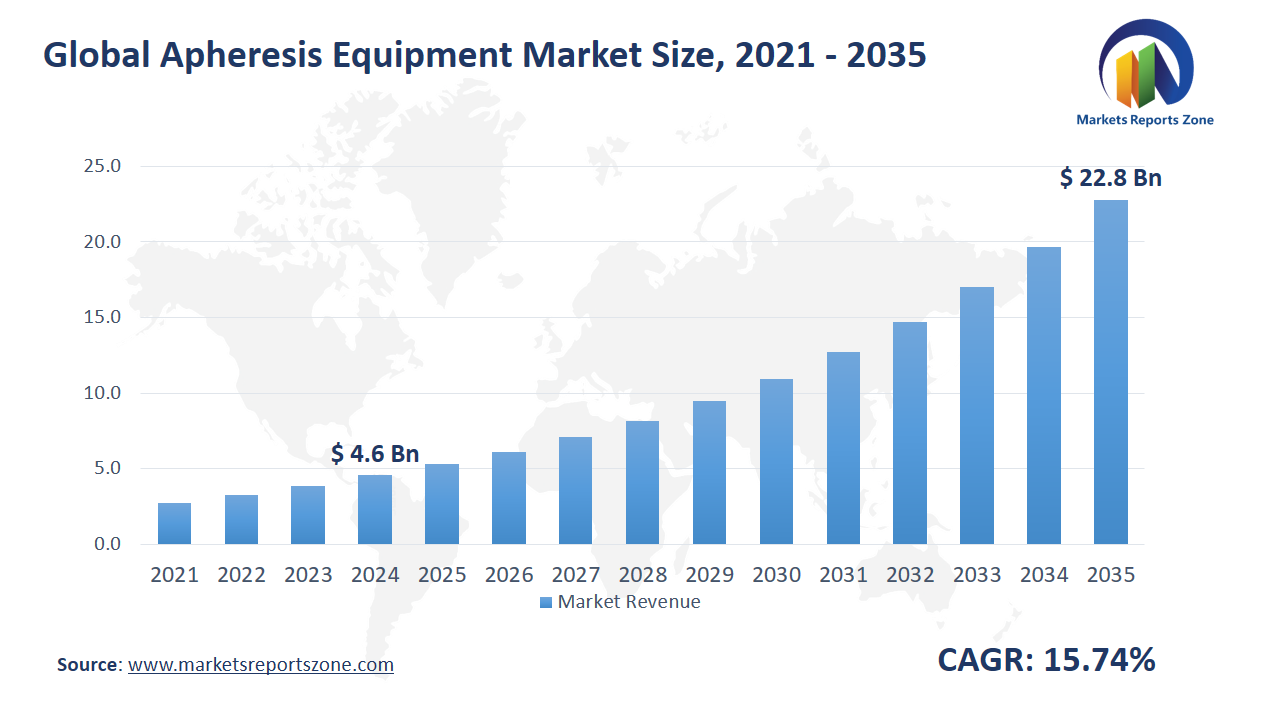
Global Apheresis Equipment Market Size is expected to reach USD 22.78 Billion by 2035 from USD 4.56 Billion in 2024, with a CAGR of around 15.74% between 2024 and 2035. The global apheresis equipment market is experiencing growth due to several key drivers. Technological advancements have enhanced the efficiency and precision of apheresis procedures. For instance, the integration of artificial intelligence in apheresis machines has improved blood component separation. Additionally, the increasing prevalence of chronic diseases has led to a higher demand for therapeutic apheresis. Patients with conditions like autoimmune disorders and certain cancers often require apheresis treatments. However, the high cost of apheresis equipment and procedures remains a significant restraint. Smaller healthcare facilities may find it challenging to invest in such advanced technologies, limiting access to these treatments. Despite this, there are notable opportunities in the market. Emerging markets, particularly in Asia-Pacific and Latin America, present growth prospects as healthcare infrastructure improves and awareness of apheresis benefits increases. For example, countries like India and Brazil are expanding their medical facilities and adopting advanced medical technologies. Furthermore, advancements in personalized medicine offer opportunities for the development of tailored apheresis treatments. The increasing focus on personalized healthcare is driving the demand for specialized apheresis procedures. These trends indicate a dynamic and evolving market for apheresis equipment globally.
Driver: Technological Advancements Revolutionize Apheresis Procedures
Technological advancements in apheresis equipment have significantly improved the precision and efficiency of blood separation, making these procedures safer and more effective. Modern apheresis machines now feature real-time monitoring systems, which allow healthcare providers to track patient conditions during the procedure, minimizing risks. For example, in hospitals where patients require frequent apheresis due to autoimmune disorders, such as lupus, advanced equipment enables faster processing times with fewer complications. The use of automated blood volume monitoring ensures that only the necessary components are removed or returned, reducing the chances of side effects like hypotension or anemia. Furthermore, the integration of AI and machine learning in some apheresis systems allows for personalized treatment plans. A good example is in cancer care, where certain patients undergo leukapheresis to remove excess white blood cells. With AI, the machine can analyze the patient's blood type and adjust settings accordingly for more tailored and effective treatment. In research settings, these technologies have been used to develop targeted therapies for rare conditions, improving patient outcomes and expanding the potential applications of apheresis. These innovations are not only enhancing the treatment process but also paving the way for new and more efficient medical approaches.
Key Insights:
- Over 60% of hospitals and specialized clinics in North America have adopted automated apheresis systems.
- Annual apheresis collections in the U.S. are projected to increase from 43,000 in 2021 to 132,000 by 2025.
- The adoption rate of apheresis treatments in rural U.S. areas is only 35% among eligible patients.
- North America is expected to account for over 40.5% of the global apheresis equipment market share in 2025.
- The U.S. saw approximately 184,720 new cases of leukemia in 2023, driving demand for apheresis procedures.
- Major companies like Terumo BCT have launched FDA-cleared plasma collection systems, enhancing safety and efficiency in blood centers.
- In the U.S., partnerships between manufacturers and healthcare providers have led to a 30% increase in apheresis equipment sales in some regions.
Segment Analysis:
The apheresis equipment market is divided into two main types: membrane apheresis and centrifugation apheresis equipment. Membrane apheresis is used for selective removal of specific blood components, such as plasma, while maintaining the rest of the blood intact. This method is widely used in plasma collection, especially in hospitals where patients require frequent plasma exchanges for conditions like thrombotic thrombocytopenic purpura (TTP). Centrifugation apheresis, on the other hand, utilizes centrifugal force to separate blood into its components based on density. It is more versatile and is often used for platelet and red blood cell (RBC) separation. Centrifugation is commonly employed in settings such as blood donation centers, where platelets are collected for patients undergoing chemotherapy or those with platelet disorders. In terms of applications, the market sees substantial demand for apheresis equipment in plasma collection due to its use in treating burns, shock, or autoimmune diseases. Platelet apheresis is another critical application, particularly for cancer patients who require platelets for ongoing treatment. Lastly, RBC apheresis is utilized to treat conditions like sickle cell disease or to collect blood for transfusions. Real-life examples include blood donation centers regularly using centrifugation to separate RBCs and platelets for hospital use, while membrane-based systems are increasingly used for chronic plasma exchange therapies.
Regional Analysis:
The apheresis equipment market exhibits distinct trends across regions, influenced by healthcare infrastructure, disease prevalence, and technological adoption. In North America, advanced healthcare facilities and high demand for blood component therapies drive the growth of apheresis equipment. For instance, hospitals in the U.S. are increasingly adopting centrifugation systems to collect platelets for cancer patients. In Europe, there is a growing emphasis on plasma collection for therapeutic treatments, with countries like Germany utilizing membrane apheresis for plasma exchanges in autoimmune disorder patients. Asia-Pacific has become a key growth region, with countries like China and India expanding their healthcare infrastructure. In India, apheresis is being used for chronic conditions such as sickle cell anemia, with centrifugation systems playing a major role in RBC collection. In Latin America, access to apheresis equipment is rising, especially in Brazil, where regional blood banks have begun using membrane apheresis for plasma separation. The Middle East and Africa face challenges due to limited healthcare infrastructure in some areas, but there is increasing adoption of apheresis equipment in major hospitals in the UAE and South Africa. For example, South African hospitals are using platelet apheresis to support leukemia treatments. As healthcare access improves, the use of apheresis technology continues to expand across all regions, driving positive growth in the market.
Competitive Scenario:
The global apheresis equipment market is witnessing significant advancements, driven by innovation and strategic collaborations among key industry players. Haemonetics Corporation continues to enhance its portfolio, focusing on blood management solutions that integrate seamlessly into hospital workflows. Fresenius Medical Care has introduced the APRΞD system, a modern device designed to streamline therapeutic apheresis procedures, improving efficiency and patient outcomes. Terumo BCT has launched the Global Therapy Innovations unit, aiming to unify therapeutic apheresis with cell and gene therapy expertise, particularly in treating conditions like sickle cell disease. Asahi Kasei Medical leverages its experience in hemodialysis to expand therapeutic apheresis options for intractable diseases, offering products like Plasmaflo OP and IMMUSORBA TR. Kawasumi Laboratories focuses on providing high-quality apheresis equipment, contributing to the global supply of therapeutic devices. B. Braun Melsungen AG continues to innovate in the medical technology sector, enhancing its apheresis offerings to meet evolving healthcare needs. Therakos, a part of Mallinckrodt Pharmaceuticals, specializes in extracorporeal photopheresis systems, particularly for treating conditions like cutaneous T-cell lymphoma. NIKKISO develops advanced apheresis equipment, contributing to the global healthcare infrastructure. Macopharma offers a range of apheresis products, focusing on improving patient care through innovative solutions. Medica S.p.A. provides apheresis platforms like APRΞD, designed to simplify complex procedures and enhance treatment efficacy. These developments reflect a dynamic and rapidly evolving market, with companies continuously striving to improve patient care through technological advancements.
Apheresis Equipment Market Report Scope
| Report Attribute | Details |
|---|---|
| Market Size Value in 2024 | USD 4.56 Billion |
| Revenue Forecast in 2035 | USD 22.78 Billion |
| Growth Rate | CAGR of 15.74% from 2025 to 2035 |
| Historic Period | 2021 - 2024 |
| Forecasted Period | 2025 - 2035 |
| Report Coverage | Revenue forecast, company ranking, competitive landscape, growth factors, and trends |
| Regions Covered | North America; Europe; Asia Pacific; Latin America; Middle East & Africa |
| Countries Covered | U.S.; Canada; Mexico, UK; Germany; France; Spain; Italy; Russia; China; Japan; India; South Korea; Australia; Southeast Asia; Brazil; Argentina; Saudi Arabia; UAE; South Africa |
| Key companies profiled | Haemonetics Corporation; Fresenius Medical Care; Terumo BCT, Inc.; Asahi Kasei Medical Co., Ltd.?; Kawasumi Laboratories Inc.; B. Braun Melsungen AG; Therakos; NIKKISO; Macopharma; Medica SPA. |
| Customization | Free report customization (equivalent up to 8 analysts working days) with purchase. Addition or alteration to country, regional & segment scope. |
The Global Apheresis Equipment Market report is segmented as follows:
By Type,
- Membrane Apheresis Equipment
- Centrifugation Apheresis Equipment
By Application,
- Plasma
- Platelets
- RBC
By Region,
- North America
- U.S.
- Canada
- Mexico
- Europe
- UK
- Germany
- France
- Spain
- Italy
- Russia
- Rest of Europe
- Asia Pacific
- China
- Japan
- India
- South Korea
- Australia
- Southeast Asia
- Rest of Asia Pacific
- Latin America
- Brazil
- Argentina
- Rest of Latin America
- Middle East & Africa
- Saudi Arabia
- UAE
- South Africa
- Rest of Middle East and Africa
Key Market Players,
- Haemonetics Corporation
- Fresenius Medical Care
- Terumo BCT, Inc.
- Asahi Kasei Medical Co., Ltd.?
- Kawasumi Laboratories Inc.
- B. Braun Melsungen AG
- Therakos
- NIKKISO
- Macopharma
- Medica SPA.
Frequently Asked Questions
How big is the Apheresis Equipment market?
Global Apheresis Equipment Market Size was valued at USD 4.56 Billion in 2024 and is projected to reach at USD 22.78 Billion in 2035.
What is the Apheresis Equipment market growth?
Global Apheresis Equipment Market is expected to grow at a CAGR of around 15.74% during the forecasted year.
Which region has the largest market share in Apheresis Equipment market?
North America, Asia Pacific and Europe are major regions in the global Apheresis Equipment Market.
Who are the key players in Apheresis Equipment market?
Key players analyzed in the global Apheresis Equipment Market are Haemonetics Corporation; Fresenius Medical Care; Terumo BCT, Inc.; Asahi Kasei Medical Co., Ltd.?; Kawasumi Laboratories Inc.; B. Braun Melsungen AG; Therakos; NIKKISO; Macopharma; Medica SPA. and so on.