
Global Anti-Adhesion Products Market - Size and Forecast Analysis, 2021-2035
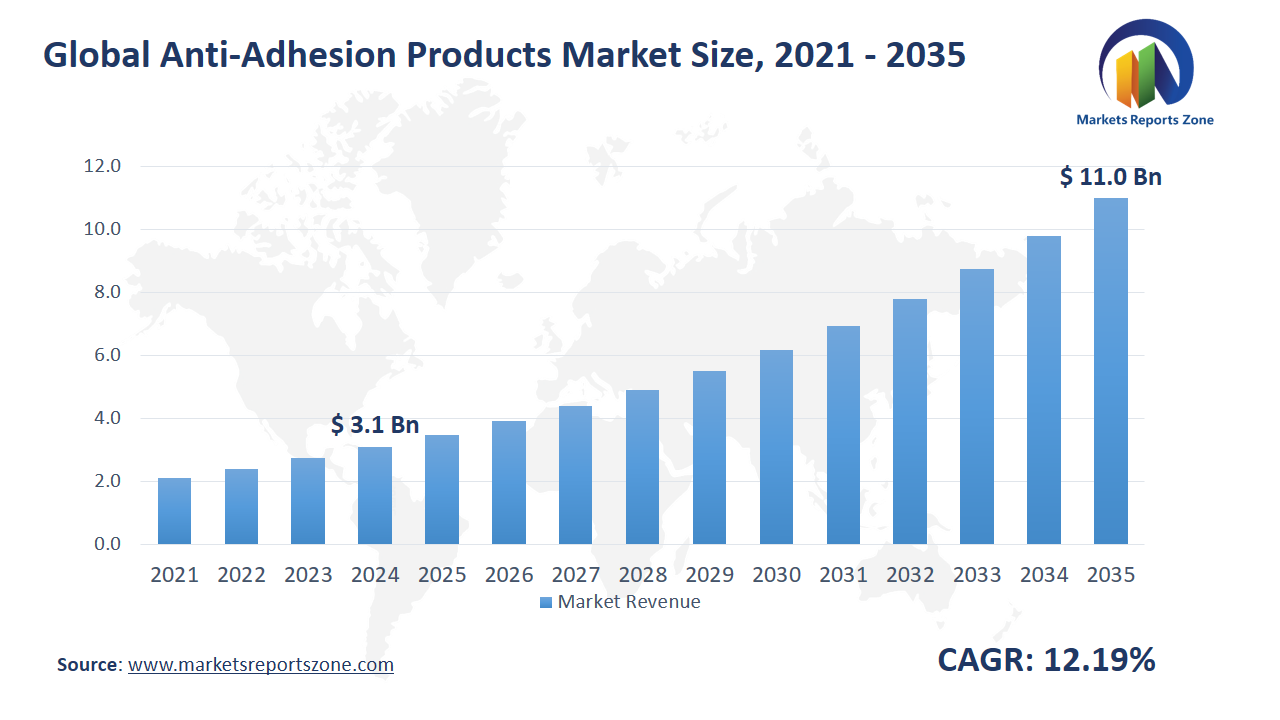
Global Anti-Adhesion Products Market Size is expected to reach USD 11 Billion by 2035 from USD 3.1 Billion in 2024, with a CAGR of around 12.19% between 2024 and 2035. The global anti-adhesion products market is being strongly driven by the rising number of surgeries and the growing awareness about post-surgical complications. Increased adoption of minimally invasive surgeries has also boosted the demand for anti-adhesion barriers. For instance, laparoscopic surgeries in gallbladder removal and hernia repair are frequently supported with anti-adhesion films to improve recovery. However, the high cost of advanced anti-adhesion products has restricted wider use, especially in lower-income regions. Many patients in rural hospitals still undergo surgeries without the protection of premium anti-adhesion solutions. Opportunities have been created with technological innovations that are introducing bioresorbable and sprayable anti-adhesion barriers. Newer products are being used in orthopedic surgeries to prevent tissue adhesion around repaired ligaments. Another major opportunity lies in the expansion of healthcare infrastructure in emerging markets. Hospitals in countries like Vietnam and South Africa are increasingly adopting anti-adhesion products during surgeries such as cesarean sections and bowel resections. As surgical procedures grow more complex and frequent, the focus on patient recovery and reduction of complications is being strengthened. With continuous improvements and broader acceptance, the global anti-adhesion products market is set to experience steady and significant growth in the coming years.
Driver: Surgeries Rising, Adhesion Risks Falling
The growing number of surgeries worldwide has been driving strong demand for anti-adhesion products. As more people undergo procedures like colorectal surgery, cardiac surgery, and gynecological operations, the need to prevent post-operative adhesions has become crucial. Adhesions, if left unmanaged, can cause chronic pain, infertility, or bowel obstructions. In real-life examples, patients undergoing open-heart surgery are now often treated with anti-adhesion gels to prevent complications around the sternum. Similarly, during orthopedic knee replacements, sheets and barriers are being applied to avoid scar tissue formation that can limit mobility. Even pediatric surgeries, such as operations for congenital anomalies, now commonly include the use of anti-adhesion sprays to protect delicate tissues. Hospitals in urban centers like Singapore and Dubai have been routinely adopting these products as standard care. Surgeons are increasingly trained to apply barrier films and gels immediately after suturing to ensure minimal adhesion risks. This rise in surgical volumes, combined with a greater emphasis on recovery outcomes, is pushing anti-adhesion product innovation and adoption. As global healthcare systems perform more complex and layered procedures, the reliance on anti-adhesion technologies is expected to grow, ensuring smoother recoveries and fewer readmissions for patients across different specialties.
Key Insights:
- The adoption rate of anti-adhesion products in gynecological surgeries reached 62% globally in 2023.
- Investments of $85 million were announced by a major US healthcare group for anti-adhesion product research in 2024.
- Over 12,500 tons of anti-adhesion barrier gels and films were manufactured globally in 2023.
- Penetration of anti-adhesion products in cardiovascular surgeries crossed 48% in major hospitals worldwide.
- A leading medical device company reported 22 million units of anti-adhesion products sold globally in 2023.
- Government-funded clinical trials on anti-adhesion technologies received $120 million support in the US in 2023.
- Penetration rate of anti-adhesion solutions among orthopedic surgeries rose to 56% by late 2024.
- European hospitals recorded an 18% annual increase in procurement orders for sprayable anti-adhesion products in 2023.
Segment Analysis:
The anti-adhesion products market by type includes Adept, Seprafilm, INTERSEED, and Surgiwrap, each addressing different surgical needs. Adept is commonly used in laparoscopic surgeries to reduce adhesion formation and is often applied during ovarian cyst removal procedures to protect reproductive organs. Seprafilm has been widely used in colorectal surgeries where preventing adhesions around the intestines is critical for patient recovery. INTERSEED, being a fabric-like barrier, is typically applied during cesarean sections to separate uterine tissues and avoid post-operative complications. Surgiwrap, a bioresorbable membrane, is favored in spinal surgeries to prevent scar tissue formation around nerve roots. By application, abdominal surgeries have seen growing adoption of these products as surgeries like hernia repairs and bowel resections frequently lead to severe adhesions if untreated. In real cases, patients undergoing liver resections are protected using anti-adhesion films to improve outcomes. Gynecological surgeries, such as endometriosis removal, have also seen significant use of barriers to preserve fertility and ensure faster healing. With rising surgical volumes and greater awareness about post-operative risks, both types and applications of anti-adhesion products are witnessing broader use in real hospital settings, ensuring safer recoveries and fewer complications for patients across specialties worldwide.
Regional Analysis:
North America has shown strong demand for anti-adhesion products, driven by high surgical volumes and quick adoption of advanced recovery methods. In the United States, hospitals performing complex bariatric surgeries often use bioresorbable barriers to prevent adhesion-related readmissions. In Europe, countries like Germany and France have expanded usage during orthopedic surgeries such as hip replacements to reduce scar tissue formation. Asia-Pacific has been witnessing rapid growth, especially in Japan and South Korea, where laparoscopic procedures for gastrointestinal disorders are increasingly paired with anti-adhesion gels. In Latin America, Brazil has seen growing adoption in public hospitals during gynecological surgeries like hysterectomies to improve patient fertility outcomes. Meanwhile, the Middle East and Africa region is focusing on modernizing surgical practices, with private hospitals in the UAE integrating anti-adhesion films into routine cardiac surgeries. Across all regions, healthcare providers are becoming more aware of the long-term cost savings and patient benefits of preventing adhesions. Real examples include the use of sprayable adhesion barriers during cesarean sections in South African maternity centers and their growing popularity in elective gallbladder removal surgeries in Australia. The global shift toward minimally invasive procedures is also supporting broader regional uptake of these products, making post-operative care safer and more efficient.
Competitive Scenario:
Major players like Johnson & Johnson have continued to innovate by expanding their surgical product lines with next-generation anti-adhesion films designed for faster healing. Baxter International has introduced new hydrogel-based barriers aimed at improving outcomes in cardiovascular and abdominal surgeries. WL Gore has focused on enhancing its bioresorbable membranes, with real-world application during complex spinal surgeries in specialty centers. Anika Therapeutics has strengthened its portfolio by investing in advanced formulations that improve barrier strength and flexibility during orthopedic surgeries. Angiotech Pharmaceuticals has been advancing its product range by targeting procedures like tendon repairs where adhesion prevention is critical. Genzyme Corporation has improved delivery mechanisms for its anti-adhesion gels, making them easier to apply during minimally invasive surgeries. LifeCell Corporation has expanded its regenerative medicine division, incorporating anti-adhesion technologies into biological mesh products used in hernia repair surgeries. MAST Biosurgery has been active in developing thinner, more adaptable film barriers that fit better during pediatric surgeries. Recent developments across these companies are focused not just on preventing adhesions but also on enhancing ease of use, speeding patient recovery, and reducing hospital stays. Together, these efforts are helping to reshape post-operative care standards across multiple surgical specialties worldwide.
Anti-Adhesion Products Market Report Scope
| Report Attribute | Details |
|---|---|
| Market Size Value in 2024 | USD 3.1 Billion |
| Revenue Forecast in 2035 | USD 11 Billion |
| Growth Rate | CAGR of 12.19% from 2025 to 2035 |
| Historic Period | 2021 - 2024 |
| Forecasted Period | 2025 - 2035 |
| Report Coverage | Revenue forecast, company ranking, competitive landscape, growth factors, and trends |
| Regions Covered | North America; Europe; Asia Pacific; Latin America; Middle East & Africa |
| Countries Covered | U.S.; Canada; Mexico, UK; Germany; France; Spain; Italy; Russia; China; Japan; India; South Korea; Australia; Southeast Asia; Brazil; Argentina; Saudi Arabia; UAE; South Africa |
| Key companies profiled | Johnson & Johnson; Baxter International; WL Gore; Anika Therapeutics; Angiotech Pharmaceuticals; Genzyme Corporation; LifeCell Corporation; MAST Biosurgery |
| Customization | Free report customization (equivalent up to 8 analysts working days) with purchase. Addition or alteration to country, regional & segment scope. |
The Global Anti-Adhesion Products Market report is segmented as follows:
By Type,
- Adept
- Seprafilm
- INTERSEED
- Surgiwrap
By Application,
- Abdominal Surgery
- Gynecological Surgery
By Region,
- North America
- U.S.
- Canada
- Mexico
- Europe
- UK
- Germany
- France
- Spain
- Italy
- Russia
- Rest of Europe
- Asia Pacific
- China
- Japan
- India
- South Korea
- Australia
- Southeast Asia
- Rest of Asia Pacific
- Latin America
- Brazil
- Argentina
- Rest of Latin America
- Middle East & Africa
- Saudi Arabia
- UAE
- South Africa
- Rest of Middle East and Africa
Key Market Players,
- Johnson & Johnson
- Baxter International
- WL Gore
- Anika Therapeutics
- Angiotech Pharmaceuticals
- Genzyme Corporation
- LifeCell Corporation
- MAST Biosurgery
Frequently Asked Questions
How big is the Anti-Adhesion Products market?
Global Anti-Adhesion Products Market Size was valued at USD 3.1 Billion in 2024 and is projected to reach at USD 11 Billion in 2035.
What is the Anti-Adhesion Products market growth?
Global Anti-Adhesion Products Market is expected to grow at a CAGR of around 12.19% during the forecasted year.
Which region has the largest market share in Anti-Adhesion Products market?
North America, Asia Pacific and Europe are major regions in the global Anti-Adhesion Products Market.
Who are the key players in Anti-Adhesion Products market?
Key players analyzed in the global Anti-Adhesion Products Market are Johnson & Johnson; Baxter International; WL Gore; Anika Therapeutics; Angiotech Pharmaceuticals; Genzyme Corporation; LifeCell Corporation; MAST Biosurgery and so on.