
Global AI Agents Market - Size and Forecast Analysis, 2021-2035
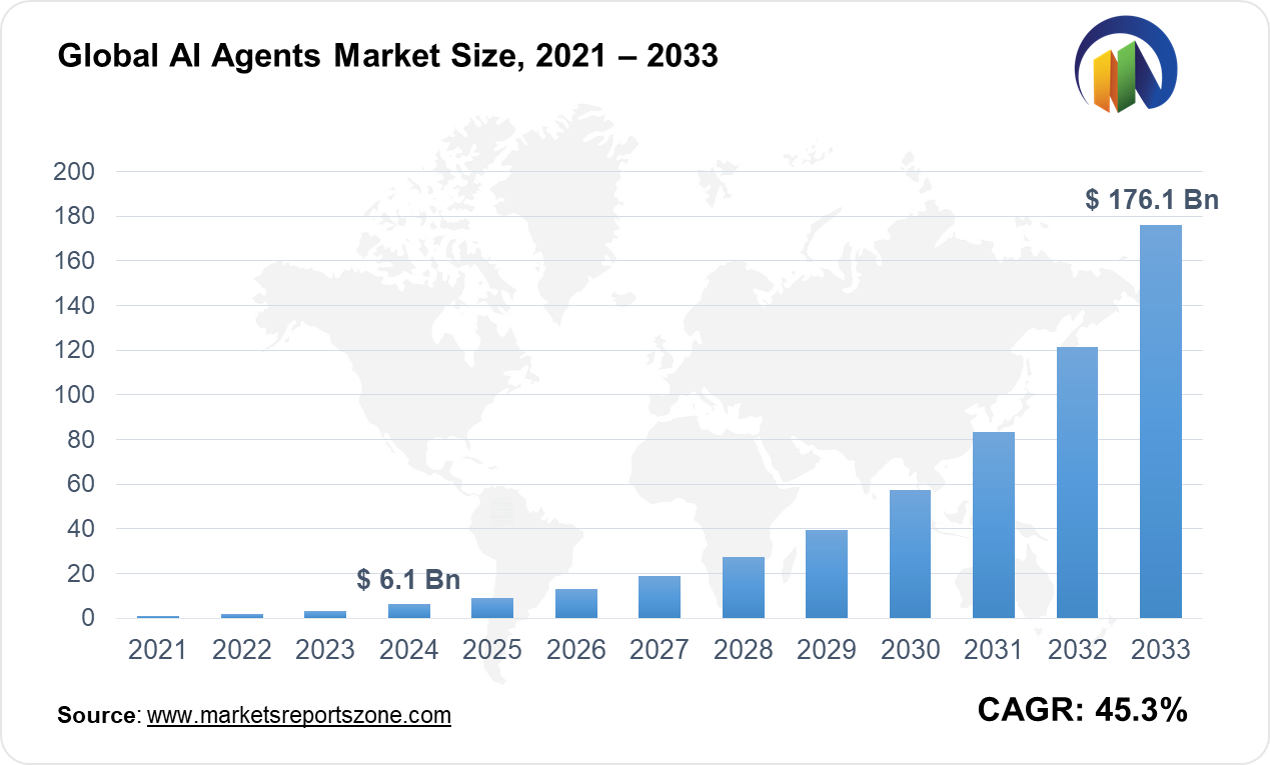
The Global AI Agents Market was valued at USD 6.10 Billion in 2024 and is projected to reach USD 176.1 Billion by 2033 at a CAGR of around 45.3% between 2024 and 2033. The global AI agents market is driven by automation demand and enhanced decision-making capabilities. Businesses seek AI-driven solutions to improve efficiency. Repetitive tasks are handled by AI agents, reducing human effort. Real-time insights are generated, helping firms make data-driven decisions. AI-powered virtual assistants like Siri and Alexa streamline daily activities. However, high implementation costs act as a restraint. Small businesses struggle with budget limitations, slowing adoption. Despite this, significant opportunities exist. Integration with IoT devices enhances AI agent functionalities. Smart home systems use AI agents to control appliances, improving user convenience. Expansion in customer service presents another opportunity.
AI chatbots resolve queries instantly, improving customer experience. Companies like Amazon and Google deploy AI-powered bots to handle millions of customer interactions efficiently. AI agents in healthcare assist in diagnostics, ensuring timely treatments. In financial services, AI detects fraud, safeguarding transactions. AI adoption in retail optimizes inventory management, enhancing sales. AI-driven marketing tools personalize customer engagement, boosting conversions. AI is used in autonomous vehicles for navigation, ensuring safety. AI-powered robotics assist in industrial automation, improving productivity. AI agents revolutionize business operations, transforming industries worldwide. Growing adoption indicates sustained market expansion in the coming years.
AI Automation: Boosting Efficiency Everywhere
Automation demand is reshaping industries with AI agents streamlining operations. Businesses rely on AI to handle repetitive tasks, reducing workload and improving productivity. AI-driven software automates data entry, scheduling, and report generation, saving valuable time. In manufacturing, AI-powered robots assemble products with precision, minimizing errors. Companies like Tesla use AI-driven automation for car production, enhancing efficiency. AI in supply chain management predicts demand, ensuring timely restocking. Retailers deploy AI-powered self-checkout systems, reducing wait times. In customer service, AI-driven ticketing systems categorize and resolve complaints faster. AI in HR automates resume screening, helping companies find talent quickly.
AI agents in legal firms review contracts, saving lawyers hours of manual work. AI-powered underwriting in insurance speeds up claim approvals, improving customer satisfaction. AI chatbots in banking automate loan processing, reducing paperwork. AI in marketing analyzes customer behavior, optimizing ad placements. AI-driven cybersecurity detects threats in real time, preventing cyberattacks. AI-powered virtual receptionists handle appointments, ensuring smooth operations. AI-driven translation tools break language barriers in global business communication. AI is transforming work environments, allowing employees to focus on strategic tasks. The rise of AI automation is revolutionizing business efficiency across multiple sectors worldwide.
Key Insights:
- As of 2025, tech giants plan to invest over $320 billion in AI-related capital expenditures.
- Amazon's investment in AI startup Anthropic has reached $14 billion, reflecting a 75% increase since 2023.
- Meta Platforms announced a significant increase in capital spending for 2025, between $60 billion and $65 billion, largely driven by advancements in artificial intelligence and the construction of a massive new data center.
- In the UK, 67% of consulting firms anticipate AI as a major growth driver in the next three years.
- In the United States, only 6.1% of companies have integrated AI into production tasks as of November 2024, up from 3.7% the previous year.
- India leads globally with an AI adoption rate of 59% among organizations.
- In the retail sector, 73% of businesses have implemented AI solutions, with an additional 15% planning adoption.
Segment Analysis:
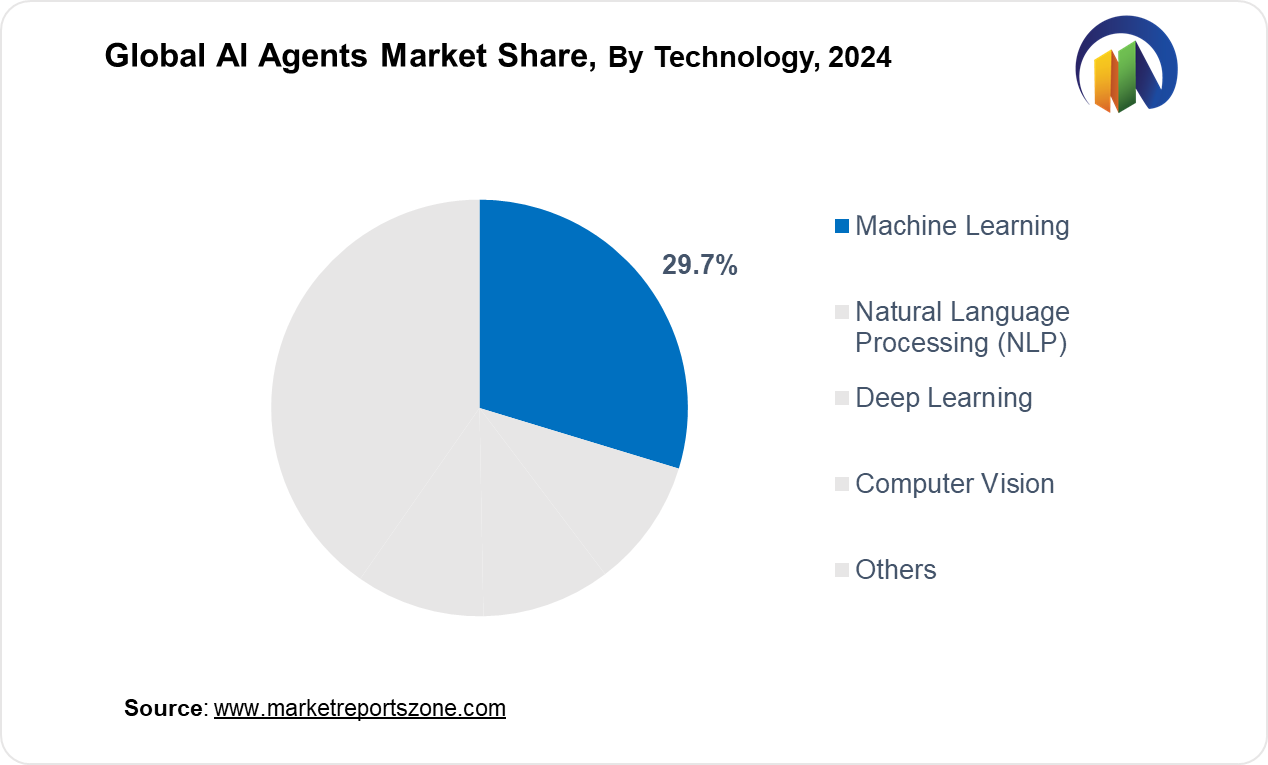
The AI agents market spans multiple technologies, agent systems, types, applications, and end-users, driving innovation across industries. Machine learning and NLP enable AI chatbots to handle complex queries, improving customer interactions. Deep learning enhances fraud detection in banking, securing transactions. Computer vision powers facial recognition in security systems, ensuring safety. Single-agent systems manage personal AI assistants like Google Assistant, while multi-agent systems coordinate logistics in smart warehouses. Ready-to-deploy AI agents streamline e-commerce recommendations, while build-your-own solutions offer customization for enterprises. AI-driven virtual assistants automate customer support, reducing wait times. Robotics and automation improve efficiency in factories, where AI-powered robotic arms assist in assembly lines. AI in healthcare helps in disease diagnosis, enabling early treatments.
Financial services use AI for algorithmic trading, maximizing profits. AI in security detects cyber threats, preventing data breaches. Gaming industries enhance realism with AI-driven NPCs, improving player experience. Marketing teams use AI for personalized ad targeting, increasing engagement. AI in HR automates employee onboarding, improving hiring efficiency. Legal firms use AI for contract analysis, reducing manual workload. Consumer adoption grows with smart home AI devices, while enterprises optimize operations. Industrial AI streamlines production, ensuring precision and quality. AI agents are reshaping industries with intelligent automation.
Regional Analysis:
North America leads AI adoption, driven by strong investments and innovation. AI-powered autonomous trucks are transforming logistics, reducing delivery times. AI in healthcare enhances diagnostics, with hospitals using AI-driven imaging systems. In Europe, strict regulations shape AI development, ensuring ethical use. AI-powered chatbots in banking improve customer service, handling queries efficiently. AI in smart factories optimizes production, reducing waste and improving quality. The Asia-Pacific region experiences rapid AI expansion, fueled by government initiatives and tech startups. AI-driven language translation apps bridge communication gaps in diverse markets. AI in e-commerce personalizes shopping experiences, increasing customer satisfaction.
In Latin America, AI adoption rises across industries, enhancing operational efficiency. AI-powered fraud detection in fintech protects users from cyber threats. AI in agriculture optimizes crop management, improving yield and sustainability. The Middle East & Africa witness AI growth in security and surveillance, ensuring public safety. AI-driven facial recognition is deployed at airports for seamless immigration processes. AI in oil and gas enhances predictive maintenance, preventing costly downtimes. AI-powered customer service in telecom reduces response times, improving user experience. Across all regions, AI agents drive transformation, boosting productivity and efficiency in multiple sectors. AI continues to redefine global industries, shaping the future of business.
Competition Landscape:
Leading technology companies are intensifying their focus on artificial intelligence (AI), unveiling significant advancements and strategic partnerships. Alibaba recently introduced over 100 AI models under the Qwen 2.5 family, including advanced text-to-video technology, enhancing its AI capabilities. Amazon Web Services (AWS) unveiled an AI supercomputer, Rainier, designed to rival existing market leaders, signaling its commitment to AI infrastructure. Apple has partnered with Alibaba to integrate AI services into its devices in China, aiming to enhance user experiences in that market. Baidu continues to develop its AI models, contributing to China's growing influence in the AI sector. Google released Gemini 1.5, a multimodal AI model capable of processing extensive context, advancing its AI offerings.
IBM has formed an AI alliance with Meta to advocate for responsible AI use, reflecting a collaborative approach in the industry. Meta has established a Business AI group, led by former Salesforce AI CEO Clara Shih, to make advanced AI accessible to businesses. Microsoft's market capitalization has reached nearly $3.1 trillion, attributed to its leadership in the generative AI race. NVIDIA's AI technologies support services from numerous companies, including Alibaba, Amazon, and Google, underscoring its pivotal role in AI hardware and software. Salesforce continues to integrate AI into its enterprise solutions, enhancing customer relationship management through intelligent automation.
AI Agents Market Report Scope
| Report Attribute | Details |
|---|---|
| Market Size Value in 2024 | USD 6.10 Billion |
| Revenue Forecast in 2033 | USD 176.1 Billion |
| Growth Rate | CAGR of 45.3% from 2025 to 2033 |
| Historic Period | 2021 - 2024 |
| Forecasted Period | 2025 - 2033 |
| Report Coverage | Revenue forecast, company ranking, competitive landscape, growth factors, and trends |
| Regions Covered | North America; Europe; Asia Pacific; Latin America; Middle East & Africa |
| Countries Covered | U.S.; Canada; Mexico, UK; Germany; France; Spain; Italy; Russia; China; Japan; India; South Korea; Australia; Southeast Asia; Brazil; Argentina; Saudi Arabia; UAE; South Africa |
| Key companies profiled | Alibaba Group Holding Limited; Amazon Web Services, Inc.; Apple Inc.; Baidu; Google; IBM Corporation; Meta; Microsoft; NVIDIA Corporation; Salesforce, Inc. |
| Customization | Free report customization (equivalent up to 8 analysts working days) with purchase. Addition or alteration to country, regional & segment scope. |
The Global AI Agents Market report is segmented as follows:
By Technology,
- Machine Learning
- Natural Language Processing (NLP)
- Deep Learning
- Computer Vision
- Others
By Agent System,
- Single Agent Systems
- Multi Agent Systems
By Type,
- Ready-to-Deploy Agents
- Build-Your-Own Agents
By Application,
- Customer Service and Virtual Assistants
- Robotics and Automation
- Healthcare
- Financial Services
- Security and Surveillance
- Gaming and Entertainment
- Marketing and Sales
- Human Resources
- Legal and Compliance
- Others
By End-use,
- Consumer
- Enterprise
- Industrial
By Region,
- North America
- U.S.
- Canada
- Mexico
- Europe
- UK
- Germany
- France
- Spain
- Italy
- Russia
- Rest of Europe
- Asia Pacific
- China
- Japan
- India
- South Korea
- Australia
- Southeast Asia
- Rest of Asia Pacific
- Latin America
- Brazil
- Argentina
- Rest of Latin America
- Middle East & Africa
- Saudi Arabia
- UAE
- South Africa
- Rest of Middle East & Africa
Key Market Players,
- Alibaba Group Holding Limited
- Amazon Web Services, Inc.
- Apple Inc.
- Baidu
- IBM Corporation
- Meta
- Microsoft
- NVIDIA Corporation
- Salesforce, Inc.
Frequently Asked Questions
How big is the AI Agents market?
The Global AI Agents Market was valued at USD 6.10 Billion in 2024 and is projected to reach USD 176.1 Billion by 2033.
What is the AI Agents market growth?
The Global AI Agents Market is expected to grow at a compounded annual growth rate of 45.3% between 2024 and 2033.
Which region has the largest market share in AI Agents market?
The North America holds the largest market share in the global AI Agents Market in 2024.
Who are the key players in AI Agents market?
Key players profiled in the global AI Agents market are Alibaba Group Holding Limited; Amazon Web Services, Inc.; Apple Inc.; Baidu; Google; IBM Corporation; Meta; Microsoft; NVIDIA Corporation; Salesforce, Inc.