
Global 5G Infrastructure Market - Size and Forecast Analysis, 2021-2035
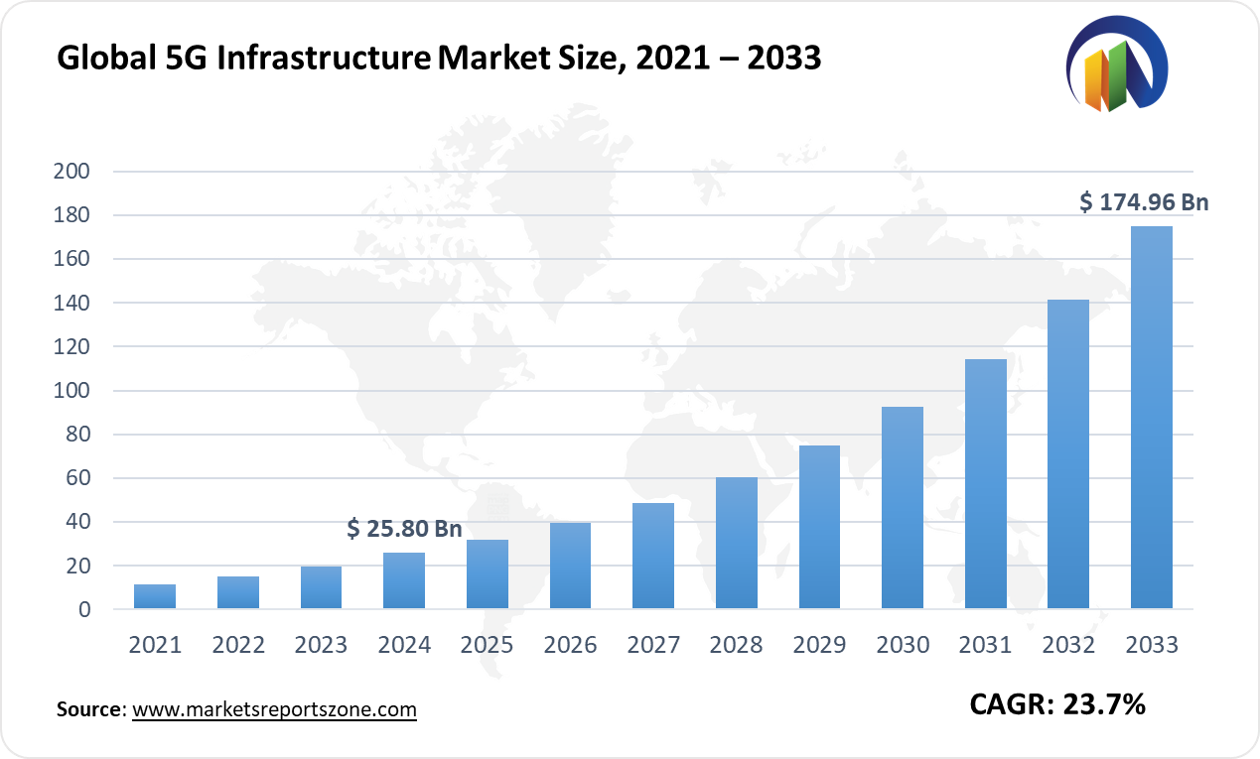
The Global 5G Infrastructure Market was valued at USD 25.8 Billion in 2024 and is projected to reach USD 175.2 Billion by 2033 at a CAGR of around 23.7% between 2024 and 2033. The growth of global 5G infrastructure is driven by rising data consumption and increasing IoT adoption. Faster connectivity demand has surged due to smart devices. Industrial automation is also being boosted by 5G networks. However, high deployment costs act as a major restraint. Infrastructure setup requires huge investment, slowing expansion in some regions. Despite this, significant opportunities exist. The healthcare sector is benefiting from 5G-powered remote surgeries and telemedicine. Real-time data transmission has improved patient care in hospitals. Another opportunity is seen in smart cities.
Traffic management and energy grids are being enhanced through 5G technology. Countries like South Korea and the U.S. have advanced their networks for better urban planning. Autonomous vehicles are also leveraging 5G for instant communication. Faster response times have reduced road accidents. In manufacturing, factories are adopting 5G for real-time monitoring of machines. Predictive maintenance has improved productivity. Edge computing is further optimizing performance in cloud-based applications. Retail businesses are enhancing customer experience using AR and VR over 5G. Shopping trends have shifted due to immersive technology. The entertainment industry is also seeing a transformation. Streaming services are delivering high-resolution content with lower latency. The rapid evolution of 5G is shaping a connected digital future.
Driver: Rising Data Demand Fueling 5G Growth
The explosion of data usage has fueled the need for 5G infrastructure. Streaming, gaming, and social media are consuming massive bandwidth. High-definition video calls have become essential for remote work and learning. Traditional networks struggle to handle this surge. 5G offers ultra-fast speeds and low latency to meet these demands. Cloud gaming services are relying on 5G for seamless experiences. Platforms like Xbox Cloud Gaming and GeForce Now are eliminating the need for high-end hardware. Smart home devices are also driving data usage. AI-powered assistants, security cameras, and home automation systems require stable and fast connectivity. E-commerce is transforming with interactive experiences.
Virtual try-ons and AI-driven recommendations are enhancing online shopping. Financial transactions are becoming smoother with instant payments. Mobile banking apps are reducing wait times with real-time processing. Sports broadcasting has seen a shift with 5G-enabled live streaming. Fans are getting 360-degree views and instant replays in stadiums. Drone technology is advancing due to high-speed data transfer. Agriculture, logistics, and surveillance are benefiting from real-time drone monitoring. The demand for high-speed connectivity is only increasing. 5G is playing a crucial role in keeping up with the growing digital ecosystem. The future of connectivity is being shaped by data-driven innovation.
Key Insights:
- In the United States, 5G adoption reached 43.1% by Q4 2022.
- Ericsson invested over $100 million in a 5G smart factory in Texas to bolster U.S. infrastructure.
- China's 5G connections are expected to surpass 1 billion by the end of 2024.
- In India, 5G availability improved from 28.1% in Q1 to 52.0% in Q4 2023, marking a 23.9% point increase within the year.
- The European Union anticipates an average 5G adoption rate of 44% by 2025, with the UK and Germany leading at 61% and 59%, respectively.
- Australia and South Korea have achieved 5G smartphone penetration rates of 82% and 88%, respectively.
- The Federal Communications Commission established the 5G Fund for Rural America, allocating up to $9 billion to enhance 5G services in rural areas.
Segment Analysis:
The 5G infrastructure market is evolving across multiple segments, each playing a crucial role in global connectivity. The Radio Access Network (RAN) is being upgraded with advanced antennas to enhance coverage, while the Core Network is integrating cloud-based solutions for better efficiency. Backhaul & Transport, Fronthaul, and Midhaul are improving network stability, ensuring seamless data transfer. Both public and private 5G networks are expanding, with enterprises deploying private 5G for secure and high-speed operations. Sub-6 GHz spectrum is enabling broader coverage, while mmWave is driving ultra-fast speeds in urban areas. Standalone architecture is gaining traction for low-latency applications, while non-standalone remains a transition phase for existing networks.
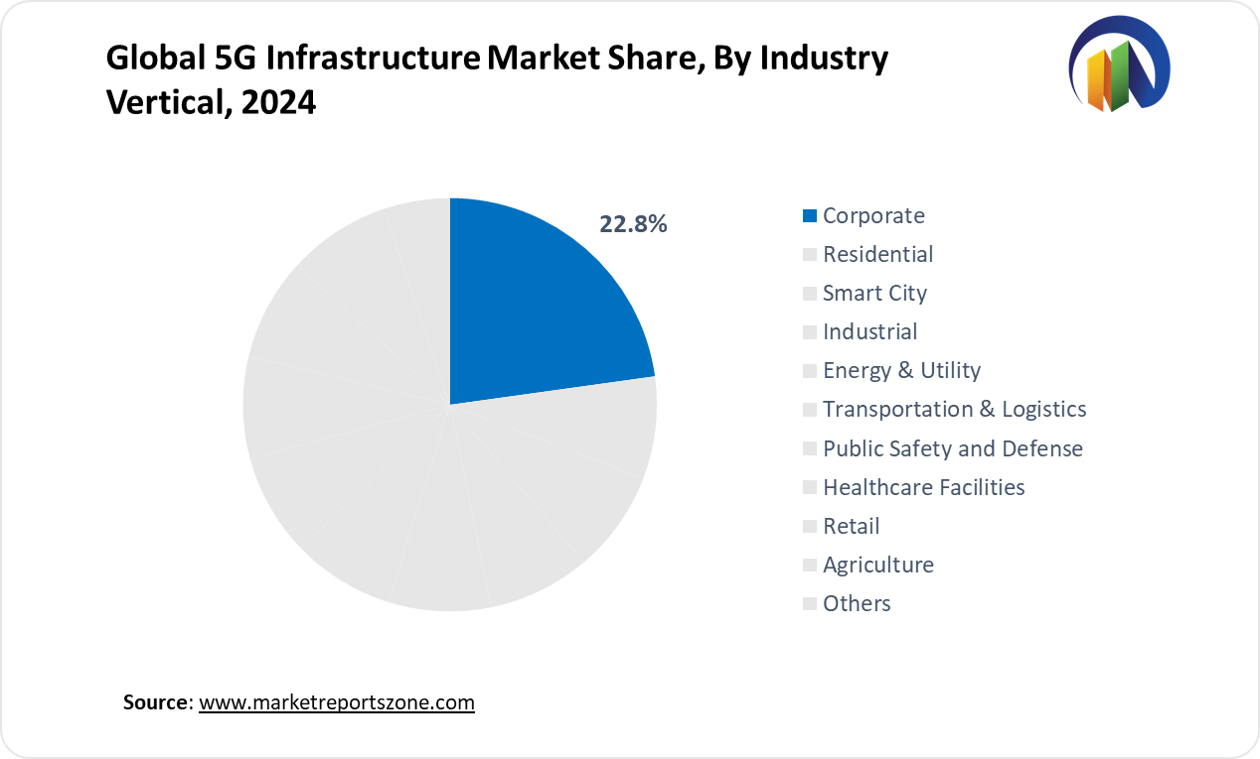
In industry verticals, residential users are experiencing faster broadband for smart homes. Corporate offices are adopting 5G for enhanced remote collaboration. Smart cities are using 5G sensors for traffic and waste management. Industrial automation is improving with real-time robotics. Energy grids are being optimized through predictive maintenance. Autonomous trucks in logistics rely on 5G for navigation. Emergency response teams use real-time video streaming for disaster management. Hospitals leverage 5G for AI-driven diagnostics. Retail stores are enhancing customer experiences with smart checkout. Farms use 5G drones for precision agriculture, driving efficiency across sectors.5G Infrastructure Market Share Analysis
Regional Analysis:
The 5G revolution is reshaping economies across all major regions. North America is leading with extensive network rollouts, with tech hubs integrating 5G for AI-driven innovations. Autonomous taxis in cities like San Francisco rely on ultra-fast connectivity for real-time navigation. Europe is rapidly deploying 5G in industrial zones, enhancing smart manufacturing. German automotive factories are using 5G-powered robotics for precision assembly. Asia-Pacific is witnessing the fastest adoption, with smart infrastructure projects driving demand. Japan’s bullet trains leverage 5G for predictive maintenance, ensuring smoother operations. Latin America is expanding its 5G footprint, focusing on digital transformation.
Brazilian farms utilize 5G-connected sensors for soil monitoring, boosting agricultural efficiency. The Middle East & Africa are investing in 5G to enhance connectivity in remote areas. In the UAE, smart airports are using 5G for seamless passenger processing with AI-powered security. Across Africa, telecommunication firms are deploying 5G in rural regions to support digital banking and e-learning. The demand for faster, low-latency networks is surging, fostering innovation in healthcare, logistics, and urban planning. As governments and enterprises accelerate deployments, 5G is bridging the digital divide and enabling smarter, more connected societies worldwide.
Competitive Scenario:
The 5G infrastructure landscape is rapidly evolving, with key industry players actively forging strategic partnerships and securing significant contracts to enhance global connectivity. Nokia has entered into a multi-year agreement with AT&T to upgrade voice services and automate 5G networks in the United States, aiming to integrate advanced functionalities such as artificial intelligence and machine learning into their offerings. Ericsson has secured a substantial contract with India's Bharti Airtel to supply 5G equipment, reflecting a resurgence in the Indian market and contributing to Ericsson's revenue growth. Meanwhile, Huawei is collaborating with MTN South Africa and China Telecom to bolster 5G capabilities, cloud services, and artificial intelligence applications, aiming to drive technological advancements across the African continent. Samsung Electronics continues to innovate in 5G technology, focusing on developing advanced network solutions to meet the growing demand for high-speed connectivity.
ZTE Corporation is expanding its global footprint by deploying 5G networks in various regions, enhancing mobile broadband services. NEC Corporation is investing in open RAN technologies to promote interoperability and flexibility in 5G networks. Cisco Systems is enhancing its 5G infrastructure portfolio by integrating security and automation features to support scalable network deployments. Fujitsu is developing energy-efficient 5G base stations to support sustainable network expansion. CommScope and Comba Telecom are providing innovative antenna solutions to improve network coverage and capacity. Altiostar, Airspan Networks, Casa Systems, Hewlett Packard Enterprise, Mavenir, Parallel Wireless, JMA Wireless, Ceragon, and Aviat Networks are contributing to the 5G ecosystem by offering specialized solutions ranging from virtualized RAN to wireless transport services, collectively advancing the global adoption of 5G technology.
5G Infrastructure Market Report Scope
| Report Attribute | Details |
|---|---|
| Market Size Value in 2024 | USD 25.8 Billion |
| Revenue Forecast in 2033 | USD 175.2 Billion |
| Growth Rate | CAGR of 23.7% from 2025 to 2033 |
| Historic Period | 2021 - 2024 |
| Forecasted Period | 2025 - 2033 |
| Report Coverage | Revenue forecast, company ranking, competitive landscape, growth factors, and trends |
| Regions Covered | North America; Europe; Asia Pacific; Latin America; Middle East & Africa |
| Countries Covered | U.S.; Canada; Mexico, UK; Germany; France; Spain; Italy; Russia; China; Japan; India; South Korea; Australia; Southeast Asia; Brazil; Argentina; Saudi Arabia; UAE; South Africa |
| Key companies profiled | Huawei Technologies Co., Ltd.; Samsung Electronics Co., Ltd.; Nokia Corp.; Telefonaktiebolaget LM Ericsson; ZTE Corp.; NEC Corp.; Cisco Systems, Inc.; Fujitsu Ltd.; CommScope Inc.; Comba Telecom Systems Holdings Ltd.; Altiostar; Airspan Networks; Casa Systems; Hewlett Packard Enterprise Development LP; Mavenir; Parallel Wireless; JMA Wireless; Ceragon; Aviat Networks, Inc. |
| Customization | Free report customization (equivalent up to 8 analysts working days) with purchase. Addition or alteration to country, regional & segment scope. |
The Global 5G Infrastructure Market report is segmented as follows:
By Component,
- Radio Access Network (RAN)
- Core Network
- Backhaul & Transport
- FrontHaul
- MidHaul
By Type,
- Pubic
- Private
By Spectrum,
- Sub-6 GHz
- mmWave
By Network Architecture,
- Standalone
- Non-standalone
By Industry Vertical,
- Residential
- Corporate
- Smart City
- Industrial
- Energy & Utility
- Transportation & Logistics
- Public Safety and Defense
- Healthcare Facilities
- Retail
- Agriculture
- Others
By Region,
- North America
- U.S.
- Canada
- Mexico
- Europe
- UK
- Germany
- France
- Spain
- Italy
- Russia
- Rest of Europe
- Asia Pacific
- China
- Japan
- India
- South Korea
- Australia
- Southeast Asia
- Rest of Asia Pacific
- Latin America
- Brazil
- Argentina
- Rest of Latin America
- Middle East & Africa
- Saudi Arabia
- UAE
- South Africa
- Rest of Middle East & Africa
Key Market Players,
- Huawei Technologies Co., Ltd.
- Samsung Electronics Co., Ltd.
- Nokia Corp.
- Telefonaktiebolaget LM Ericsson
- ZTE Corp.
- NEC Corp.
- Cisco Systems, Inc.
- Fujitsu Ltd.
- CommScope Inc.
- Comba Telecom Systems Holdings Ltd.
- Altiostar
- Airspan Networks
- Casa Systems
- Hewlett Packard Enterprise Development LP
- Mavenir
- Parallel Wireless
- JMA Wireless
- Ceragon
- Aviat Networks, Inc.
Frequently Asked Questions
How big is the 5G Infrastructure market?
The Global 5G Infrastructure Market was valued at USD 25.8 Billion in 2024 and is projected to reach USD 175.2 Billion by 2033.
What is the 5G Infrastructure market growth?
The Global 5G Infrastructure Market is expected to grow at a compounded annual growth rate of 23.7% between 2024 and 2033.
Which region has the largest market share in 5G Infrastructure market?
The Asia Pacific holds the largest market share in the global 5G Infrastructure Market in 2024.
Who are the key players in 5G Infrastructure market?
Key players profiled in the global 5G Infrastructure market are Huawei Technologies Co., Ltd.; Samsung Electronics Co., Ltd.; Nokia Corp.; Telefonaktiebolaget LM Ericsson; ZTE Corp.; NEC Corp.; Cisco Systems, Inc.; Fujitsu Ltd.; CommScope Inc.; Comba Telecom Systems Holdings Ltd.; Altiostar; Airspan Networks; Casa Systems; Hewlett Packard Enterprise Development LP; Mavenir; Parallel Wireless; JMA Wireless; Ceragon; Aviat Networks, Inc..